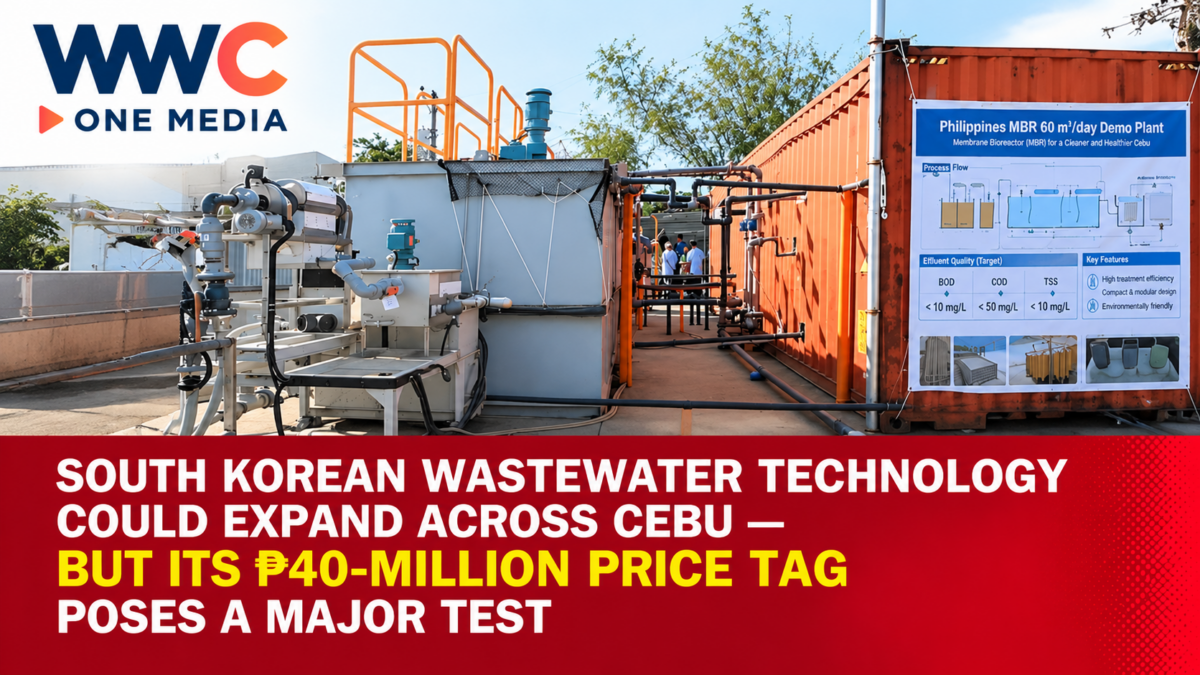
CEBU CITY, Philippines — A wastewater treatment system developed in South Korea could offer Cebu’s hotels, resorts and local governments a new way to manage polluted water without constructing large conventional treatment plants.
The Department of Science and Technology in Central Visayas (DOST-7), working with Korean and Philippine engineering partners, is demonstrating a compact facility in Lapu-Lapu City capable of treating up to 50,000 liters of wastewater every day.
The system, developed by South Korea-based HifilM Inc., combines biological treatment and specialized membrane filtration inside a 40-foot container.
It is designed to process wastewater from kitchens, bathrooms, laundry facilities and commercial operations before the treated water is discharged in accordance with applicable environmental requirements.
Project partners presented the technology during an October 14, 2026 ceremony and technical seminar at the City Sports Club Cebu.
Early testing suggests the facility can reduce selected pollutants to levels meeting applicable Philippine discharge standards.
But the technology faces several hurdles before it can be widely adopted.
With estimated project costs reaching ₱35 million to ₱40 million, can Cebu’s businesses and local governments afford the system — and will its promising test results translate into reliable long-term performance?
A Wastewater Plant That Fits Inside a Shipping Container
Conventional wastewater treatment facilities can require several structures, pumps, tanks and substantial land area.
The Korean system takes a different approach by housing its core treatment equipment inside a standard 40-foot shipping container.
Its compact footprint could make installation more practical for establishments with limited space.
This may be particularly relevant for hotels and resorts, where available land often has competing uses.
The demonstration plant has a rated capacity of 50 cubic meters daily, equivalent to 50,000 liters.
That figure describes the amount of wastewater it is designed to process under appropriate operating conditions.
It does not mean the facility has already demonstrated uninterrupted treatment of exactly 50,000 liters every day over an extended commercial operating period.
Long-term performance will depend on actual wastewater volume, pollutant concentrations, maintenance and operational conditions.
DOST Partners With South Korean Technology Developers
The project brings together DOST-7, HifilM Inc., Suki Trading Corporation/Vic Metal Fabrication and Environmental Services Inc., and the Korea Environmental Professional Engineers Association.
HifilM supplies the underlying treatment technology, including its membrane system.
Vic Metal provides local demonstration and operational support and is preparing to market and deploy the system.
The Korea Environmental Professional Engineers Association helps coordinate technical cooperation between Korean and Philippine participants.
DOST-7 provides technical assistance and support related to certification requirements.
Regional director Dr. Tristan Abando has emphasized the potential for the demonstration to help address local wastewater challenges.
The project forms part of a South Korean research and development initiative that includes field testing in the Philippines.
It represents technology cooperation and a demonstration project, not an announcement that every Cebu municipality will receive a new treatment plant.
How the Korean Membrane Technology Works
The facility uses a treatment method called a membrane bioreactor, commonly known as MBR.
The process combines biological treatment with membrane filtration.
Wastewater first passes through preliminary treatment equipment that removes materials such as debris and grease.
It then enters biological treatment stages where microorganisms help break down organic pollutants.
The system uses several stages with different oxygen conditions to improve the removal of contaminants.
After biological treatment, water passes through membranes containing openings approximately 0.1 micrometer in size.
These openings are extremely small, allowing treated water to pass while retaining many suspended particles and microorganisms.
The combination of biological treatment and fine filtration is intended to produce water suitable for regulated discharge when required standards are met.
However, membrane filtration alone should not be described as making the water safe to drink.
Potable water requires separate quality criteria, verification and, where necessary, additional treatment.
Moving Membranes Could Reduce Cleaning Energy
One distinguishing feature is HifilM’s moving membrane design.
Membrane systems can suffer from fouling, which occurs when materials accumulate on their surfaces and interfere with filtration.
Many systems use air to help clean membrane surfaces.
HifilM’s technology moves its membranes back and forth to help limit buildup.
According to the technology developer, this approach may reduce the energy required for membrane cleaning.
Lower energy demand could help businesses control operating expenses.
But the publicly available project announcements do not provide independently verified, long-term electricity consumption figures comparing the Cebu unit with conventional alternatives under identical conditions.
Therefore, claims of lower power consumption should be treated as a potential technical advantage rather than a guaranteed percentage saving.
Installation costs, replacement parts, maintenance and staffing must also be included when comparing technologies.
Preliminary Tests Meet Selected Wastewater Standards
DOST-7 and its partners reported encouraging results from preliminary field measurements conducted in August 2026.
Chemical oxygen demand, an indicator of organic pollution, was reported below the applicable Philippine regulatory limit.
Nitrate nitrogen concentrations were typically around 10 milligrams per liter, compared with a cited limit of 20 milligrams per liter.
Total phosphorus concentrations were reported at or below 2 milligrams per liter.
These indicators are relevant because excessive organic waste and nutrients can contribute to environmental degradation.
High nutrient levels may also encourage unwanted biological growth in receiving waters.
But the test results remain provisional.
They do not constitute a comprehensive guarantee that the system will comply with every parameter under every operating condition.
The precise discharge requirements can depend on wastewater characteristics, receiving waters and the applicable environmental rules.
Longer-term monitoring and relevant approvals will be necessary before customers can rely on the technology for their specific facilities.
Cebu’s Wastewater Proved More Challenging Than Expected
One significant finding from the demonstration involves differences between Korean and Philippine wastewater.
According to DOST-7, the Korean developers encountered local wastewater containing higher concentrations of certain contaminants than those typically treated in their home market.
That meant the system required adjustments to suit Cebu’s conditions.
The experience highlights why technology that works in one country cannot always be installed elsewhere without modification.
Wastewater composition can vary considerably.
A hotel kitchen may discharge grease and food-related waste.
A laundry facility may produce water containing detergents.
An industrial business could generate more complex wastewater requiring specialized handling.
Successful deployment therefore depends on testing the wastewater generated by each facility.
Technology providers must determine whether the proposed system is appropriate for those pollutants and volumes.
Resorts and Hotels Are Major Potential Customers
Cebu’s tourism industry is one of the main markets being considered.
Hotels and resorts generate wastewater from guest bathrooms, laundry, kitchens and maintenance activities.
Properties near beaches or coastal ecosystems face particular responsibilities to prevent inadequately treated water from contaminating the environment.
A compact treatment facility could be attractive where construction space is limited.
The system may also help establishments seeking to improve wastewater management or upgrade existing treatment arrangements.
However, each site requires a technical assessment.
Some hotels may already have suitable wastewater treatment infrastructure.
Others may need a different capacity or additional pretreatment equipment.
The correct solution depends on the actual wastewater characteristics, available space, operating costs and regulatory requirements.
The project partners have not announced signed rollout contracts covering all Cebu hotels or resorts.
₱35 Million to ₱40 Million Investment Could Be a Major Barrier
Victoriano Ocon, head of Vic Metal Fabrication and Environmental Services, estimated that wastewater treatment installations could require an investment of approximately ₱35 million to ₱40 million.
The final amount would depend on treatment capacity and customer requirements.
For large resorts, industrial facilities or local governments, that level of investment may be considered as part of a broader environmental compliance program.
For smaller businesses, the upfront expense may be difficult to justify without clear financing options or demonstrable operating savings.
The indicative price should not be treated as a fixed nationwide quotation for every 50,000-liter installation.
Nor should it be presented as a ₱40-million government contract already awarded.
The estimate reflects a prospective commercial deployment model rather than a completed public procurement.
Project developers will need to demonstrate that lifetime costs, including operations and maintenance, are competitive with available alternatives.
Local Governments May Choose Partnership Models
Ocon said local governments and private businesses could have different ways to adopt the technology.
One option involves purchasing equipment and operating the treatment system directly or through a contracted service provider.
Another involves a partnership in which Vic Metal finances and operates the facility while a local government provides a suitable site.
Such arrangements could reduce upfront equipment spending for participating authorities.
But they would not necessarily make the service free.
Operating agreements may involve long-term payments, land commitments, service charges and performance obligations.
Any arrangement involving public funds or government property would need to comply with applicable procurement, budgeting and legal requirements.
The company has not announced finalized contracts with named Cebu municipalities under this proposed model.
For now, these are prospective financing and operating arrangements.
Local Fabrication Could Reduce Import Dependence
Vic Metal plans to support the local fabrication and deployment of some system components.
DOST-7 believes that producing appropriate parts in the Philippines could reduce dependence on imported equipment and potentially lower costs.
Local manufacturing could also improve access to certain maintenance services and replacement components.
However, the technology’s specialized membranes and other components may still need to be sourced from approved suppliers.
The partners have not disclosed a verified percentage reduction in installation costs resulting from local fabrication.
Actual savings will depend on the component specifications, production volume, quality requirements and supply chain.
The commercial advantage of local production will become clearer as standardized systems move beyond the demonstration stage.
Larger 100,000-Liter Systems Are Under Consideration
Independent reporting from BusinessMirror and SunStar Cebu says the project partners are exploring standardized systems capable of treating either 50 or 100 cubic meters of wastewater daily.
Those capacities are equivalent to 50,000 and 100,000 liters per day.
The larger option could serve establishments requiring more treatment capacity.
But a 100,000-liter version should not be confused with the existing Lapu-Lapu demonstration plant.
The confirmed demonstration unit has a 50,000-liter daily design capacity.
The introduction of other capacities remains a proposed next step.
The project’s eventual scale will depend on technical validation, customer requirements, commercial arrangements and regulatory approval.
Treated Water Could Be Reused for Landscaping
The partners are also exploring whether treated wastewater could be reused for non-drinking purposes.
One potential application is irrigation.
Hotels and resorts with landscaped grounds may require substantial quantities of water for maintenance.
Using appropriately treated wastewater for suitable non-potable purposes could reduce demand for freshwater.
This may be particularly useful during periods when water resources are under pressure.
But reuse requires additional assessment.
The treated water must be suitable for its intended application and meet all relevant regulatory and public-health requirements.
DOST-7 has made clear that water produced by the current treatment system is not intended for drinking.
The announcement does not establish that all reuse applications have already been approved.
Sanitary Landfills May Offer Another Use Case
DOST-7 and the project partners are also exploring possible applications in sanitary landfills.
Landfills can generate contaminated liquid known as leachate when water passes through waste materials.
Leachate may contain complex pollutants and requires appropriate treatment.
A membrane-based system might form part of a treatment solution in some circumstances.
But landfill leachate can differ substantially from wastewater produced by hotels or restaurants.
It may require additional chemical, biological or advanced treatment stages.
The project has not yet demonstrated that the current containerized system alone can safely treat every type of landfill leachate.
The landfill proposal should therefore be viewed as an area for further evaluation, not an approved deployment or verified capability across all landfill conditions.
Water Security Becomes a Bigger Concern for Cebu
The project’s potential importance extends beyond regulatory compliance.
Water security is an increasing concern for cities and tourism destinations that must balance residential, industrial and commercial demand.
DOST-7 has linked wastewater treatment and reuse to preparedness for possible dry conditions associated with El Niño.
Reusing treated wastewater for suitable applications could help conserve freshwater.
Preventing polluted discharges can also protect rivers and coastal environments that support tourism, fisheries and communities.
However, wastewater reuse is not a complete solution to water scarcity.
Reliable supply also depends on watershed management, water distribution infrastructure, demand management and appropriate investment.
A compact treatment system can contribute to a wider strategy, but it cannot replace the need for comprehensive water-resource planning.
Cebu Already Has Other Wastewater Infrastructure Projects
The Korean demonstration is not the province’s only wastewater-related initiative.
Cebu’s local governments and national development partners have pursued other treatment projects.
In July 2026, the Cebu provincial government broke ground on an ₱8.4-million sewage treatment plant for Oslob District Hospital.
Japan’s international development agency has also supported septage management infrastructure in the Cebu area.
These projects have different technologies, sizes and purposes.
A hospital sewage treatment facility cannot be directly equated with a commercial wastewater plant.
Likewise, septage treatment—the processing of material removed from septic tanks—is different from treating ordinary wastewater generated daily by kitchens and bathrooms.
Together, the developments demonstrate that wastewater management is being approached through several infrastructure models.
The Korean system offers another potential option rather than replacing every existing project.
What Must Happen Before a Wider Rollout?
Several steps remain before the containerized technology can become widely available.
Project partners must continue evaluating performance under Philippine conditions.
Prospective customers need site-specific assessments.
The technology must demonstrate that it can meet the relevant environmental requirements for each proposed installation.
Financing and operating arrangements will need to be finalized.
Businesses and local governments must also assess whether the system’s cost, capacity and maintenance needs are appropriate.
DOST-7 has reported interest from local governments, resorts, restaurants and other establishments.
But interest is not the same as a signed purchase agreement or construction contract.
No confirmed number of additional installations or completion timetable has been disclosed.
The Bigger Test: Can Cebu Turn a Successful Pilot Into Cleaner Water?
The Lapu-Lapu City demonstration represents a promising example of South Korean and Philippine technology cooperation.
A 40-foot container housing a system capable of treating up to 50,000 liters daily could appeal to customers facing space constraints.
Preliminary treatment results suggest that the system may help establishments comply with important water quality requirements.
Local fabrication and flexible financing arrangements could improve its commercial prospects.
But substantial questions remain about installation cost, operating expenses, long-term reliability and the treatment of different wastewater types.
The technology must also demonstrate that its early test results can be sustained as more demanding commercial users adopt it.
Cebu now has a working demonstration of a Korean wastewater treatment system capable of processing 50,000 liters a day. But the bigger test is whether its ₱35-million to ₱40-million investment requirement, ongoing maintenance costs and environmental compliance needs will allow the technology to expand beyond one pilot and deliver cleaner waterways across the region.
WWC ONE MEDIA | Philippine Environmental Technology, Cebu Infrastructure, Wastewater Management and Sustainable Business News
CEBU CITY, Philippines — A wastewater treatment system developed in South Korea could offer Cebu’s hotels, resorts and local governments a new way to manage polluted water without constructing large conventional treatment plants.
The Department of Science and Technology in Central Visayas (DOST-7), working with Korean and Philippine engineering partners, is demonstrating a compact facility in Lapu-Lapu City capable of treating up to 50,000 liters of wastewater every day.
The system, developed by South Korea-based HifilM Inc., combines biological treatment and specialized membrane filtration inside a 40-foot container.
It is designed to process wastewater from kitchens, bathrooms, laundry facilities and commercial operations before the treated water is discharged in accordance with applicable environmental requirements.
Project partners presented the technology during an October 14, 2026 ceremony and technical seminar at the City Sports Club Cebu.
Early testing suggests the facility can reduce selected pollutants to levels meeting applicable Philippine discharge standards.
But the technology faces several hurdles before it can be widely adopted.
With estimated project costs reaching ₱35 million to ₱40 million, can Cebu’s businesses and local governments afford the system — and will its promising test results translate into reliable long-term performance?
A Wastewater Plant That Fits Inside a Shipping Container
Conventional wastewater treatment facilities can require several structures, pumps, tanks and substantial land area.
The Korean system takes a different approach by housing its core treatment equipment inside a standard 40-foot shipping container.
Its compact footprint could make installation more practical for establishments with limited space.
This may be particularly relevant for hotels and resorts, where available land often has competing uses.
The demonstration plant has a rated capacity of 50 cubic meters daily, equivalent to 50,000 liters.
That figure describes the amount of wastewater it is designed to process under appropriate operating conditions.
It does not mean the facility has already demonstrated uninterrupted treatment of exactly 50,000 liters every day over an extended commercial operating period.
Long-term performance will depend on actual wastewater volume, pollutant concentrations, maintenance and operational conditions.
DOST Partners With South Korean Technology Developers
The project brings together DOST-7, HifilM Inc., Suki Trading Corporation/Vic Metal Fabrication and Environmental Services Inc., and the Korea Environmental Professional Engineers Association.
HifilM supplies the underlying treatment technology, including its membrane system.
Vic Metal provides local demonstration and operational support and is preparing to market and deploy the system.
The Korea Environmental Professional Engineers Association helps coordinate technical cooperation between Korean and Philippine participants.
DOST-7 provides technical assistance and support related to certification requirements.
Regional director Dr. Tristan Abando has emphasized the potential for the demonstration to help address local wastewater challenges.
The project forms part of a South Korean research and development initiative that includes field testing in the Philippines.
It represents technology cooperation and a demonstration project, not an announcement that every Cebu municipality will receive a new treatment plant.
How the Korean Membrane Technology Works
The facility uses a treatment method called a membrane bioreactor, commonly known as MBR.
The process combines biological treatment with membrane filtration.
Wastewater first passes through preliminary treatment equipment that removes materials such as debris and grease.
It then enters biological treatment stages where microorganisms help break down organic pollutants.
The system uses several stages with different oxygen conditions to improve the removal of contaminants.
After biological treatment, water passes through membranes containing openings approximately 0.1 micrometer in size.
These openings are extremely small, allowing treated water to pass while retaining many suspended particles and microorganisms.
The combination of biological treatment and fine filtration is intended to produce water suitable for regulated discharge when required standards are met.
However, membrane filtration alone should not be described as making the water safe to drink.
Potable water requires separate quality criteria, verification and, where necessary, additional treatment.
Moving Membranes Could Reduce Cleaning Energy
One distinguishing feature is HifilM’s moving membrane design.
Membrane systems can suffer from fouling, which occurs when materials accumulate on their surfaces and interfere with filtration.
Many systems use air to help clean membrane surfaces.
HifilM’s technology moves its membranes back and forth to help limit buildup.
According to the technology developer, this approach may reduce the energy required for membrane cleaning.
Lower energy demand could help businesses control operating expenses.
But the publicly available project announcements do not provide independently verified, long-term electricity consumption figures comparing the Cebu unit with conventional alternatives under identical conditions.
Therefore, claims of lower power consumption should be treated as a potential technical advantage rather than a guaranteed percentage saving.
Installation costs, replacement parts, maintenance and staffing must also be included when comparing technologies.
Preliminary Tests Meet Selected Wastewater Standards
DOST-7 and its partners reported encouraging results from preliminary field measurements conducted in August 2026.
Chemical oxygen demand, an indicator of organic pollution, was reported below the applicable Philippine regulatory limit.
Nitrate nitrogen concentrations were typically around 10 milligrams per liter, compared with a cited limit of 20 milligrams per liter.
Total phosphorus concentrations were reported at or below 2 milligrams per liter.
These indicators are relevant because excessive organic waste and nutrients can contribute to environmental degradation.
High nutrient levels may also encourage unwanted biological growth in receiving waters.
But the test results remain provisional.
They do not constitute a comprehensive guarantee that the system will comply with every parameter under every operating condition.
The precise discharge requirements can depend on wastewater characteristics, receiving waters and the applicable environmental rules.
Longer-term monitoring and relevant approvals will be necessary before customers can rely on the technology for their specific facilities.
Cebu’s Wastewater Proved More Challenging Than Expected
One significant finding from the demonstration involves differences between Korean and Philippine wastewater.
According to DOST-7, the Korean developers encountered local wastewater containing higher concentrations of certain contaminants than those typically treated in their home market.
That meant the system required adjustments to suit Cebu’s conditions.
The experience highlights why technology that works in one country cannot always be installed elsewhere without modification.
Wastewater composition can vary considerably.
A hotel kitchen may discharge grease and food-related waste.
A laundry facility may produce water containing detergents.
An industrial business could generate more complex wastewater requiring specialized handling.
Successful deployment therefore depends on testing the wastewater generated by each facility.
Technology providers must determine whether the proposed system is appropriate for those pollutants and volumes.
Resorts and Hotels Are Major Potential Customers
Cebu’s tourism industry is one of the main markets being considered.
Hotels and resorts generate wastewater from guest bathrooms, laundry, kitchens and maintenance activities.
Properties near beaches or coastal ecosystems face particular responsibilities to prevent inadequately treated water from contaminating the environment.
A compact treatment facility could be attractive where construction space is limited.
The system may also help establishments seeking to improve wastewater management or upgrade existing treatment arrangements.
However, each site requires a technical assessment.
Some hotels may already have suitable wastewater treatment infrastructure.
Others may need a different capacity or additional pretreatment equipment.
The correct solution depends on the actual wastewater characteristics, available space, operating costs and regulatory requirements.
The project partners have not announced signed rollout contracts covering all Cebu hotels or resorts.
₱35 Million to ₱40 Million Investment Could Be a Major Barrier
Victoriano Ocon, head of Vic Metal Fabrication and Environmental Services, estimated that wastewater treatment installations could require an investment of approximately ₱35 million to ₱40 million.
The final amount would depend on treatment capacity and customer requirements.
For large resorts, industrial facilities or local governments, that level of investment may be considered as part of a broader environmental compliance program.
For smaller businesses, the upfront expense may be difficult to justify without clear financing options or demonstrable operating savings.
The indicative price should not be treated as a fixed nationwide quotation for every 50,000-liter installation.
Nor should it be presented as a ₱40-million government contract already awarded.
The estimate reflects a prospective commercial deployment model rather than a completed public procurement.
Project developers will need to demonstrate that lifetime costs, including operations and maintenance, are competitive with available alternatives.
Local Governments May Choose Partnership Models
Ocon said local governments and private businesses could have different ways to adopt the technology.
One option involves purchasing equipment and operating the treatment system directly or through a contracted service provider.
Another involves a partnership in which Vic Metal finances and operates the facility while a local government provides a suitable site.
Such arrangements could reduce upfront equipment spending for participating authorities.
But they would not necessarily make the service free.
Operating agreements may involve long-term payments, land commitments, service charges and performance obligations.
Any arrangement involving public funds or government property would need to comply with applicable procurement, budgeting and legal requirements.
The company has not announced finalized contracts with named Cebu municipalities under this proposed model.
For now, these are prospective financing and operating arrangements.
Local Fabrication Could Reduce Import Dependence
Vic Metal plans to support the local fabrication and deployment of some system components.
DOST-7 believes that producing appropriate parts in the Philippines could reduce dependence on imported equipment and potentially lower costs.
Local manufacturing could also improve access to certain maintenance services and replacement components.
However, the technology’s specialized membranes and other components may still need to be sourced from approved suppliers.
The partners have not disclosed a verified percentage reduction in installation costs resulting from local fabrication.
Actual savings will depend on the component specifications, production volume, quality requirements and supply chain.
The commercial advantage of local production will become clearer as standardized systems move beyond the demonstration stage.
Larger 100,000-Liter Systems Are Under Consideration
Independent reporting from BusinessMirror and SunStar Cebu says the project partners are exploring standardized systems capable of treating either 50 or 100 cubic meters of wastewater daily.
Those capacities are equivalent to 50,000 and 100,000 liters per day.
The larger option could serve establishments requiring more treatment capacity.
But a 100,000-liter version should not be confused with the existing Lapu-Lapu demonstration plant.
The confirmed demonstration unit has a 50,000-liter daily design capacity.
The introduction of other capacities remains a proposed next step.
The project’s eventual scale will depend on technical validation, customer requirements, commercial arrangements and regulatory approval.
Treated Water Could Be Reused for Landscaping
The partners are also exploring whether treated wastewater could be reused for non-drinking purposes.
One potential application is irrigation.
Hotels and resorts with landscaped grounds may require substantial quantities of water for maintenance.
Using appropriately treated wastewater for suitable non-potable purposes could reduce demand for freshwater.
This may be particularly useful during periods when water resources are under pressure.
But reuse requires additional assessment.
The treated water must be suitable for its intended application and meet all relevant regulatory and public-health requirements.
DOST-7 has made clear that water produced by the current treatment system is not intended for drinking.
The announcement does not establish that all reuse applications have already been approved.
Sanitary Landfills May Offer Another Use Case
DOST-7 and the project partners are also exploring possible applications in sanitary landfills.
Landfills can generate contaminated liquid known as leachate when water passes through waste materials.
Leachate may contain complex pollutants and requires appropriate treatment.
A membrane-based system might form part of a treatment solution in some circumstances.
But landfill leachate can differ substantially from wastewater produced by hotels or restaurants.
It may require additional chemical, biological or advanced treatment stages.
The project has not yet demonstrated that the current containerized system alone can safely treat every type of landfill leachate.
The landfill proposal should therefore be viewed as an area for further evaluation, not an approved deployment or verified capability across all landfill conditions.
Water Security Becomes a Bigger Concern for Cebu
The project’s potential importance extends beyond regulatory compliance.
Water security is an increasing concern for cities and tourism destinations that must balance residential, industrial and commercial demand.
DOST-7 has linked wastewater treatment and reuse to preparedness for possible dry conditions associated with El Niño.
Reusing treated wastewater for suitable applications could help conserve freshwater.
Preventing polluted discharges can also protect rivers and coastal environments that support tourism, fisheries and communities.
However, wastewater reuse is not a complete solution to water scarcity.
Reliable supply also depends on watershed management, water distribution infrastructure, demand management and appropriate investment.
A compact treatment system can contribute to a wider strategy, but it cannot replace the need for comprehensive water-resource planning.
Cebu Already Has Other Wastewater Infrastructure Projects
The Korean demonstration is not the province’s only wastewater-related initiative.
Cebu’s local governments and national development partners have pursued other treatment projects.
In July 2026, the Cebu provincial government broke ground on an ₱8.4-million sewage treatment plant for Oslob District Hospital.
Japan’s international development agency has also supported septage management infrastructure in the Cebu area.
These projects have different technologies, sizes and purposes.
A hospital sewage treatment facility cannot be directly equated with a commercial wastewater plant.
Likewise, septage treatment—the processing of material removed from septic tanks—is different from treating ordinary wastewater generated daily by kitchens and bathrooms.
Together, the developments demonstrate that wastewater management is being approached through several infrastructure models.
The Korean system offers another potential option rather than replacing every existing project.
What Must Happen Before a Wider Rollout?
Several steps remain before the containerized technology can become widely available.
Project partners must continue evaluating performance under Philippine conditions.
Prospective customers need site-specific assessments.
The technology must demonstrate that it can meet the relevant environmental requirements for each proposed installation.
Financing and operating arrangements will need to be finalized.
Businesses and local governments must also assess whether the system’s cost, capacity and maintenance needs are appropriate.
DOST-7 has reported interest from local governments, resorts, restaurants and other establishments.
But interest is not the same as a signed purchase agreement or construction contract.
No confirmed number of additional installations or completion timetable has been disclosed.
The Bigger Test: Can Cebu Turn a Successful Pilot Into Cleaner Water?
The Lapu-Lapu City demonstration represents a promising example of South Korean and Philippine technology cooperation.
A 40-foot container housing a system capable of treating up to 50,000 liters daily could appeal to customers facing space constraints.
Preliminary treatment results suggest that the system may help establishments comply with important water quality requirements.
Local fabrication and flexible financing arrangements could improve its commercial prospects.
But substantial questions remain about installation cost, operating expenses, long-term reliability and the treatment of different wastewater types.
The technology must also demonstrate that its early test results can be sustained as more demanding commercial users adopt it.
Cebu now has a working demonstration of a Korean wastewater treatment system capable of processing 50,000 liters a day. But the bigger test is whether its ₱35-million to ₱40-million investment requirement, ongoing maintenance costs and environmental compliance needs will allow the technology to expand beyond one pilot and deliver cleaner waterways across the region.