
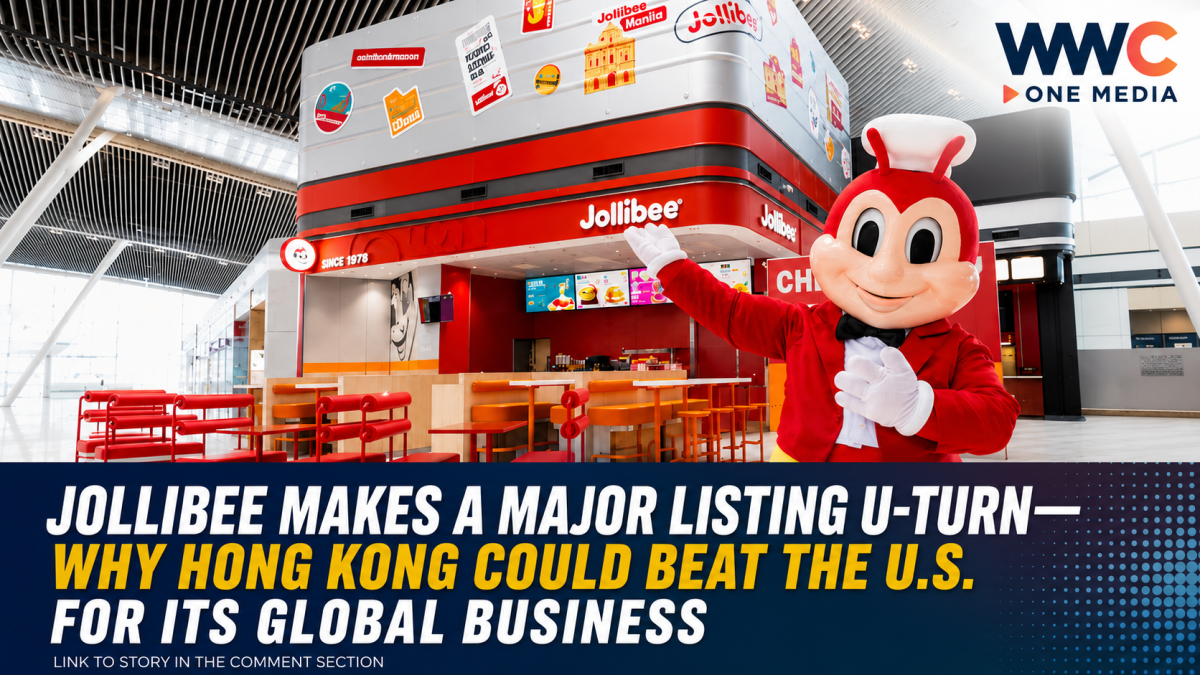
MANILA, Philippines — Jollibee Foods Corp. is shifting course on one of its biggest corporate moves, with the Philippine fast-food giant now planning to list its international business in Hong Kong instead of the United States.
The company said Tuesday that it is progressing with the separation of its international operations under Jollibee Foods Corporation International (JFCI), which is being prepared for a planned spin-off and listing on the Hong Kong Stock Exchange (HKEX).
The move marks a significant change from Jollibee’s January announcement, when the company said it intended to create a standalone international business and pursue a listing on a U.S. securities exchange.
According to the latest report from Reuters, Jollibee said Hong Kong was chosen because of the company’s existing presence in the market, its strong brand recognition across Asia, and the access HKEX can provide to both regional and global investors.
“HKEX also provides access to a broad base of global and regional investors,” Jollibee said, noting that the platform could support a business whose ambitions extend beyond Asia, including continued expansion in North America.
Why Hong Kong?
The decision comes as Hong Kong’s stock market experiences a strong rebound in initial public offerings.
Reuters reported that companies raised about $22.45 billion through new listings in Hong Kong during the first half of 2026, nearly 57% higher than the same period a year earlier. The performance marked the city’s strongest first-half IPO showing in five years.
The renewed activity has also made Hong Kong increasingly attractive to companies looking for access to international and Asian investors.
Jollibee already has an established presence in Hong Kong. The company has continued expanding its flagship brand there, including the opening of a new Jollibee location at Hong Kong International Airport’s Terminal 2 in May. Jollibee described the airport as an important global travel hub for reaching international customers.
That existing footprint could give the company an additional strategic advantage as it prepares to position JFCI as a global restaurant business.
From U.S. listing to Hong Kong
The latest announcement follows months of uncertainty surrounding the eventual destination of Jollibee’s international listing.
In January, Jollibee announced plans to separate its Philippine and international businesses, with the international entity initially intended for a U.S. stock-market listing.
The proposed structure would leave the Philippine business listed on the Philippine Stock Exchange, while JFCI would hold operations outside the Philippines. Existing Jollibee shareholders were expected to receive interests in both businesses, subject to regulatory, tax and legal requirements.
Jollibee’s international business has become increasingly important to the group’s growth. Reuters reported in January that international operations accounted for about 6,800 of Jollibee’s 10,300 stores at the end of the previous year’s third quarter, with the overseas store network growing at a substantially faster rate than the group’s overall network.
The international portfolio includes brands such as Jollibee, Chowking, Smashburger and Tim Ho Wan, among others.
The plan was not always Hong Kong
The change is particularly notable because Jollibee had previously reaffirmed that it was evaluating a U.S. listing.
In June, after reports that the company was considering Hong Kong, Jollibee told the Philippine Stock Exchange that its evaluation of strategic options was still ongoing. At that time, the company continued to cite the U.S. securities market as its previously announced intended venue while stressing that the final decision had not been made.
The latest announcement now represents a much clearer shift toward Hong Kong.
Jollibee also appointed its current chief financial and risk officer, Richard Chong Woo Shin, as chief executive officer of JFCI, according to the latest disclosure reported by Reuters.
What it means for Jollibee shareholders
The planned transaction is designed to create two businesses with different strategic focuses: a Philippine operation that remains listed in Manila and an international company capable of attracting investors specifically interested in Jollibee’s overseas growth.
However, investors should not interpret the announcement as meaning the Hong Kong listing has already happened.
The spin-off and listing remain subject to the necessary corporate, regulatory and market conditions. Jollibee’s earlier timetable had targeted a transaction toward the end of 2027, although the final structure and timing could change.
For Jollibee, the bigger story is not simply where its international business will trade.
It is whether separating the rapidly expanding overseas operations from the Philippine business can unlock more value for shareholders—and give the Filipino restaurant giant greater financial firepower for its next phase of global expansion.
For a company that started in the Philippines and built a global restaurant empire, the next big question is now clear: can Hong Kong become the launchpad for Jollibee’s next international chapter?

Leave a Reply