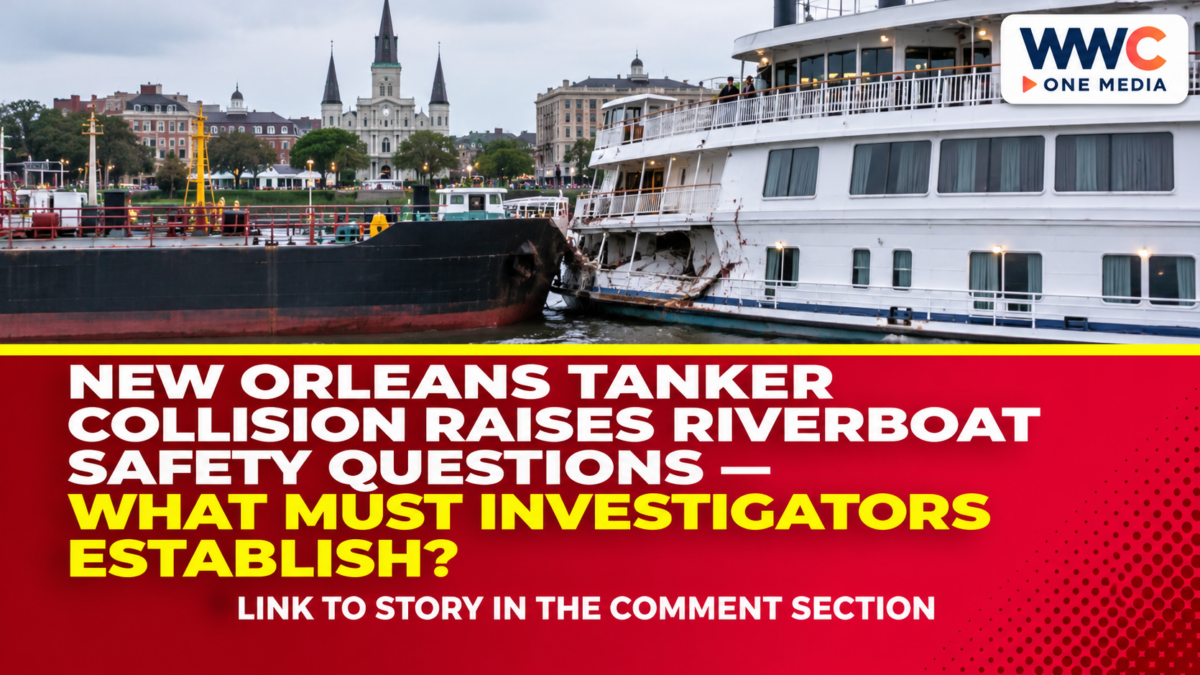
UNITED STATES— Nov. 14, 2026. A tanker struck a docked American Cruise Lines passenger riverboat in New Orleans on Nov. 13, prompting an emergency evacuation and a multiagency response along the Mississippi River. The vessel operator’s public statement identifies the riverboat as American Heritage and confirms that guests and crew were evacuated; however, the statement was available for this review only as an attributed reproduction, not on a directly opened operator incident page.
That distinction limits the details that can be certified independently. The ship’s original published specifications are accessible, and federal maritime safety records establish the investigative questions that matter. Exact casualty totals, the collision’s cause and the sequence of navigation decisions require directly examinable official incident records.
New Orleans Tanker Collision: What Is Documented
The operator’s statement, circulated publicly on Nov. 13, confirms an incident involving American Heritage while the vessel was docked and says the company was coordinating with the US Coast Guard and local authorities. The original company incident bulletin was not located on its own website during this review, so the statement should be independently obtained before the report is cleared for publication.
A Port of New Orleans incident statement reproduced by several publishers identifies the other vessel as Atlantic Asphalt and places the occurrence at approximately 12:30 p.m. local time. It describes about 129 passengers plus crew aboard the cruise vessel and says the vessel was already docked for disembarkation. Because a directly opened Port bulletin was unavailable, those details are treated as provisional, not certified primary-record facts.
The early statements also describe emergency assistance and temporary river restrictions. They do not constitute a determination of fault or establish whether a mechanical, navigational, communications or environmental factor caused the impact. No such cause should be supplied from speculation.
The American Heritage Is a River Cruise Vessel, Not an Ocean Liner
American Cruise Lines’ original fleet page identifies American Heritage as a paddlewheeler built in 2015, with capacity for 150 guests and service on the Mississippi River. Its listed facilities include a dining room, lounges, fitness centre and passenger-deck elevator access.
These characteristics matter because river cruising combines passenger accommodation with navigation on a working waterway. Commercial cargo vessels and passenger riverboats may operate near the same ports and terminals, but they have different schedules, handling characteristics and operational requirements.
The 150-guest capacity is not a Nov. 13 manifest. Authorities must reconcile passengers and crew.
Nor should the ship’s published future cruise dates be presented as confirmation that normal voyages will operate after the incident. Timetables and advertised fares are subject to change following damage or inspection.
What Investigators Need to Establish About the Impact
The central maritime questions concern the movement of the tanker, the position of the stationary riverboat, traffic conditions and communications before contact. Investigators may examine vessel-tracking data, bridge recordings, navigation logs, crew statements and physical damage. These are potential evidence sources, not findings about this particular incident.
US maritime investigators distinguish evidence of contact from proof of its cause. In an unrelated, completed National Transportation Safety Board investigation on the lower Mississippi River, officials examined radio passing arrangements, the relative positions of two towing vessels and decisions made while one vessel was navigating a bend. That earlier case does not establish anything about the behaviour of either ship in New Orleans in 2026.
The distinction is especially important when video of a serious accident circulates online. Footage can show the location and direction of visible motion but may omit earlier radio exchanges, equipment conditions or traffic instructions. An investigation should test all relevant evidence before attributing responsibility.
Evacuation and Rescue Are Separate From an Injury Count
The cruise operator’s publicly circulated statement said guests and crew were evacuated. That does not, by itself, disclose how many people required medical attention or whether the passenger and crew manifests were fully reconciled at the moment the statement was issued.
Reports circulating later on Nov. 13 described people hospitalised and everyone accounted for. This review did not locate the original, dated city or port record establishing the final tally. Those reported figures are therefore excluded rather than presented as verified numbers. Readers should expect official totals to be updated as responders reconcile records.
The response also has implications for the wider river. Temporarily restricting vessel movement may give rescuers space to work and reduce additional risks. The precise boundaries and duration of any restriction must come from the Coast Guard’s original marine safety information bulletin or a subsequent authoritative notice.
The distinction between rescue and a completed investigation is familiar in the Philippines. WWC’s report on Philippine tanker fire response described emergency action following a separate incident. It is a comparison of response processes, not evidence connecting that event with New Orleans.
Why the Accident Matters to Passenger and Port Operations
Analysis: An incident at a passenger berth can involve more than ship damage. Port access, passenger assistance, accommodation, onward transport and the safe movement of other vessels may all need separate decisions after the immediate emergency.
WWC’s coverage of cruise-vessel legal and passenger disruption in Singapore concerned a different kind of interruption, but shows why cruise operators must communicate clearly when an itinerary can no longer proceed as planned.
For port managers, the operational question is whether existing controls clearly separate vessels approaching berths from stationary passenger ships, and whether communications and emergency procedures function as intended. These questions do not establish a violation.
WWC also examined the importance of separating evidence from assumptions in a Philippine maritime accident investigation. Findings from that unrelated case cannot be transferred to the Mississippi River collision.
What Happens Next
A publishable definitive chronology needs the original Port of New Orleans incident bulletin, the Coast Guard’s operational notices, any NTSB investigation announcement and the operator’s dated updates. Together, those records can establish the confirmed injury count, river restrictions, vessel condition and any announced investigative authority.
For now, the available first-party ship profile confirms what American Heritage is, while the operator’s circulated statement confirms an evacuation but still needs direct-source authentication. The cause of the collision must remain undetermined until investigators publish evidence-based findings.
Frequently Asked Questions
Which cruise ship was involved in the New Orleans tanker incident?
The vessel operator identified its riverboat as American Heritage. Its official fleet page lists a 2015-built paddlewheeler with room for 150 guests.
Was American Heritage moving when it was struck?
The company’s circulated statement describes the vessel as docked. The original incident bulletin should be checked before the exact chronology is certified for publication.
How many people were injured?
A final injury count was not verified from a directly inspected port, Coast Guard or city record during this review. Conflicting preliminary reports should not be treated as a final tally.
What caused the tanker to strike the riverboat?
No authenticated final investigative finding was located. Navigation decisions, communications and vessel conditions must be established through official evidence.