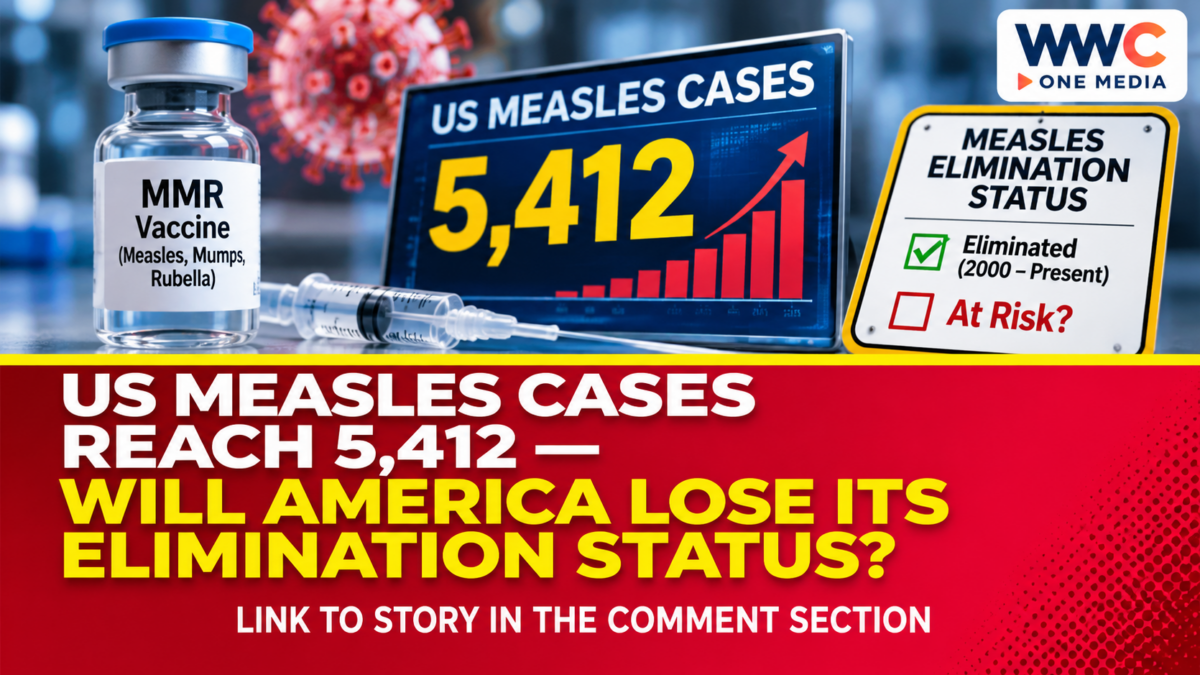
MANILA, Philippines — Nov. 14, 2026. The United States reported 5,412 confirmed measles cases for 2026 as of Nov. 12, more than double its 2025 total, while a regional expert commission met this week to reassess whether the country still qualifies as having eliminated endemic measles. The latest federal surveillance data establish a substantial resurgence, but an official final decision removing the US elimination designation was not available in the primary records reviewed.
The distinction matters: an outbreak count measures illnesses, while elimination status depends on evidence about how long the same chain of virus transmission has persisted. One cannot automatically substitute for the other. The question is how quickly authorities can interrupt transmission and close vaccination gaps.
US Measles Cases Rise Far Above Last Year’s Total
The CDC’s Nov. 13 surveillance update lists 5,412 confirmed cases in 2026, including 5,394 reported by 47 US jurisdictions and 18 among international visitors. The agency reported 2,289 cases for 2025, making this year’s preliminary total more than twice as large before December has begun.
Its current table records 591 hospitalisations, representing 11% of reported 2026 cases, and six deaths. The CDC warns that the death figure can change as reporting and classification reviews continue. These are counts for different surveillance categories; they should not be combined with state-level or media totals without checking whether cases overlap.
The CDC also says 96% of 2026 patients were unvaccinated or had unknown vaccination status. That wording is essential: it is a combined surveillance category and does not prove that every person in the group was definitely unvaccinated.
WWC previously examined the outbreak when the US total stood at 5,182 cases. The new official figures add 230 cases to that earlier snapshot, but the increase between published updates is not necessarily the number of infections acquired during those particular days.
What Measles Elimination Status Really Means
The United States was declared to have eliminated endemic measles transmission in 2000. Elimination does not mean no one can ever develop measles within its borders. An infected international traveller can introduce the virus, and an outbreak can still occur, particularly in communities with limited immunity.
PAHO’s verification framework tests a different condition: whether epidemiological and laboratory evidence demonstrates an uninterrupted transmission chain involving the same viral genotype and lineage for at least 12 months in a country or defined area.
This requires more than counting annual cases. Investigators must examine when illnesses began, connections between infections, laboratory findings and the quality of surveillance. Separate imported outbreaks can produce many cases without necessarily documenting one continuous endemic chain.
PAHO’s Oct. 14 announcement scheduled an independent commission meeting for Nov. 10–13. Its published procedure says the commission reviews countries’ evidence, forwards recommendations to the PAHO director and subsequently publishes an official report. No accessible post-meeting statement formally reclassifying the United States was located for this article.
Why the November Review Matters
PAHO identified Jan. 20, 2025 as the start date relevant to assessing whether the US outbreak had established sustained transmission. The review also covers Mexico, whose corresponding assessment period began on Feb. 1, 2025.
The commission considers surveillance performance, vaccine coverage, laboratory and genomic evidence, and outbreak responses. The criteria apply across countries.
The distinction also prevents confusion about the wider Americas. The region lost its regional measles-free status in 2025, after the verification process found endemic transmission had re-established itself in Canada. That regional decision did not automatically mean the United States individually lost its own designation at the same moment.
The official October notice described Canada as the only country in the region then classified as endemic. Any subsequent change requires a later, authoritative classification notice rather than an inference from the US case count alone.
Vaccination Coverage Remains Central to Outbreak Control
Measles is highly contagious. CDC clinical guidance says up to nine out of ten susceptible people who have close contact with an infected patient can develop the disease. The virus can remain infectious in indoor air for up to two hours after an infected person leaves.
CDC guidance estimates two doses of measles vaccine are 97% effective at preventing the disease, compared with approximately 93% for one dose. No vaccine guarantees protection in every individual, but maintaining high community coverage reduces opportunities for the virus to spread.
The agency reports that US kindergarten MMR coverage fell from 95.2% in the 2019–2020 school year to 92.4% in 2025–2026, leaving an estimated 280,000 kindergarten pupils at risk. National averages can conceal much larger gaps in particular communities.
These figures do not explain every outbreak. They do explain why prevention depends on both timely vaccination and prompt detection, isolation and contact tracing when cases appear.
What the Resurgence Means for the Philippines
Analysis: The US experience is relevant to the Philippines because measles can cross borders through travel. It does not mean that a change in America’s elimination status would automatically change Philippine health policy or the risk facing any individual traveller.
For Philippine families, the practical issue remains timely immunisation under local health guidance. WWC previously covered Vigan City’s campaign to vaccinate eligible children despite no reported local cases at the time. Its prevention-first approach illustrates why communities do not need to experience a large outbreak before closing protection gaps.
A separate Oriental Mindoro measles-rubella immunisation campaign likewise focused on children who might have missed recommended protection. The local campaigns are distinct from the US outbreak and should not be used to infer current Philippine infection totals.
Vaccination questions, especially for infants, pregnant people and those with certain immune conditions, should be discussed with qualified healthcare professionals using applicable Philippine Department of Health recommendations.
What Happens Next
The next decisive record will be PAHO’s formal communication of the United States’ classification and the commission’s published findings. The CDC’s subsequent surveillance releases will show whether confirmed cases and outbreak-associated transmission are declining.
Analysis: A status designation can sharpen attention, but the operational measures are measurable regardless of the label: sustained vaccination coverage, rapid laboratory confirmation and the interruption of transmission chains. Until an official reclassification appears, the verified headline is the surge to 5,412 US cases—not a conclusively documented loss of elimination status.
Frequently Asked Questions
Has the United States officially lost measles-elimination status?
An official PAHO announcement confirming that change was not located among the primary records reviewed as of Nov. 14, 2026. The Nov. 10–13 expert review was scheduled, but the final designation requires formal communication.
How many measles cases has the US reported in 2026?
The CDC’s Nov. 13 update reports 5,412 confirmed cases as of Nov. 12. The total is preliminary and may change.
Does elimination mean there are zero measles cases?
No. Imported infections and limited outbreaks can occur after elimination. The designation concerns sustained endemic transmission over time.
How effective are two MMR doses against measles?
CDC guidance estimates approximately 97% effectiveness against measles. People should follow the vaccination guidance applicable to their age and circumstances.