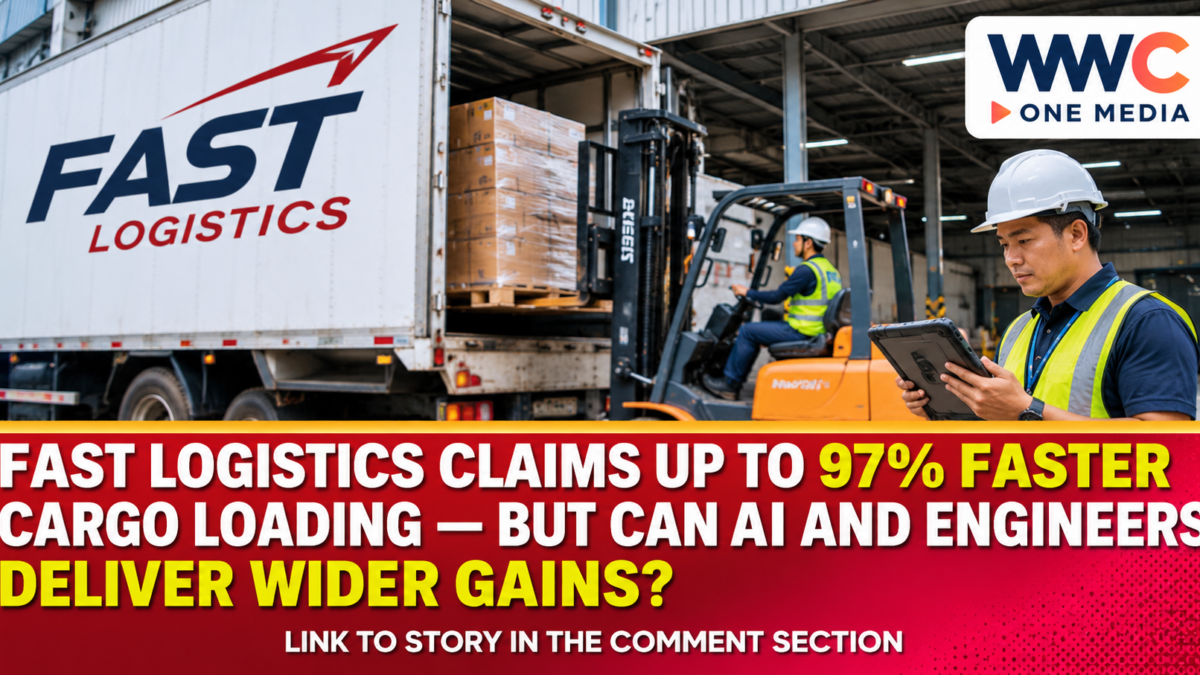
MANILA, Philippines — Nov. 14, 2026. FAST Logistics Group is promoting AI-assisted operations and an equipment-based loading system that it says can cut a four-hour truck-loading process to about 20 minutes. The company’s published technology and workforce announcements show why Philippine engineers increasingly need to understand both physical processes and the digital systems controlling them.
The commercial question is larger than a dramatic percentage. An improvement at a loading dock can free up trucks, but lasting gains in delivery depend on inventory accuracy, planning, road conditions, driver safety and employees who know how to respond when operations depart from the plan.
FAST Logistics AI: What the Company Has Documented
FAST’s October 2026 statement on the Philippine Institute of Industrial Engineers’ 21st National Congress identifies Chief Information Officer Leo Sacamos Jr. as a participant in an Oct. 8 discussion on digital transformation. The company says its approach combines AI tools with employee judgement rather than treating automation as a substitute for operational expertise.
Its transport-system materials describe shipment visibility and system-guided coordination, while its warehouse technology integrates information about goods and movement through distribution facilities. These functions matter because warehouse decisions and transport decisions often affect each other: an incomplete order can delay a truck even when a driver is ready.
This is an operational framework, not evidence that every FAST warehouse or route uses identical technology. Company product descriptions show what the systems are designed to do, but do not provide a network-wide audited measure of time saved or costs reduced.
The 97% FleXchange Claim Needs Careful Reading
FAST introduced FleXchange in September 2024. Its own description says the arrangement uses detachable, stackable boxes that staff can load before the vehicle arrives. Workers then attach the prepared boxes to the truck, limiting the time the vehicle spends waiting at the warehouse.
FAST markets a reduction in loading time of up to 97%, contrasting a process lasting four hours with one taking approximately 20 minutes. The company identifies its innovation as a systems-guided solution connected to warehouse and transport management tools.
The figure is important, but so is its denominator. Four hours becoming 20 minutes represents 220 minutes saved, or about 91.7% of the original four-hour period. The company’s separate up to 97% claim therefore should not be treated as a mathematical conversion of that single example or as a universal result.
Neither figure measures the entire journey from warehouse to customer. A faster departure does not eliminate traffic, missed receiving windows, route restrictions or delays at the destination. Nor does a claim about a patented design establish how many trucks currently use it.
For context, WWC previously examined FAST’s wider distribution network and the shipping-cost challenge facing Cebu businesses. Physical capacity and faster handling can help, but reliable delivery still requires coordinating the different stages of a shipment.
Where Warehouse Software and Driver Monitoring Fit
FAST’s technology materials describe links between FleXchange, its transport-management capabilities and a Honeywell warehouse-management system. In practice, such a connection can help operators associate what has been picked and loaded with what a vehicle is scheduled to carry.
The company has also described AI-supported dashboard-camera monitoring in its transport operations. Its published account identifies risks such as speeding, sudden braking and distracted driving as situations the system is designed to flag for its control team.
Those functions address different problems. Detachable boxes aim to reduce loading waits; inventory systems help control accuracy; transport systems organise dispatch and tracking; camera-based alerts support safety oversight. Combining them sensibly may matter more than the number of AI-labelled products deployed.
A safety alert is not proof that an accident has been prevented. Similarly, real-time tracking is useful only if staff can investigate discrepancies and act on the information. Customers should look for measurable service outcomes instead of assuming that digital visibility alone guarantees punctual deliveries.
The same integration challenge appears outside logistics. WWC’s earlier discussion of Globe Business’s push to connect fragmented enterprise systems explored why companies need information to flow between applications, not merely more applications.
Why Filipino Engineers Still Matter in an Automated Warehouse
FAST’s October 2026 workforce communications call for closer cooperation between employers and educational institutions. Executives at a supply-chain conference in the Visayas highlighted technical competencies alongside communication, problem-solving and the ability to work with digital technology.
The company says its Learning and Innovation Hub in Cabuyao, Laguna, supports practical training, including warehouse and forklift competencies. Its announcements also describe management-trainee pathways that expose graduates to different business functions.
For aspiring engineers, the lesson is practical: logistics work joins software, mechanical handling, facility layout, workplace safety and decision-making under pressure. A technical design that looks efficient in isolation may fail if it creates bottlenecks at another stage.
The opportunity also fits a broader discussion of Philippine technical talent. WWC has reported on efforts to train specialised AI engineers for international business systems. Logistics presents a different test: engineers must translate digital capabilities into dependable movement of physical goods.
What This Could Mean for Philippine Supply Chains
Analysis: FAST’s published products suggest a promising direction: treat loading, storage, transport and employee training as connected parts of one process. But promotional performance claims need to be distinguished from independently verified results across customers and locations.
A credible business evaluation would compare time at the loading dock, truck utilisation, delivery punctuality, picking accuracy, safety incidents and cost per completed delivery before and after implementation. It would also account for equipment expenses, staff training and the types of cargo handled.
That kind of measurement would show whether shorter loading queues generate sustained value rather than simply shifting the bottleneck elsewhere. It would also make it easier for smaller manufacturers and distributors to judge whether a comparable approach fits their operations.
What Happens Next
FAST has publicly committed to expanding digital skills and industry-academe collaboration. The next useful disclosures would be independently assessed operational results, deployment scale and details of how workers are trained to supervise automated processes.
For Philippine engineers, the bigger question is whether training can produce solutions that work under actual warehouse and road conditions. Technology can improve decisions, but evidence of consistent delivery performance is what would establish broader success.
Frequently Asked Questions
What is FleXchange by FAST?
It is FAST’s system-guided loading solution using detachable, stackable cargo boxes that can be prepared before a truck arrives. The company says it reduces vehicle waiting at loading facilities.
Does FleXchange make deliveries 97% faster?
No such network-wide delivery-speed result is established in the official materials reviewed. FAST advertises up to 97% less loading time, which is different from total journey time.
How does FAST Logistics use AI?
Its published statements discuss AI-assisted operational analysis and camera-based road-safety monitoring, alongside digital warehouse and transport systems. The specific tools serve different functions.
Why does the company want more engineering and digital skills?
FAST says its operations need people who can interpret data, manage equipment and integrate technology with real-world processes. Its workforce announcements also stress communication and human judgement.