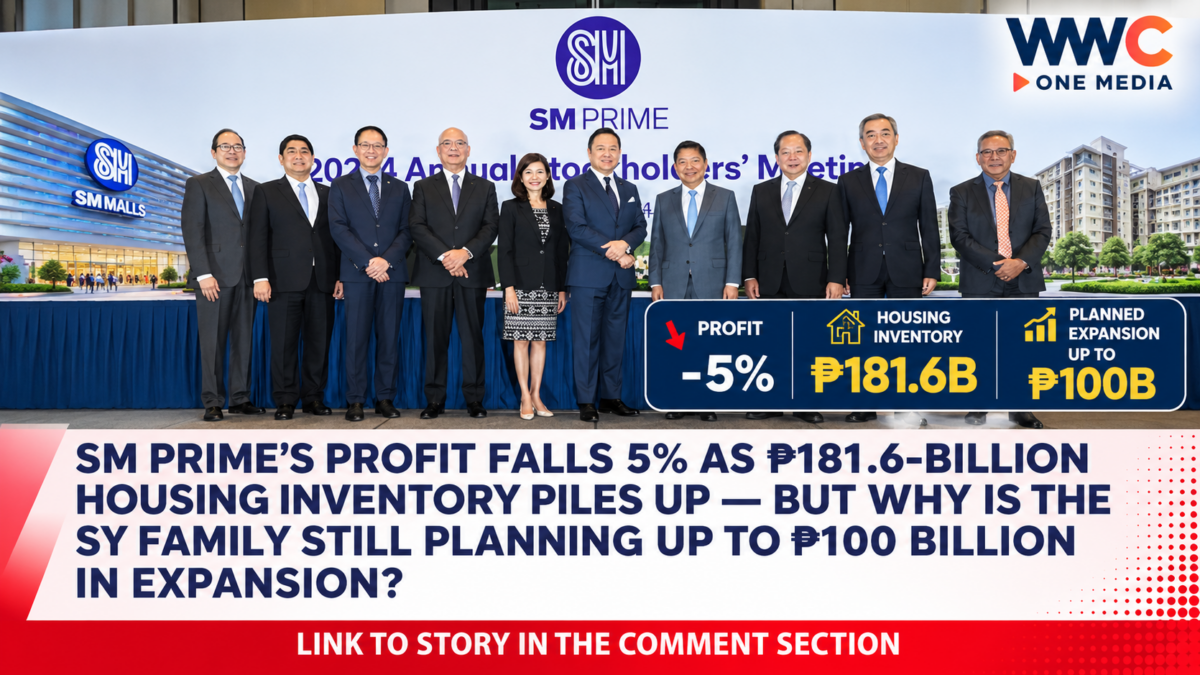
MANILA, PHILIPPINES — November 10, 2026 — The Sy family’s property giant SM Prime Holdings is preparing another major wave of shopping mall, hotel and convention center investments despite a prolonged Philippine housing slowdown that has dragged down its earnings and left approximately ₱181.6 billion worth of residential inventory awaiting buyers.
The country’s leading integrated property developer reported consolidated net income of ₱35.4 billion for the first nine months of 2026, a 5% decline from ₱37.2 billion a year earlier.
Residential sales weakened sharply, putting additional pressure on the company’s condominium and housing operations.
But while homebuyers remain cautious, SM Prime’s malls are generating stronger revenues, hotels are benefiting from travel and events, and rental income continues to rise.
That contrast is reshaping how the conglomerate decides where to invest.
According to InsiderPH’s November 9 report, SM Prime President Jeffrey C. Lim said the company intends to continue expanding but will become more selective about which projects receive funding and when construction proceeds.
The group spent ₱44.4 billion on capital expenditures during the first nine months of 2026, down 25% from ₱59.3 billion a year earlier.
For 2027, management is considering capital spending broadly in line with its 2026 plans, with a possible range of approximately ₱60 billion to ₱100 billion.
The strategy raises a crucial question: Can SM Prime use its expanding mall and hotel businesses to overcome the Philippine property downturn—or could continued weakness in residential demand put its next investment cycle under pressure?
SM Prime Reports ₱35.4 Billion Profit as Housing Sales Weaken
SM Prime’s November 9 financial announcement revealed a business increasingly divided between strong recurring income and weak property sales.
Consolidated net income declined 5% to ₱35.4 billion during January to September 2026.
Total revenue stood at approximately ₱103.1 billion, compared with ₱103.4 billion in the same period last year.
The modest overall revenue decline concealed substantial differences among the company’s operations.
Rental income rose 8% to ₱66 billion from ₱61 billion.
Meanwhile, real estate sales fell 23% to ₱24 billion from ₱31.2 billion, according to the company’s consolidated revenue breakdown.
Other revenues, including leisure, entertainment, hotel dining, advertising and sponsorships, increased 17% to ₱13.1 billion.
These results show why malls and related commercial businesses have become increasingly important to the group’s earnings.
They generate income from tenants and visitors even when fewer households are committing to major residential purchases.
However, recurring income does not completely eliminate the effects of a housing slowdown.
SM Prime’s third-quarter consolidated net income fell 15% to ₱10.9 billion, indicating that the residential weakness continued to affect the group’s overall performance.
Why SM Prime Is Still Expanding Despite Slower Earnings
Lim’s message to investors was that SM Prime remains confident in the long-term value of its diversified property portfolio.
But the company is adjusting how aggressively it commits capital.
Instead of launching projects simply because they are included in a long-term pipeline, management will evaluate actual market demand and the expected timing of returns.
Ongoing mall developments and redevelopments will remain priorities.
Hotel and convention center projects are also expected to proceed.
New residential launches will be more selective, favoring segments where buyer demand has remained relatively resilient.
Meanwhile, new office projects are being deferred as the company concentrates on completing existing developments and improving occupancy.
The approach is not a complete retreat from property development.
It is a shift toward businesses where management currently sees stronger demand and more dependable revenue.
For investors, the question is whether those stronger segments can continue growing fast enough to offset declining housing sales.
Malls Become SM Prime’s Biggest Earnings Defense
SM Prime’s mall operations remain the strongest part of its business.
During the first nine months of 2026, the mall segment generated approximately ₱63.7 billion in revenue, an increase of 10% from ₱58.2 billion a year earlier.
That represented about 62% of consolidated revenue.
InsiderPH separately reported that mall operating profit increased 16% to approximately ₱38.5 billion.
The distinction is important: revenue reflects sales generated by the segment, while operating profit reflects earnings after relevant operating expenses.
The growth was supported by additional leasable space, improving tenant occupancy and consumer interest in dining, entertainment and leisure activities.
These developments highlight an increasingly important aspect of Philippine retail.
Shopping malls are no longer competing only as places to buy clothing, electronics and household necessities.
They are also becoming destinations for restaurants, entertainment, sports, fitness and family activities.
As previously reported by WWC ONE MEDIA, the country’s four major mall developers have a combined ₱184-billion pipeline covering 46 shopping center projects, based on research from Colliers Philippines.
Related WWC ONE MEDIA coverage: Philippine Mall Giants Bet ₱184 Billion on 46 Projects as Pickleball Replaces Cinemas — But Will Shoppers Keep Coming?
The combined pipeline includes SM Prime, Ayala Land, Megaworld and Robinsons Land.
That ₱184-billion figure refers to the four-company industry pipeline, not SM Prime’s individual capital-expenditure commitment.
Hotels and Convention Centers Emerge as Another Growth Engine
SM Prime is also increasing its emphasis on hotels, convention centers and tourism-related developments.
Revenue from its hospitality and meetings, incentives, conventions and exhibitions business rose 7% to approximately ₱6.4 billion during the first nine months of 2026.
The company attributed the improvement to stronger hotel bookings, higher average room rates and increased demand for events.
Lim said planned hotel and convention projects would continue because SM Prime sees opportunities in tourism and business gatherings.
These investments have a strategic advantage when developed alongside existing shopping centers.
A hotel guest may visit nearby restaurants and stores.
Convention attendees may generate demand for lodging, transportation, dining and entertainment.
An exhibition or major corporate event can attract visitors who would not otherwise travel to the property.
That means the benefits of hospitality developments may extend beyond the revenue generated by a single building.
However, the company must still manage construction costs, occupancy levels and competition from other hotels and event venues.
Tourism demand is promising, but individual project performance is not guaranteed.
Why SM Prime Is Betting on the Concert Economy
A further source of opportunity comes from live entertainment.
SM Prime’s major entertainment venues welcomed more than one million visitors during the first eight months of 2026, representing a substantial increase from the comparable period in 2025.
Its properties include SM Mall of Asia Arena, SM Seaside Cebu Arena and SMDC Festival Grounds.
Major concerts, sports events and live performances can help attract visitors to surrounding commercial developments.
The strategy connects entertainment, restaurants, parking, retail and hospitality in one destination.
As WWC ONE MEDIA previously examined, the company is increasingly positioning live events as an economic driver for its wider property network.
Related WWC ONE MEDIA coverage: SM Prime Live Venues Top 1 Million Visitors as Concert Demand Surges — But the Bigger Business Is Happening Outside the Arena
The growth in visitors supports management’s decision to emphasize experience-driven businesses.
But attendance figures alone do not establish profitability.
Entertainment venues require substantial spending on maintenance, personnel, utilities and event operations.
The financial benefit depends on how much of that visitor activity translates into sustainable earnings across SM Prime’s properties.
₱181.6 Billion in Residential Inventory Creates a Major Challenge
The company’s housing business remains its most difficult segment.
According to InsiderPH, the estimated sales value of SM Prime’s residential inventory increased 3% to ₱181.6 billion during the first nine months of 2026.
The inventory covers completed and unfinished housing units still available for sale.
That number should not be confused with an accounting loss or an amount of debt.
It represents the estimated sales value of available residential properties under the company’s reported inventory measure.
Interestingly, the number of unsold units declined 5% to approximately 25,914.
The fact that the unit count fell while the estimated sales value rose suggests that changes in inventory composition or valuation may be relevant.
The available data alone do not establish precisely why the average value changed.
What is clear is that SM Prime continues to hold a substantial residential portfolio at a time when buyer demand remains weak.
The company’s sales reservations also declined 10% to ₱36.8 billion, suggesting that the near-term pipeline for future residential revenue remains under pressure.
Residential Revenue Falls as Homebuyers Remain Cautious
SM Prime’s residential segment reported approximately ₱25.6 billion in revenue for the first nine months, down 21% from the previous year.
This is a segment reporting figure and differs in scope from the ₱24-billion consolidated real estate sales line in the company’s release.
The residential business also suffered a 49% decline in operating profit to approximately ₱6.6 billion, according to InsiderPH.
Third-quarter residential revenue fell sharply.
The slowdown reflects several pressures affecting Philippine homebuyers.
Higher financing costs can make mortgage payments less affordable.
Inflation reduces households’ available income for major purchases.
Economic uncertainty can encourage buyers to delay commitments.
Meanwhile, some customers who reserved properties under preselling arrangements may encounter difficulty completing purchases when larger financing obligations become due.
These problems are not unique to SM Prime.
Other major Philippine property developers have also reported weaker housing demand.
For SM Prime, the challenge is to reduce available inventory without sacrificing margins unnecessarily.
Premium Housing Becomes a Bigger Priority
Lim said demand has remained relatively stronger in premium residential developments.
As a result, SM Prime is considering opportunities in higher-end projects while slowing new launches in its core housing segment.
That does not mean the company is abandoning affordable or middle-income buyers permanently.
Instead, management is seeking clearer evidence of recovery before making additional large commitments in more price-sensitive markets.
The strategy may help reduce the risk of launching projects into areas with excessive available supply.
But premium developments have their own risks.
High-end property markets can be affected by investment sentiment, competition and changes in buyers’ wealth.
A stronger premium segment does not guarantee that every proposed project will achieve its sales targets.
The appropriate balance will depend on location, demand, pricing and the company’s ability to differentiate its developments.
SMDC Projects Remain Part of the Long-Term Portfolio
Although the company is slowing some new residential launches, it continues work on existing projects.
SM Development Corporation remains an important part of the group’s property operations.
In October, SMDC marked the topping-off of Joy Residences in Baliwag City, Bulacan.
The development is located beside SM City Baliwag and forms part of the company’s strategy of integrating residential communities with commercial destinations.
As previously reported by WWC ONE MEDIA, the structural milestone was an important construction development but did not mean every home was already ready for occupancy.
Related WWC ONE MEDIA coverage: SMDC Joy Residences Reaches Topping-Off Milestone in Bulacan — But the Bigger Question Is When Homebuyers Can Finally Move In
The development illustrates why SM Prime must balance two priorities.
It needs to complete projects already underway while carefully evaluating the timing of new housing investments.
Delaying new launches can help control future inventory.
But existing projects still require funding, construction management and eventual turnover to buyers.
Office Expansion Put on Hold as Occupancy Improves
SM Prime is also taking a cautious approach toward office developments.
The company has no new office launches planned at present.
Instead, management is focusing on completing existing projects and increasing occupancy.
According to InsiderPH, occupancy across the relevant office portfolio improved to 79% from 73%.
That is a positive development because higher occupancy can increase recurring rental income from completed buildings.
However, the figure also shows that a portion of the existing office space remains unoccupied.
Launching additional developments before current buildings are more fully leased could increase that exposure.
The company’s decision therefore reflects a preference for improving returns on existing assets before expanding supply.
The strategy is particularly relevant as the office market faces uncertainty involving corporate demand, changing workplace practices and the long-term effects of automation on service-sector employment.
SM Prime Cuts Nine-Month Capital Spending by 25%
Capital spending is another important part of the company’s changing strategy.
SM Prime invested ₱44.4 billion from January through September 2026.
That was 25% below the ₱59.3 billion spent during the corresponding period of 2025.
The spending reduction does not mean the company has stopped construction.
The bulk of capital expenditures continued supporting ongoing mall and residential developments.
Other allocations went toward commercial, integrated, hotel and convention center projects.
The lower spending reflects a more deliberate approach to project timing.
For investors, capital discipline can help preserve financial flexibility during difficult market conditions.
But reducing investment too aggressively can also delay future income-generating assets.
SM Prime must therefore strike a balance between conserving capital and maintaining the growth of its commercial portfolio.
Up to ₱100 Billion in 2027 Spending Is Still Possible
Despite the reduction in spending during the first nine months of 2026, SM Prime is considering another major capital program next year.
Lim indicated that 2027 capital expenditures could be broadly comparable to this year’s expected range, citing approximately ₱60 billion to ₱80 billion, with an upper limit of around ₱100 billion.
The important point is that the company has not committed to spending the maximum amount regardless of market conditions.
Project selection and timing remain flexible.
For malls, priority will go to ongoing construction and redevelopment.
For hospitality, planned hotels and convention centers will proceed according to the company’s existing program.
For residential projects, management will favor developments with stronger demand.
For offices, no new launches are currently planned.
This approach demonstrates that SM Prime is not simply trying to build more properties.
It is attempting to direct investment toward projects most likely to deliver sustainable returns.
SM’s Mall Expansion Could Strengthen Provincial Growth
SM Prime’s strategy also reflects the broader movement of commercial investment beyond Metro Manila.
The company has identified mall developments in regional growth centers, including locations in Laguna, Cavite and Davao del Norte.
Its previously disclosed pipeline includes SM Nuvali, SM City General Trias and SM City Tagum.
The timing of individual openings remains subject to development and operational schedules.
Provincial expansion can allow the company to benefit from population growth, increasing consumer activity and new economic centers.
But each location must support enough demand to justify investment.
A growing city does not automatically guarantee that a new shopping mall will achieve strong occupancy and rental income.
As WWC ONE MEDIA previously reported, parent company SM Investments has emphasized the importance of seeking growth opportunities beyond Metro Manila.
Related WWC ONE MEDIA coverage: SM Investments Looks Beyond Metro Manila as DyBuncio Sees New Growth Opportunities Across the Philippines
The regional strategy could support long-term growth, but its results will depend on household purchasing power, local economic activity and the financial performance of individual projects.
Investors Face a Two-Speed Property Business
SM Prime’s latest results illustrate how differently property businesses can perform under the same economic conditions.
The mall segment continues growing.
Hotels and convention centers are benefiting from events and tourism.
Offices are showing improvements in occupancy.
But residential sales remain under substantial pressure.
For investors, this creates a two-speed business.
Recurring-income assets provide stability and opportunities for growth.
Residential developments, however, depend heavily on buyers committing substantial amounts of money and obtaining appropriate financing.
SM Prime’s diversification helps cushion the impact of the housing downturn.
But the decline in consolidated earnings demonstrates that the weaker segment still matters.
The group’s financial position provides some capacity to continue investing.
At the end of September, SM Prime reported approximately ₱1.1 trillion in total assets and ₱27.9 billion in cash and cash equivalents.
Its net debt-to-equity ratio stood at 0.84 times, with interest coverage of 7.3 times.
These figures provide useful context for evaluating financial capacity, but they do not eliminate the risks associated with large construction projects.
What Could Change SM Prime’s Outlook in 2027?
Several developments could influence performance over the coming year.
An improvement in household purchasing power or more affordable housing finance could support residential demand.
Stronger consumer spending could increase mall tenant sales and rental opportunities.
Growth in domestic tourism and business events could benefit hotels and convention centers.
Higher occupancy could strengthen income from existing office buildings.
But risks remain.
Construction expenses, borrowing costs, inflation and changing consumer behavior could affect project returns.
Meanwhile, an extended residential slowdown could keep the company’s housing inventory elevated.
For SM Prime, the challenge will be ensuring that growth in stronger business segments translates into improved consolidated earnings.
The Bigger Picture: Is SM Prime Redefining Philippine Property Expansion?
SM Prime’s latest strategy offers a revealing picture of the Philippine property industry.
The company is not abandoning construction or retreating from growth.
It is becoming more selective.
Malls remain central to its earnings.
Hotels and convention centers are gaining importance.
Office investments are being managed cautiously.
And residential launches are being timed according to actual buyer demand.
The numbers explain why.
Nine-month net income fell 5% to ₱35.4 billion.
Residential inventory reached ₱181.6 billion in estimated sales value.
But rental income climbed to ₱66 billion, mall revenues expanded and hospitality continued growing.
The company has responded by cutting nine-month capital spending while maintaining the option of a substantial 2027 investment program.
The next test is whether management can convert greater spending discipline into stronger profits without sacrificing the long-term expansion of the SM property network.
And as the Sy family’s property giant continues building shopping centers, hotels and convention facilities while thousands of housing units remain unsold, one question could define its next chapter: Can SM Prime’s recurring-income empire overcome the condominium slump—or will weak homebuyer demand continue holding back one of the Philippines’ biggest developers?