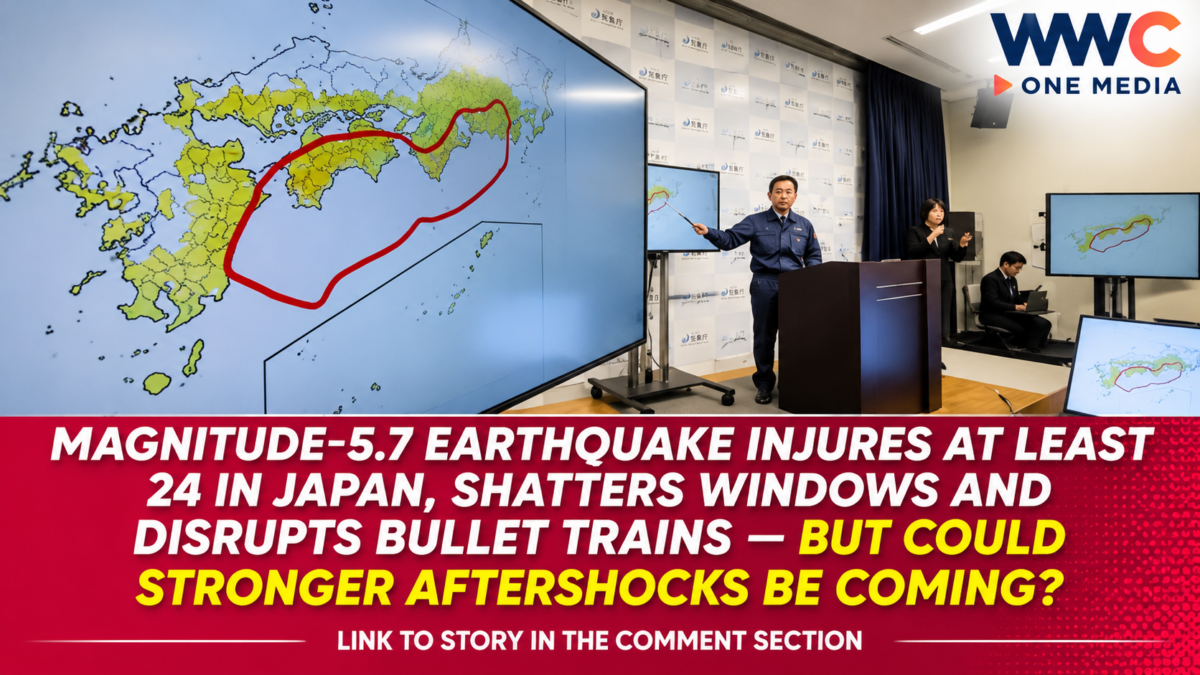
TOKYO, JAPAN — A powerful overnight earthquake has shaken central Japan, injuring at least 24 people according to local media reports, shattering storefront windows and disrupting high-speed rail services as authorities warn residents to prepare for possible further strong tremors.
The magnitude-5.7 earthquake struck at approximately 1:04 a.m. on Sunday, November 8, with its focus beneath western Shizuoka Prefecture at a depth of around 40 kilometres.
The strongest shaking was recorded in neighbouring Aichi Prefecture, where the Japan Meteorological Agency (JMA) measured an intensity of upper 5 on Japan’s seismic scale.
Buildings shook, merchandise fell from store shelves and frightened residents rushed to safety.
In some areas, people were injured after falling or being struck by objects during the shaking.
No tsunami threat was reported, and authorities had not confirmed any deaths in the initial reports.
But Japan’s earthquake agency has issued a warning that could keep millions of residents on alert: further strong earthquakes remain possible during the coming week, with particular caution needed over the next two to three days.
The tremor comes just two days after a separate magnitude-6.1 earthquake struck offshore near Tokyo.
Although authorities have not established a direct connection between the earthquakes, the timing has renewed attention on Japan’s vulnerability to seismic disasters.
And the central question is whether the latest event will remain an isolated emergency or be followed by more dangerous shaking.
Powerful Earthquake Strikes Shizuoka at 1:04 a.m.
According to the Japan Meteorological Agency, the earthquake originated beneath western Shizuoka Prefecture.
Its estimated depth was approximately 40 kilometres.
The JMA recorded a preliminary magnitude of 5.7, while the United States Geological Survey assigned a magnitude of 5.5.
Such differences between agencies can result from variations in seismic data, measurement methods and subsequent revisions.
The strongest observed shaking occurred in Chita, Aichi Prefecture.
The city recorded an intensity of upper 5 on Japan’s scale, which ranges from zero to seven.
Lower-5 shaking was also observed in parts of Aichi, Shizuoka, Gifu and Nagano prefectures.
The tremor was felt across a wider area of central Japan.
The effects included broken glass, fallen merchandise and temporary transportation disruptions.
For residents awakened in the middle of the night, the sudden shaking created an urgent need to protect themselves from falling objects and damaged surroundings.
At Least 24 Injured as Windows Shatter and Residents Fall
The earthquake caused injuries across central Japan.
Channel News Asia, citing AFP, reported that officials in Aichi had received 16 reports of mostly minor injuries.
Authorities in neighbouring Shizuoka also reported at least three women seeking emergency medical treatment.
One was a woman in her nineties who injured her shoulder after falling from her bed during the earthquake.
Local newspaper Chunichi Shimbun and Tokai Television reported at least 24 people injured across Aichi and Shizuoka.
The Associated Press separately reported at least 22 injuries in its earlier account.
These numbers reflect different reporting times and sources, not necessarily contradictory final totals.
The full number of casualties may change as authorities complete their assessments.
In Toyohashi, Aichi Prefecture, the windows of a car dealership were shattered.
A large bookstore in Toyota city reported books and merchandise falling from shelves.
Japanese television footage showed broken glass scattered across commercial premises.
Some injuries occurred when residents fell while attempting to escape.
Authorities had not announced a confirmed fatality in the reporting reviewed.
Japan’s Bullet Train Services Disrupted
The earthquake also affected transportation.
Some regional rail services were temporarily suspended or delayed while operators assessed conditions.
The Tokaido Shinkansen, one of Japan’s most important high-speed rail corridors, introduced precautionary speed reductions along affected sections.
Reports indicated that services between Shizuoka and Hashima in Gifu Prefecture were affected.
High-speed rail operators must take earthquakes seriously because strong ground movement can potentially damage tracks, supporting structures and other railway infrastructure.
Reducing train speeds or temporarily stopping services allows safety checks to take place.
Such precautions do not automatically mean that railway lines have suffered major structural damage.
For passengers, however, even temporary restrictions can lead to missed connections and changes to travel plans.
The disruptions are particularly important because the Tokaido Shinkansen connects major Japanese economic and population centres.
Why a Magnitude-5.7 Earthquake Can Cause Serious Damage
Earthquake magnitude and seismic intensity measure different things.
Magnitude describes the size of an earthquake at its source.
Japan’s seismic intensity scale measures how strongly the ground shakes at a particular location.
That distinction helps explain why a magnitude-5.7 earthquake can create dangerous conditions.
At intensity upper 5, many people may find it extremely difficult to move without support.
Unsecured furniture can topple.
Objects can fall from shelves.
Glass and other fragile materials may break.
The damage can also vary considerably between neighbouring districts.
Local geology, building conditions and the distance from the earthquake’s source can influence shaking intensity.
The November 8 earthquake illustrates that moderate-magnitude events can still cause injuries and disruption when shaking is sufficiently strong.
It is therefore misleading to assess earthquake danger using magnitude alone.
Japan Warns of More Strong Shaking Over the Next Several Days
Following the earthquake, JMA officials urged residents to remain alert.
The agency warned that earthquakes producing similar strong shaking could occur during the following week.
Particular caution was advised over the next two to three days.
The warning did not mean that another major earthquake was certain.
Rather, it reflected the elevated possibility of additional seismic activity after a significant tremor.
Authorities also warned residents to watch for falling rocks and landslides, especially in areas affected by rainfall.
Strong shaking can destabilize slopes and loosen rocks.
Subsequent rain may increase the danger.
Residents in affected regions were encouraged to check their surroundings, avoid damaged structures and follow official emergency information.
Was the Earthquake Connected to the Feared Nankai Trough Megaquake?
One of the biggest questions surrounding the November 8 earthquake concerns the Nankai Trough.
This offshore region extends along Japan’s Pacific coast and is capable of producing extremely powerful earthquakes.
Scientists have long warned about the potential consequences of a major rupture in the region.
But the Japan Meteorological Agency did not report evidence that the November 8 earthquake marked the beginning of such an event.
According to the Associated Press, an agency official said no apparent changes had been detected in the Nankai Trough system.
Other regional reporting said authorities considered a direct connection unlikely.
That distinction is critical.
An earthquake occurring in central Japan does not automatically mean that a Nankai Trough megaquake is approaching.
Earthquakes cannot currently be predicted with precise dates, times and magnitudes.
Scientists can identify areas of elevated long-term seismic risk, but they cannot reliably announce when a particular large earthquake will occur.
The appropriate response is preparedness rather than unsupported speculation.
Another Earthquake Struck Near Tokyo Just Two Days Earlier
The November 8 earthquake came shortly after another significant seismic event.
On November 6, a magnitude-6.1 earthquake struck offshore southeast of the Tokyo metropolitan region.
The earlier tremor was recorded near the Kanto area.
Authorities reported no tsunami warning and no immediate serious damage or injuries.
The two events occurred in different areas and had different seismic characteristics.
There is no verified evidence that the November 6 earthquake directly caused the November 8 Shizuoka earthquake.
Still, the close timing demonstrates Japan’s continuing exposure to seismic activity.
As previously reported by WWC ONE MEDIA in its coverage of a magnitude-7.0 earthquake near the Ogasawara Islands, an earthquake’s depth, location and geological characteristics can dramatically influence its consequences.
The October 25 Ogasawara quake occurred much deeper underground and did not generate a tsunami threat.
Both incidents reinforce why earthquakes with similar or even larger magnitudes can produce very different effects.
Japan’s Earthquake Warning System Has Faced Recent Scrutiny
The latest tremor comes weeks after a separate controversy involving Japan’s earthquake early-warning technology.
On October 16, the Japan Meteorological Agency mistakenly issued an emergency alert suggesting a magnitude-9.9 earthquake.
The warning was subsequently cancelled.
Authorities explained that the error involved how the system processed information from an earthquake near Russia’s Kamchatka Peninsula.
As WWC ONE MEDIA reported in its investigation into the mistaken magnitude-9.9 warning, the incident raised questions about the reliability of automated seismic-alert calculations.
The October false alarm and the November 8 earthquake are separate events.
There is no evidence that the earlier technical problem caused or affected the latest earthquake.
But accurate alerts remain important because residents and transport operators may have only seconds to react to strong shaking.
Japan’s warning systems are designed to reduce the consequences of earthquakes, not prevent earthquakes from occurring.
Japan’s New Disaster Agency Faces an Early Test
The earthquake struck shortly after Japan began introducing a more centralized disaster-management system.
The government launched a new National Disaster Management Agency in early November to improve coordination between ministries, local authorities and emergency-response organizations.
The agency is intended to strengthen preparedness, response and recovery.
The initiative reflects lessons from previous disasters, including the devastating 2011 earthquake and tsunami.
Following the November 8 earthquake, Prime Minister Sanae Takaichi said the government had established a liaison office at the Prime Minister’s Office Crisis Management Centre.
She instructed officials to assess damage and provide accurate information to the public.
The response included monitoring injuries, infrastructure and transportation disruptions.
The creation of a national disaster agency does not eliminate earthquake risk.
Its effectiveness will depend on coordination, timely information and the capacity of local emergency services.
Nuclear Safety Remains a Major Concern in Central Japan
Shizuoka Prefecture is also home to the Hamaoka nuclear power plant.
The facility has faced regulatory scrutiny because of the potential risks associated with major earthquakes.
In September, senior executives at Chubu Electric Power resigned following revelations involving manipulated earthquake-safety data submitted during regulatory assessments.
As WWC ONE MEDIA reported in its coverage of the Hamaoka nuclear safety controversy, the incident raised serious questions about the reliability of seismic-risk assessments.
That earlier controversy is separate from the November 8 earthquake.
The reporting reviewed did not establish that the latest tremor damaged Hamaoka’s nuclear facilities or caused a nuclear emergency.
Nevertheless, the episode illustrates why reliable seismic information and transparent safety procedures matter in earthquake-prone regions.
Public confidence depends on both effective infrastructure protection and credible regulatory oversight.
Why Disaster Communications Matter for Travellers and Residents
Japan’s earthquake risk is also relevant to international travellers.
Visitors may be unfamiliar with local warning systems, evacuation procedures or the difference between earthquake magnitude and intensity.
Reliable communications are particularly important when transportation systems are disrupted.
For Filipino travellers, mobile connectivity may provide access to weather information, emergency messages and transportation updates.
As WWC ONE MEDIA reported on Globe’s satellite roaming partnership with Japan’s KDDI, eligible travellers with compatible devices can access selected satellite-based services in locations where conventional mobile networks are unavailable.
Such technology may support communications in remote areas.
However, satellite connectivity does not replace official earthquake warning systems, emergency services or local evacuation instructions.
During an earthquake, travellers should follow verified announcements from Japanese authorities and their transport operators.
A Separate Earthquake Strikes Kumamoto Hours Later
Japan experienced another earthquake later on Sunday morning.
According to CNA and the Japan Meteorological Agency, a magnitude-4.3 earthquake struck the Kumamoto region at approximately 10:53 a.m.
There were no immediate reports of serious damage or injuries from that separate event.
The occurrence of earthquakes in different regions on the same day does not establish a common cause.
Japan experiences frequent seismic activity because of its location near several interacting tectonic plates.
Each significant earthquake must be evaluated according to its location, depth and observed effects.
Authorities continue monitoring seismic activity across the country.
What Residents Should Do After Strong Shaking
Japan’s earthquake authorities have urged residents to remain cautious during the period following the November 8 tremor.
Practical precautions include securing unstable furniture, avoiding broken glass and inspecting homes for visible damage.
Residents should keep access to emergency supplies, including drinking water, food, necessary medications and flashlights.
People in mountainous areas should remain alert to unstable slopes and falling rocks.
Travellers should check railway and public transport announcements before beginning journeys.
If further shaking occurs, people should protect their heads and remain away from windows, unsecured furniture and falling objects.
Once the shaking stops, they should follow local official instructions.
Residents should also avoid spreading unverified predictions about imminent megaquakes or tsunami threats.
The Japan Meteorological Agency remains the primary authority for official earthquake and tsunami information.
The Bottom Line: Japan Escapes Tsunami Threat but Faces Aftershock Risk
A magnitude-5.7 earthquake struck western Shizuoka Prefecture early on November 8, causing strong shaking across central Japan.
At least 24 people were reportedly injured, according to local media cited by CNA.
The tremor shattered windows, caused objects to fall from shelves and disrupted regional rail services, including the Shinkansen.
The strongest observed shaking reached upper 5 on Japan’s seismic intensity scale in Chita, Aichi Prefecture.
Authorities reported no tsunami threat and no confirmed deaths in the initial coverage.
The Japan Meteorological Agency warned that additional strong earthquakes could occur over the coming days.
However, officials did not identify evidence that the event was the beginning of a catastrophic Nankai Trough earthquake.
For now, the focus is on assessing injuries, restoring transportation and ensuring that residents remain prepared.
And as Japan recovers from another frightening overnight earthquake, one question remains: Will the next few days bring only smaller aftershocks—or could stronger shaking once again test the country’s emergency response systems?