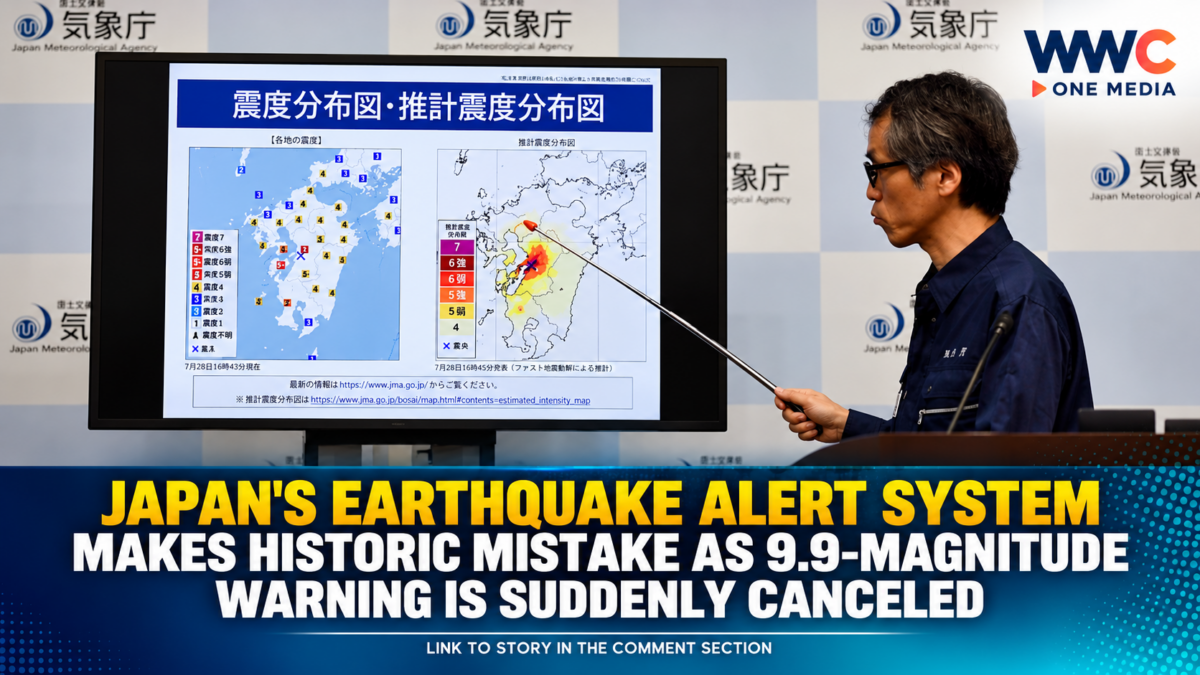
Japan has withdrawn an alarming earthquake warning that mistakenly indicated a magnitude 9.9 tremor, correcting an error that raised concerns in a country highly vulnerable to powerful earthquakes and tsunamis.
The incident has once again highlighted the importance of accurate and timely emergency alerts in Japan, where earthquake early-warning systems play a critical role in protecting millions of people.
Although earthquake alerts are designed to give residents precious seconds to prepare before strong shaking arrives, incorrect information can create unnecessary fear and confusion, particularly when it involves an earthquake of potentially catastrophic magnitude.
The Japan Meteorological Agency (JMA) issued the emergency warning at 12:40 p.m. on October 16, alerting a wide area stretching from Hokkaido to central Japan. The announcement prompted emergency notifications on mobile phones and public warning systems, with residents being advised to prepare for potentially severe shaking.
However, the warning was canceled at 12:48 p.m., just eight minutes after it was issued.
Officials later clarified that the actual earthquake occurred near Russia’s Kamchatka Peninsula, with a magnitude of approximately 6.9. The tremor was also reported near the Kuril Islands, which are known in Japan as the Chishima Islands. It was felt lightly in Hakodate, Hokkaido, where a seismic intensity of 1 was recorded. No tsunami warning or advisory was issued.
Incorrect Earthquake Calculations Triggered the False Alarm
The JMA explained that its earthquake early-warning processing system incorrectly estimated the earthquake’s location and magnitude, resulting in an extraordinary reading of 9.9.
Further investigation revealed that the problem involved the agency’s calculations for an earthquake occurring far from Japan. According to the agency’s subsequent explanation, the system failed to properly apply a restriction involving observation points located more than 700 kilometers from the estimated epicenter.
The agency also explained that the estimated epicenter used to calculate the earthquake’s magnitude differed from the location used to predict shaking intensity. This contributed to the unusually high estimate and the widespread warning.
Officials said the precise technical cause was still being investigated. The agency apologized publicly for the confusion and inconvenience caused by the erroneous alert.
Japan’s Emergency Warning System Faces Unusual Setback
The incident was particularly significant because it marked the first time Japan’s Meteorological Agency had canceled an emergency earthquake warning after issuing one.
Although the country has previously withdrawn certain earthquake forecasts, the cancellation of an official emergency warning was unprecedented.
The false alert also had consequences beyond mobile phone notifications. Reports indicated that public transportation was temporarily disrupted as safety procedures were activated.
Japan’s Tokaido Shinkansen also temporarily stopped operating after the warning triggered emergency safety measures, according to Japanese television reports.
Why a Magnitude 9.9 Earthquake Would Have Been Catastrophic
The mistaken magnitude was particularly alarming because a 9.9 earthquake would exceed the strongest earthquake ever instrumentally recorded.
The 1960 Valdivia earthquake in Chile, which registered magnitude 9.5, remains the largest recorded earthquake in history.
Japan also remains deeply affected by the devastating magnitude 9.0 earthquake that struck northeastern Japan in March 2011. The disaster triggered a massive tsunami, killed or left missing approximately 18,500 people, and caused the Fukushima Daiichi nuclear disaster.
The country’s experience with major earthquakes explains why emergency warnings are taken extremely seriously, even when they provide only a few seconds of advance notice.
JMA Rules Out Cyberattack as Investigation Continues
Following the incident, the agency also addressed concerns that an external cyberattack might have compromised its warning system.
Officials said there was no indication of a cyberattack and that the problem appeared to involve the earthquake information-processing system.
The agency is continuing to investigate why the system produced such an inaccurate estimate and what improvements may be necessary to prevent a similar incident.
The episode has raised important questions about the reliability of automated disaster-warning technology, particularly in a country where accurate information can make a critical difference during an emergency.
Japan’s earthquake early-warning system remains an essential part of its disaster preparedness strategy. However, the incident demonstrates that even sophisticated warning technology requires rigorous monitoring, accurate calculations and continuous improvements.
For residents, the challenge is maintaining confidence in emergency alerts while ensuring that future warnings remain accurate enough to support rapid and potentially life-saving decisions.