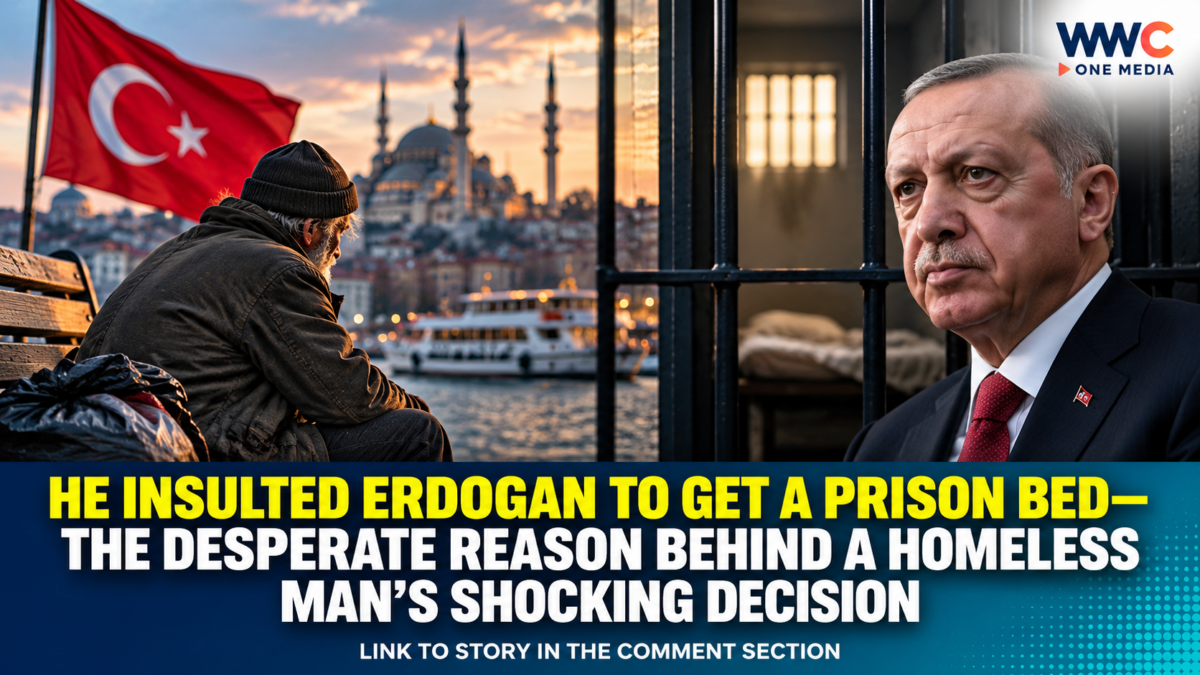
A 66-year-old homeless man in Turkey reportedly took an extraordinary step to escape life on the streets: he deliberately insulted President Recep Tayyip Erdoğan in the hope of being sent to prison, where he could obtain food and a place to sleep.
The man, identified only by the initials R.K., was detained in a park in Alanya, a resort city in Turkey’s southern Antalya province. According to Turkish newspaper Sözcü, he was subsequently ordered held in pretrial detention on a charge of insulting the president. The case was reported by Agence France-Presse (AFP) and other international news outlets on October 16, 2026.
“I have nowhere to stay, I sleep in rubbish dumps. That is why I did it,” the man reportedly told the court.
His statement offers a stark glimpse into the desperation of someone who says he has nowhere to go and sees detention as a possible source of basic necessities.
FOUR ATTEMPTS TO GET INTO JAIL
According to Sözcü, R.K. had reportedly been detained three times previously over similar allegations, but those incidents had not resulted in his placement in pretrial detention. The fourth attempt, however, led to a judge ordering him held pending trial.
The reported circumstances have prompted broader questions about homelessness, access to basic services and the consequences of criminalizing insults against political leaders.
Although the man’s account does not establish the full extent of his circumstances, his reported decision highlights the severity of the situation he described: sleeping in rubbish dumps and lacking a stable place to stay.
TURKEY’S PRESIDENTIAL INSULT LAW UNDER SCRUTINY
The case also draws attention to Article 299 of Turkey’s Penal Code, which criminalizes insulting the president.
Under the provision, the offense carries a potential prison sentence of one to four years. The punishment may be increased when the offense is committed publicly.
According to AFP reporting carried by The Straits Times and Turkish news outlet Turkish Minute, Turkish authorities have pursued thousands of cases involving alleged insults against Erdoğan. Those targeted have included journalists, teenagers and a former Miss Turkey.
The provision has become a recurring source of controversy among press freedom advocates and government critics, who argue that it can be used to restrict legitimate criticism of those in power.
NEARLY 83,000 CASES INVOLVING STATE-RELATED OFFENSES
Statistics from Turkey’s Justice Ministry, cited in the AFP report, indicate that prosecutors opened nearly 83,000 cases between 2016 and the end of 2025 under Articles 299 to 301 of the Turkish Penal Code.
These provisions cover several offenses, including insulting the president, denigrating national symbols and insulting the Turkish nation or state institutions. The figure therefore should not be interpreted as representing cases exclusively involving insults against Erdoğan.
Reports have also noted a significant increase in the use of the presidential-insult provision following Turkey’s transition to an executive presidential system in 2018.
The figures add context to the legal environment surrounding R.K.’s case, although they do not establish the specific reasons for his detention beyond the reported allegation.
A CASE THAT GOES BEYOND POLITICS
The story raises a difficult question: What does it say about a society when a person reportedly considers imprisonment preferable to sleeping outdoors?
For people experiencing homelessness, access to shelter, food, sanitation and social assistance can be critical to survival. When those necessities appear out of reach, desperate decisions may follow.
R.K.’s reported actions also illustrate how a law intended to protect the dignity of the presidency can intersect with a deeply personal struggle for survival. The case does not, by itself, establish the scale of Turkey’s homelessness problem or prove that prison conditions are generally better than life on the streets.
What it does reveal is the extraordinary choice the man said he made—and the questions it raises about poverty, public assistance and freedom of expression.
As the legal proceedings move forward, the circumstances surrounding his detention serve as a reminder that the issues behind a headline can extend far beyond the courtroom.