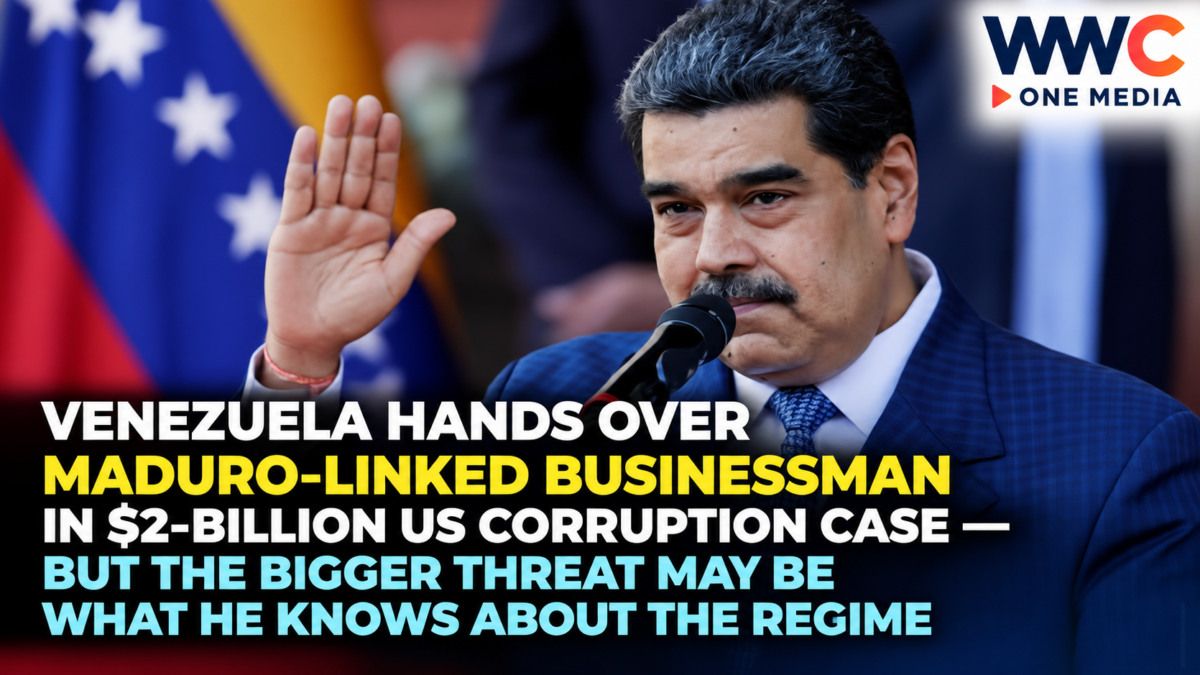
MIAMI, United States — October 14, 2026 — A businessman with longstanding ties to Venezuela’s former ruling elite has been transferred into US custody to face federal corruption and money-laundering charges involving government contracts worth billions of dollars, marking another major development in Washington’s effort to investigate alleged financial networks associated with ousted President Nicolás Maduro.
Álvaro Pulido Vargas, a 62-year-old Colombian-born businessman who also holds Venezuelan citizenship, is accused of participating in schemes involving food, medicine and low-income housing programs intended to help ordinary Venezuelans.
The US Department of Justice confirmed on October 11 that Pulido had been taken into custody following an investigation involving the Drug Enforcement Administration, Federal Bureau of Investigation and Homeland Security Investigations.
He was scheduled to make his first appearance before a federal court in Miami on October 13.
According to US prosecutors, Pulido and his alleged associates secured approximately $1.6 billion in government contracts through Venezuela’s CLAP food-distribution program and participated in a separate scheme involving approximately $350 million in alleged money laundering connected to public housing.
The transfer carries major political implications because Pulido was a longtime business partner of Alex Saab, the former Maduro ally who pleaded guilty to a US money-laundering charge in September and agreed to cooperate with American investigators.
The development also comes as Venezuela’s acting President Delcy Rodríguez strengthens cooperation with President Donald Trump’s administration following Maduro’s capture by US forces in January.
But while Pulido’s arrival in Miami puts another Maduro-linked businessman before American prosecutors, the bigger question is whether the case could expose a wider financial network involving former ministers, government contractors and influential figures from Venezuela’s previous leadership.
Who Is Álvaro Pulido Vargas?
Álvaro Pulido Vargas is a Colombian-born businessman who spent years operating in Venezuela and developing commercial relationships linked to government contracts.
He has also been identified as Germán Enrique Rubio Salas, an alias cited in US criminal proceedings.
According to Bloomberg, Pulido was convicted of drug trafficking in Italy in 1997 under that name.
He later became associated with major Venezuelan government procurement arrangements.
His business activities drew increasing attention from US investigators examining alleged corruption involving public contracts, financial transfers and politically connected intermediaries.
Pulido was indicted in the United States in 2019 and again in 2021.
He was detained in Venezuela in 2023 amid a broader investigation involving corruption at state oil company Petróleos de Venezuela, commonly known as PDVSA.
Before entering US custody, Pulido had been held at a prison outside Caracas, according to Bloomberg reporting.
His latest detention represents the culmination of years of investigations by American law enforcement agencies.
However, his earlier conviction in Italy is legally separate from the US corruption and money-laundering allegations now before the federal court.
US Prosecutors Allege $1.6 Billion in Food and Medicine Contract Fraud
One of the most significant cases involves Venezuela’s CLAP program.
CLAP stands for Comité Local de Abastecimiento y Producción, a government-controlled system established to distribute essential goods, particularly food, to vulnerable households.
The program became especially important as Venezuela struggled with widespread shortages, inflation and economic collapse.
According to the US Department of Justice, Pulido and four alleged associates secured approximately $1.6 billion in government contracts through the program between 2015 and 2020.
Prosecutors allege that the defendants paid bribes to Venezuelan officials to obtain contracts and inflated prices to generate money for those bribes and personal enrichment.
They also allegedly transferred funds through financial accounts in several countries.
The Justice Department identified Antigua, the United Arab Emirates and the United States among the jurisdictions involved in the alleged money flows.
Approximately $180 million was allegedly transferred through or into US financial accounts, including accounts in southern Florida.
These allegations raise serious concerns about whether programs intended to provide food and medicine were used as vehicles for private financial gain.
However, the $1.6-billion figure represents the approximate value of contracts obtained under the alleged scheme, not a judicial finding that the entire amount was stolen.
The distinction is important when reporting the scale of the allegations.
Separate $350-Million Housing Scheme Involves Alex Saab
Pulido also faces charges connected to a separate alleged money-laundering scheme involving Alex Saab.
According to the Justice Department’s 2019 indictment, Pulido and Saab obtained a government contract to build low-income housing in Venezuela.
Prosecutors allege that the defendants exploited Venezuela’s tightly controlled currency exchange system by submitting fraudulent import documents.
Those documents allegedly described construction materials or other goods that were never actually imported into the country.
The defendants then allegedly bribed Venezuelan officials to approve the transactions.
US authorities contend that approximately $350 million was transferred out of Venezuela through American bank accounts and into overseas accounts controlled by the alleged participants.
The case involves accusations of money laundering, bribery and fraudulent use of government-related financial arrangements.
The alleged misconduct is particularly sensitive because it concerns housing intended for lower-income Venezuelans.
However, the $350-million figure refers to allegedly laundered funds and is not identical to the value of the contracts described in the CLAP case.
The two figures should not be combined and described as a single proven theft from the Venezuelan treasury.
The Financial Allegations: What the Numbers Actually Mean
The two criminal cases involve substantial sums, but the figures measure different things.
| Financial detail | Amount | What it represents |
|---|---|---|
| CLAP-related government contracts | Approximately $1.6 billion | Contracts allegedly obtained through bribery and inflated pricing |
| CLAP-related transfers involving US accounts | Approximately $180 million | Alleged financial transfers linked to the CLAP scheme |
| Separate housing-related money laundering | Approximately $350 million | Funds prosecutors allege were moved through the US and overseas accounts |
| Previously offered reward | Up to $10 million | US reward for information leading to Pulido’s arrest |
The amounts come from US prosecutorial allegations and related official announcements.
They have not all been established as criminal proceeds through a final verdict against Pulido.
Nor should the $180 million be added to the $1.6 billion as though it represented an entirely separate pool of money.
The financial details demonstrate why the prosecution is significant, but careful reporting is necessary to distinguish government contract values, alleged transfers and potential criminal proceeds.
Alex Saab’s Guilty Plea Changes the Stakes
Pulido’s arrival in US custody follows a major development involving his longtime business partner.
On September 15, Alex Saab pleaded guilty in Miami to one count of conspiracy to commit money laundering.
According to Reuters, Saab agreed to forfeit $195 million and cooperate with the US Department of Justice.
The court records available in that reporting did not identify all the investigations in which Saab might provide assistance.
Saab had been a prominent figure within Maduro’s circle and previously served in the Venezuelan government.
His return to the United States in May 2026 marked a major shift in Venezuela’s relationship with Washington.
The guilty plea increases interest in Pulido’s case because the two men were allegedly involved in overlapping financial arrangements.
However, Saab’s plea does not automatically establish Pulido’s guilt.
Prosecutors must independently prove the charges against Pulido unless he chooses to resolve the case through an agreement with the government.
There is also no verified announcement that Pulido has entered a plea agreement or committed to assisting US investigators.
Venezuela’s Acting President Delcy Rodríguez Deepens Cooperation With Washington
Pulido’s transfer is politically significant because it occurred under the government of acting President Delcy Rodríguez.
Rodríguez assumed leadership after US forces captured Nicolás Maduro in January 2026.
Since then, Caracas and Washington have pursued closer cooperation on selected security, financial and economic matters.
The transfer of individuals wanted by US authorities has become one of the most visible examples of that changing relationship.
Bloomberg reported that Pulido was at least the second person sent from Venezuela to the United States in October and the third during 2026.
The handovers suggest that Venezuela’s new leadership is willing to take actions that would have been politically sensitive under the previous government.
However, the exact terms of the arrangements have not been fully disclosed.
Neither Washington nor Caracas has publicly provided a comprehensive explanation of how Pulido’s transfer was negotiated.
The move therefore demonstrates cooperation but does not establish that Venezuela has agreed to surrender every individual sought by US investigators.
Why Pulido’s Venezuelan Citizenship Creates a Legal Question
One of the most consequential unresolved issues involves Venezuela’s constitution.
Article 69 of the Venezuelan Constitution prohibits the extradition of Venezuelan nationals.
Pulido was born in Colombia but reportedly acquired Venezuelan citizenship.
That creates questions about the legal mechanism used to move him into US custody.
According to Bloomberg, Venezuelan authorities had previously examined ways to annul Alex Saab’s Venezuelan citizenship before transferring him.
Authorities later said Saab’s citizenship had been obtained unlawfully.
It remains unclear whether comparable steps were taken in Pulido’s case.
US officials confirmed that he was in American custody, but they did not disclose exactly how he left Venezuela.
This distinction is central to the story.
The confirmed fact is that Pulido entered US custody.
Whether his transfer legally constituted extradition, deportation, expulsion or another form of surrender has not been established through publicly available official documentation.
For Venezuela, the issue could become important in future legal and political challenges.
US Justice Department Highlights International Corruption Investigation
US Attorney General Todd Blanche publicly welcomed the arrest.
In the Justice Department’s October 11 announcement, federal prosecutors accused Pulido and his alleged associates of exploiting programs intended to deliver essential goods to Venezuelan citizens.
The investigation involved multiple US agencies.
The DEA, FBI and Homeland Security Investigations worked together to secure Pulido’s custody.
Federal prosecutors in the Southern District of Florida are handling the cases.
The indictments involve money-laundering conspiracy and substantive money-laundering counts.
According to the Justice Department, the five counts in the 2021 case each carry a statutory maximum sentence of 20 years.
The 2019 indictment contains a separate conspiracy count and seven additional money-laundering counts.
The maximum penalties are potential statutory outcomes, not a sentence already imposed.
If convicted, any actual punishment would depend on the charges proven, sentencing rules and judicial decisions.
The Justice Department emphasizes that indictments are allegations and defendants are presumed innocent unless proven guilty beyond a reasonable doubt.
US Authorities Had Offered a $10-Million Reward
Pulido had been wanted by US authorities for several years.
The US government previously offered a reward of up to $10 million for information leading to his arrest.
The reward reflected the priority investigators placed on locating him and bringing him before American courts.
However, the announcement that Pulido is in custody does not establish that anyone received the reward.
Reward payments, when applicable, depend on government criteria and decisions.
The figure should therefore not be described as money already paid to an informant or law enforcement partner.
Why the Corruption Case Matters to Ordinary Venezuelans
The alleged schemes involve essential government services.
Food, medicine and housing programs are particularly important in a country that has experienced years of economic crisis, shortages and mass migration.
When government procurement systems are affected by bribery or inflated pricing, public resources may be diverted away from their intended purposes.
Such conduct can undermine confidence in public institutions and weaken services for vulnerable communities.
However, investigators must distinguish between alleged financial misconduct and the actual effect on specific beneficiaries.
The available indictments describe corruption and money-laundering allegations, but they do not independently establish how many individual households were deprived of food, medicine or housing because of Pulido’s alleged actions.
The broader concern is whether Venezuela’s public procurement system had sufficient safeguards to prevent politically connected contractors from exploiting state spending.
Could the Case Lead to More Arrests?
Pulido’s transfer has renewed attention on other figures associated with Venezuela’s former political and financial leadership.
Bloomberg identified former oil minister Tareck El Aissami and former Supreme Court chief justice Maikel Moreno among individuals sought by US authorities.
El Aissami has been detained in Venezuela since 2024.
The movement of Pulido and Saab into US custody has prompted speculation that more individuals could eventually face proceedings abroad.
However, there has been no verified announcement that either man has been scheduled for transfer to the United States.
Nor does Pulido’s detention establish that a new wave of arrests has already been authorized.
Future developments will depend on the legal status of each case, the evidence available and the decisions of Venezuelan and American authorities.
Maduro Faces His Own US Criminal Proceedings
The corruption investigation is unfolding alongside the prosecution of former Venezuelan President Nicolás Maduro.
Maduro and his wife, Cilia Flores, have been held in US custody since January.
On October 8, Reuters reported that American prosecutors had added allegations concerning the torture of political opponents and American citizens.
Those charges were added to earlier criminal accusations.
Maduro and Flores previously pleaded not guilty to the original charges.
The proceedings raise questions about alleged abuses of power during Maduro’s presidency, but the allegations must still be examined by the courts.
Their trial is scheduled for 2027.
The Pulido and Saab cases are legally distinct from Maduro’s criminal proceedings.
Nevertheless, they concern financial and political networks associated with the former Venezuelan administration.
That overlapping context explains why investigators and political observers are closely watching the latest custody transfer.
Venezuela’s Oil Industry Adds Another Layer to US Relations
The closer relationship between Caracas and Washington extends beyond criminal investigations.
Venezuela possesses major petroleum resources, and its oil industry has experienced prolonged financial, operational and political difficulties.
The Rodríguez administration has been seeking new investment and greater international economic engagement.
The United States has also shown interest in expanding commercial involvement in Venezuelan energy production.
These economic interests create an important political backdrop to the recent law-enforcement cooperation.
The transfer of Maduro-linked individuals could become one element of a broader realignment between the two governments.
However, the available reporting does not establish that Pulido was handed over in direct exchange for a specific oil contract, sanctions concession or financial payment.
Such a claim would require separate documentary evidence.
Is Venezuela Trying to Distance Itself From Maduro’s Inner Circle?
The emerging pattern has important political implications inside Venezuela.
The Rodríguez administration remains connected to the country’s long-established socialist political movement.
Yet it has been cooperating with US authorities in cases involving figures previously associated with the Maduro government.
That creates questions about how the current leadership intends to manage the political legacy of the previous administration.
Some observers see the transfers as evidence of a deliberate attempt to establish a new relationship with Washington.
Others remain skeptical about whether the measures represent lasting institutional reform.
Handing over individual suspects does not automatically prove that corruption has been eliminated from the government.
The deeper test will be whether financial transparency, independent investigations and legal accountability improve within Venezuela itself.
Why the Case Matters for International Banking
The indictments also show how alleged corruption in one country can become a criminal matter in another.
US prosecutors contend that financial transactions connected to Venezuelan government contracts moved through American banks and international accounts.
Those transactions provide part of the basis for US money-laundering charges.
The cases highlight the importance of anti-money-laundering controls in international banking.
Financial institutions are expected to monitor suspicious transactions and apply appropriate due diligence to higher-risk activities.
Payments involving government procurement, politically exposed persons and complicated offshore structures may require particular scrutiny.
However, the use of an American or foreign bank account in an alleged scheme does not automatically establish that the bank itself participated knowingly in criminal activity.
Individual institutional responsibility requires separate evidence and legal analysis.
What International Investors Should Watch
The latest development is relevant to investors examining Venezuela’s potential economic reopening.
Greater cooperation with international authorities could influence perceptions of governance and political risk.
However, Venezuela continues to face significant challenges involving legal certainty, public finances, infrastructure and investor confidence.
The Pulido case also demonstrates how unresolved historical financial transactions can create long-term legal exposure.
Investors entering emerging markets often evaluate beneficial ownership, politically connected intermediaries and the integrity of public contracts.
Strong compliance procedures are especially important where government procurement and natural-resource industries are involved.
The case offers a reminder that legal and reputational risks can continue long after the original business arrangements have ended.
What Happens Next for Álvaro Pulido?
Several issues will determine the next stage of the proceedings.
Court process: Pulido must respond to the two federal indictments, with future hearings determining the progress of the cases.
Defense position: His attorneys may challenge evidence, procedural matters or legal arguments advanced by prosecutors.
Potential cooperation: Investigators may seek information about the broader financial network, but no cooperation agreement by Pulido has been confirmed.
Financial evidence: Prosecutors must establish the alleged money flows, criminal intent and relationship to the charged offenses.
Venezuela’s role: Authorities have not fully explained the legal process through which Pulido left Venezuela.
Other investigations: Additional cases involving former Venezuelan officials may proceed independently.
The Justice Department’s October 11 release confirmed his scheduled appearance on October 13, but the reporting reviewed does not independently establish the detailed outcome of that hearing.
It would therefore be premature to report that he pleaded guilty, made admissions or agreed to testify.
The Bigger Question: What Could Pulido’s Case Reveal About Maduro-Era Finances?
Pulido’s arrival in US custody marks another major moment in the investigation of alleged corruption involving Venezuela’s former ruling elite.
American prosecutors accuse him of participating in complex financial schemes that exploited public procurement contracts for essential goods.
The allegations involve approximately $1.6 billion in food and medicine contracts and a separate $350-million housing-related money-laundering case.
His longtime associate Alex Saab has already pleaded guilty and agreed to cooperate with the Justice Department.
Meanwhile, Venezuela’s acting government is developing a closer relationship with Washington, raising questions about whether other politically connected individuals could eventually be transferred.
But the case is far from resolved.
Pulido is entitled to contest the charges, and prosecutors must establish his guilt through the legal process.
The wider political implications will depend on the evidence introduced, any future testimony and the willingness of both governments to pursue additional cases.
Venezuela has placed another Maduro-linked businessman in the hands of American prosecutors — but the biggest story may be what comes next: whether the investigation stops with Pulido and Saab, or exposes a much larger financial network that once operated close to the center of power in Caracas.