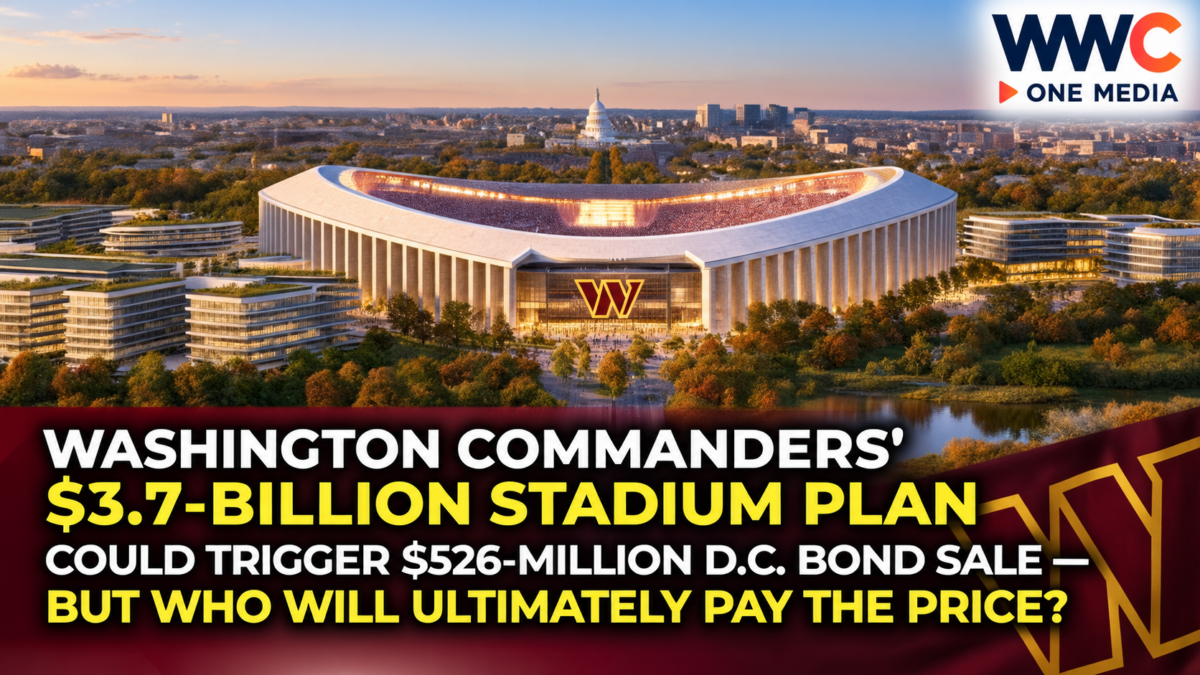
WASHINGTON, D.C. — October 14, 2026 — The Washington Commanders’ ambitious return to the nation’s capital is moving toward a major financial milestone as District officials consider issuing approximately $526 million in municipal bonds to support infrastructure surrounding the NFL franchise’s planned new stadium.
The proposed financing, disclosed in an October 9 securities notice and reported by Bloomberg on October 12, would help fund the transformation of the former Robert F. Kennedy Memorial Stadium site into a modern sports and entertainment destination.
According to the District of Columbia’s official investor notice, authorities are evaluating a potential $525.905-million Sports Facilities Fee Revenue Bond offering, with Goldman Sachs and Loop Capital Markets leading the underwriting syndicate.
The money would support infrastructure required for the stadium project, rather than represent the entire cost of building the venue.
The stadium itself is planned as an approximately 65,000-seat, enclosed facility on a 180-acre campus along the Anacostia River. The Commanders are targeting a 2030 opening.
But the project is also attracting questions about public financing, long-term debt obligations and whether the economic benefits promised by sports developments can justify their costs.
With Washington preparing to borrow hundreds of millions of dollars for one of its most ambitious redevelopment projects, the bigger question is whether a new NFL stadium will generate lasting economic growth — or leave the city facing financial obligations long after the opening celebration.
Washington, D.C., Considers $525.9-Million Municipal Bond Offering
The District’s October 9 disclosure identifies a potential bond offering with a preliminary principal amount of $525,905,000.
The securities would be issued as Sports Facilities Fee Revenue Bonds, Series 2026, for the RFK Campus Infrastructure Project.
The financing is being evaluated through a negotiated sale led by Goldman Sachs & Co. and Loop Capital Markets.
According to the notice, the preliminary schedule includes publication of a bond offering document in early November, pricing in mid-November and settlement in December.
Proposed bond financing timetable
| Development | Preliminary schedule |
|---|---|
| Securities notice published | October 9, 2026 |
| Proposed bond principal | $525.905 million |
| Preliminary official statement | Week of November 2 |
| Expected bond pricing | Week of November 16 |
| Expected closing | Week of December 7 |
| Planned stadium opening | 2030 |
The dates are preliminary and subject to change.
The District has explicitly stated that it is evaluating the transaction, meaning the announcement should not be interpreted as confirmation that the bonds have already been sold.
Actual financing terms, including interest rates, maturities and repayment costs, will depend on the final offering documents and market conditions.
Why Washington Wants to Borrow Money for the Commanders Stadium
The proposed bonds are part of a larger public-private redevelopment agreement.
Under the original arrangement announced in 2025, the Commanders committed to investing at least $2.7 billion toward developing a new stadium and associated improvements.
The District agreed to contribute $500 million toward certain site and stadium infrastructure costs.
The public investment is intended to support work such as preparing the site, developing essential infrastructure and enabling stadium-related construction.
The city also established arrangements for parking facilities and other elements of the surrounding development.
The proposed $525.9-million principal amount should not be confused with a new $525.9-million stadium subsidy added on top of the previously announced $500-million infrastructure contribution.
Bond principal, project proceeds, financing expenses and the broader public funding commitment are related but different measures.
The final documents will clarify how the bond proceeds correspond to the authorized public infrastructure contribution.
What Are Municipal Bonds and How Would They Work?
Municipal bonds are debt securities issued by governments or authorized public bodies to raise money for public purposes.
Investors purchase the securities and receive interest and repayment according to the bond terms.
For Washington’s proposed stadium financing, the securities would be backed by a dedicated revenue source linked to the Sports Facilities Fee.
That fee was previously associated with financing Nationals Park, the home of Major League Baseball’s Washington Nationals.
The District intends to redirect eligible revenues toward the RFK Campus Infrastructure Fund after the earlier ballpark bonds were fully repaid during fiscal 2026.
This approach could allow Washington to finance infrastructure over time rather than paying the entire amount immediately.
However, borrowing is not free.
The District must meet debt-service obligations according to the financing agreement.
The economic impact will depend partly on the interest rate, repayment schedule and adequacy of the pledged revenue.
The bonds should not automatically be described as being repaid by all D.C. taxpayers equally.
Likewise, the use of dedicated business-related revenue does not mean the public financing has no economic opportunity cost.
Goldman Sachs and Loop Capital Will Lead the Potential Bond Sale
Goldman Sachs and Loop Capital Markets are expected to lead the underwriting syndicate.
Underwriters help issuers structure and market bonds to investors.
Their responsibilities may include advising on pricing, coordinating investor demand and arranging the distribution of securities.
The District plans a negotiated offering, which differs from a competitive bond sale in which underwriting firms submit bids under an auction-style process.
A negotiated sale can allow flexibility when a transaction involves specialized revenue streams or a complicated financing structure.
However, the final borrowing costs will depend on investor demand, credit assessments, financial-market conditions and the bonds’ terms.
The October 9 notice does not establish that Goldman Sachs or Loop Capital has already purchased the entire bond issue.
The planned underwriting arrangement is part of the contemplated transaction.
Commanders Plan a 65,000-Seat Stadium at Historic RFK Site
The Washington Commanders intend to build a modern enclosed stadium on the former RFK Stadium campus.
The venue is designed to accommodate approximately 65,000 spectators.
According to the team’s official August 2026 announcement, the stadium will cover roughly 1.8 million square feet.
The project includes a climate-controlled environment to support year-round use.
Beyond NFL games, the facility is expected to host concerts, public events and other large gatherings.
The Commanders selected a joint venture involving Clark Construction, Mortenson and Smoot Construction to lead the stadium’s construction.
The project represents a major development for a franchise that currently plays at Northwest Stadium in Landover, Maryland.
Returning to Washington would reconnect the Commanders with the area where they played for decades at RFK Stadium.
However, the announced opening date remains a target.
Construction schedules can change because of permitting, infrastructure requirements, labor conditions or other development risks.
A $3.7-Billion Stadium Project Could Anchor a Much Larger District
The new stadium is the centerpiece of a broader urban redevelopment strategy.
Washington officials intend to transform the roughly 180-acre RFK campus into a mixed-use neighborhood featuring residential buildings, parks, retail spaces, restaurants, entertainment facilities and public infrastructure.
Mayor Muriel Bowser has promoted the project as a way to strengthen economic activity and make better use of a major riverfront property.
A September 2026 master plan calls for as many as 6,500 homes, with approximately one-third designated as affordable housing.
The long-term redevelopment is intended to bring activity to the area beyond NFL game days.
For city planners, that distinction is important.
A stadium used mainly for home football games may generate relatively limited activity compared with a broader district attracting residents, businesses and visitors throughout the year.
The financial performance of the surrounding neighborhood could therefore become as important as the stadium itself.
Total RFK Campus Development Could Approach $8 Billion
The broader financial scale is significantly larger than the proposed bond issue.
An economic impact assessment commissioned for the RFK development estimated approximately $8 billion in total project costs.
That estimate consisted of roughly $3.2 billion for the stadium and $4.8 billion for the surrounding mixed-use development.
These figures describe a wider development scenario, not the amount Washington is proposing to borrow in November.
Different published totals refer to different project scopes.
Major project figures explained
| Project component | Reported figure |
|---|---|
| Potential 2026 municipal bond principal | $525.9 million |
| District infrastructure commitment | $500 million |
| Minimum team-led stadium investment | $2.7 billion |
| Stadium and public-private deal, commonly cited | Approximately $3.7 billion |
| Estimated broader stadium and mixed-use development | Approximately $8 billion |
| RFK campus size | 180 acres |
| Planned stadium capacity | Approximately 65,000 |
The estimates should not be added together to calculate a new grand total because some amounts overlap or represent different stages and categories of financing.
D.C. Council Approves $305 Million in Transit Improvements
The stadium’s financial implications extend beyond the immediate construction project.
On October 6, The Washington Post reported that the D.C. Council unanimously approved $305 million for public transportation improvements near the RFK campus.
Approximately $300 million was allocated to upgrades at the Stadium-Armory Metro station.
An additional $5 million was designated for initial planning and design of a proposed Gold Line bus connection to Union Station.
The investment aims to prepare transportation infrastructure for larger crowds once the stadium opens.
Transit capacity is important because a 65,000-seat stadium can create major transportation challenges before and after events.
Efficient public transportation may help reduce congestion and make the site more accessible to residents and visitors.
However, the $305-million transit package is a separate funding decision from the proposed $525.9-million stadium infrastructure bond offering.
Treating them as a single bond transaction would be misleading.
Their combined significance nevertheless highlights the wider public costs associated with large sports developments.
Mayor Muriel Bowser Bets on Jobs, Tourism and Economic Growth
Supporters of the project argue that the new stadium could stimulate development and help Washington diversify its economy.
The District has faced pressure from federal employment reductions and weakness in parts of the office property market.
A major mixed-use project could create construction employment and attract new businesses.
Stadium events could also generate spending on hotels, restaurants, retail and transportation.
The official economic impact assessment projects substantial activity associated with the venue and surrounding district over time.
It anticipates roughly 28 to 29 ticketed stadium events and more than 200 private events annually, with approximately 1.4 million attendees each year.
These are projections, not realized results.
Actual benefits will depend on event schedules, attendance, spending patterns and the pace of surrounding development.
For Washington, the challenge will be translating construction activity into sustainable economic and tax benefits.
Why Publicly Financed NFL Stadiums Remain Controversial
Professional sports stadiums have long generated debate about the use of public money.
Supporters argue that major venues can attract visitors, support local development and enhance a city’s profile.
Critics argue that publicly funded stadium projects may deliver fewer net economic benefits than promised.
One concern is that some stadium spending merely redirects money that residents would otherwise spend elsewhere in the same city.
Another is that construction jobs are temporary, while debt-service obligations can extend for many years.
Cities must also consider the value of alternative investments.
Money committed to stadium-related infrastructure could potentially support other public priorities, depending on the financing restrictions and available revenue.
That does not mean every stadium project is economically unjustified.
The outcome depends on the project structure, public contribution, private investment and actual economic performance.
Washington’s RFK redevelopment will ultimately be judged by how its benefits compare with its full public costs.
What Protections Does Washington Have Against Cost Overruns?
The redevelopment agreement includes provisions intended to limit the District’s financial exposure.
The city’s official announcement states that the Commanders will drive at least $2.7 billion in private investment.
Under the financing structure, the team is responsible for stadium construction costs and related overruns specified in the agreement.
The District’s contribution to the stadium budget is capped under the relevant legislation.
Separate limits apply to specified parking-related public contributions.
These provisions are intended to prevent some additional expenses from shifting directly to the city.
However, cost caps for the stadium do not eliminate every financial or economic risk associated with surrounding infrastructure, transportation, maintenance or public services.
The overall financial outcome will depend on adherence to the agreement and the performance of the redevelopment.
Washington’s Credit Rating Creates Another Consideration
Municipal bond investors will also examine Washington’s financial condition.
In April 2026, Moody’s revised the District’s issuer outlook from negative to stable while affirming its Aa1 issuer rating.
The agency noted that the city’s fiscal governance and budget management helped offset challenges involving federal workforce reductions and weakness in commercial real estate.
A strong general credit profile can support investor confidence.
However, the proposed Sports Facilities Fee bonds are a particular revenue-backed financing structure.
Their credit characteristics and investor protections must be evaluated using the final offering documents.
It would be inaccurate to assume that every bond issued by Washington automatically carries identical ratings, repayment security or investment risk.
Investors will need to assess the pledged revenue and the specific contractual terms.
What the New Stadium Means for the NFL
The Commanders’ proposed return to Washington represents one of the league’s most significant venue projects.
Modern NFL stadiums are increasingly designed as multipurpose entertainment facilities.
They often include premium hospitality areas, expanded food and beverage services, technology upgrades and year-round commercial uses.
The Commanders have also been developing plans for premium seating and related revenue opportunities.
In September, the team announced an expanded partnership with sports and entertainment agency Elevate to support its stadium sales and hospitality strategy.
These initiatives are important because stadium operators rely on more than ordinary ticket sales to generate revenue.
Premium seating, sponsorships, naming rights and non-football events may contribute to the overall business model.
However, the team has not established that these revenue sources will guarantee the District’s projected economic returns.
What Happens Before Construction Is Completed?
The proposed municipal bond financing is one step in a longer development process.
The District must finalize the transaction documents and determine whether market conditions are favorable for issuance.
Infrastructure planning and construction must also be coordinated with the stadium project.
At the same time, broader RFK campus redevelopment will proceed through planning, approvals and phased investment.
The National Capital Planning Commission has reviewed stadium-related plans as part of its federal planning responsibilities.
Because the site has historical significance, preservation and community considerations also form part of the wider development discussion.
The stadium’s targeted 2030 completion remains dependent on successfully coordinating these activities.
What Bond Investors Should Watch
For municipal bond investors, the key question is not simply whether the Commanders’ stadium will be popular.
It is whether the securities offer an appropriate relationship between yield, repayment security and risk.
Important considerations include the final interest rate, maturity schedule, coverage of debt-service payments and legal protections for bondholders.
Investors should also examine whether the bonds are tax-exempt or taxable under the final terms.
The October 9 notice is preliminary and does not constitute a final offer to purchase securities.
Anyone considering the bonds would need to review the official statement once available.
The proposed offering should not be interpreted as guaranteed to proceed on the preliminary timetable.
The Bigger Question: Will Washington’s Stadium Investment Pay Off?
The Washington Commanders’ stadium project represents a major opportunity for the District of Columbia.
A new enclosed NFL venue could help transform a large riverfront property into a destination for sports, entertainment, housing and business activity.
The team’s multibillion-dollar private commitment is substantial, and the broader redevelopment could create economic opportunities beyond football.
But the proposed $525.9-million municipal bond sale highlights an essential reality: large sports developments also involve public financial commitments.
The ultimate cost will depend on borrowing terms, infrastructure spending and the success of the development.
Washington must also balance the project against transportation needs, housing priorities and other public investments.
For Mayor Muriel Bowser and the Commanders, the ambition is clear.
They want to create a landmark stadium and new urban district that generate benefits long after the first game.
But the financial test will last much longer than one NFL season.
Washington is preparing to finance a new chapter in the Commanders’ history — but the bigger challenge is proving that hundreds of millions in public borrowing will create enough long-term value to justify the cost, rather than leaving future generations paying for a stadium whose economic promises fell short.