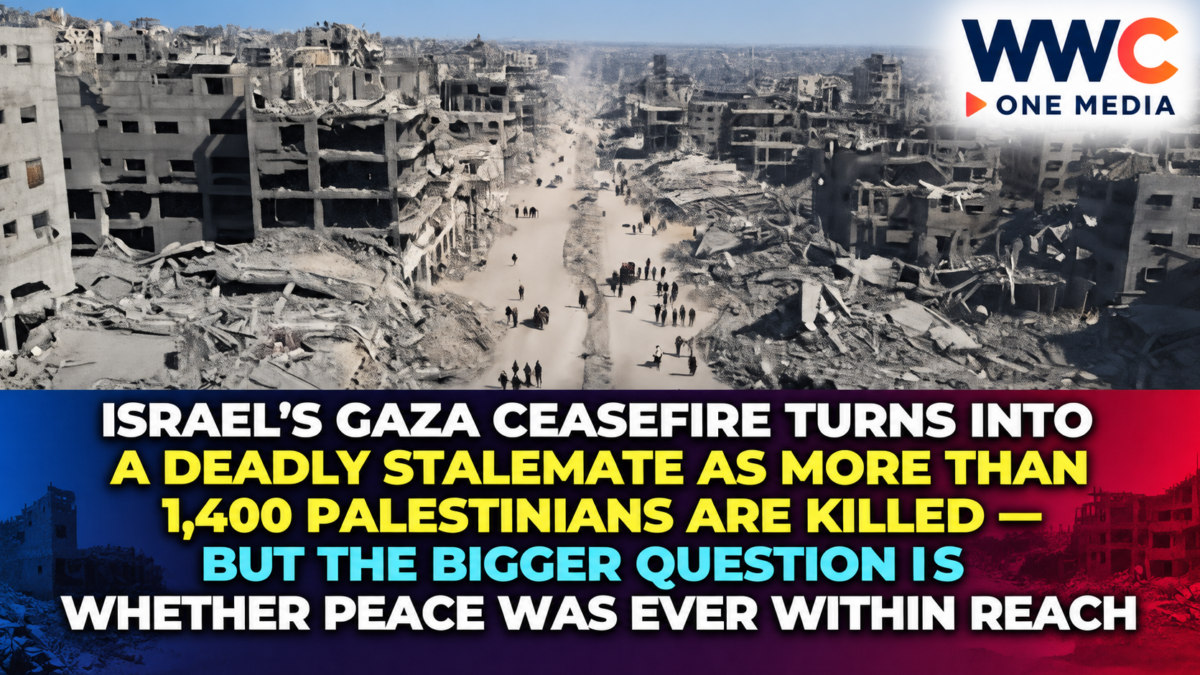
GAZA STRIP — A ceasefire intended to end one of the Middle East’s deadliest modern conflicts is facing a devastating reality: a year after the guns were supposed to fall silent, Palestinians in Gaza continue to die, entire neighborhoods remain in ruins, and the political agreement meant to deliver lasting peace is dangerously close to paralysis.
A Financial Times investigation published October 9 describes Israel’s continuing military campaign under the year-old truce as a scorched-earth approach, examining how military operations, demolitions and territorial control have continued despite the US-brokered agreement.
According to Reuters, more than 1,400 Palestinians have been killed in Gaza since the ceasefire took effect on October 10, 2025, citing Palestinian health authorities.
Israel maintains that its operations target Hamas militants and military infrastructure. However, the continued deaths of civilians, widespread destruction and prolonged occupation of much of the territory have raised serious questions about whether the ceasefire can evolve into a genuine peace settlement.
One year after the ceasefire, the death toll keeps rising
GAZA CRISIS | OCTOBER 2026
1,471
Reported deaths since ceasefireGaza Health Ministry, reported Oct. 8
5,189
Reported injuries since ceasefireGaza Health Ministry, reported Oct. 8
~2/3
Territory under Israeli military controlReuters, Oct. 6
$71.4B
Estimated recovery and reconstruction needsReuters, Oct. 6
Casualty figures are reported by Gaza’s Health Ministry and were not independently verified here. Territorial control and reconstruction estimates are approximate.
The figures present a grim contrast with the optimism that accompanied the original ceasefire agreement.
The deal, negotiated under US President Donald Trump’s peace initiative, secured the release of remaining Israeli hostages and Palestinian prisoners and detainees, along with increased humanitarian access.
But other critical promises have remained unfulfilled.
Israeli military operations continue. Hamas has not completed disarmament. Israeli troops remain in large parts of Gaza. And major reconstruction projects have barely begun.
The result is an increasingly unstable situation in which the formal existence of a ceasefire has not translated into safety for millions of Palestinian civilians.
Satellite images reveal extensive destruction across Gaza
New satellite imagery examined by the Associated Press shows the enormous physical transformation of the Gaza Strip.
Rafah, once home to approximately 250,000 residents, has been almost entirely flattened. Other communities in Israeli-controlled areas have also been demolished or cleared.
The investigation documented at least 50 Israeli military outposts across parts of Gaza under Israeli control, including at least 18 constructed after the October 2025 ceasefire began.
The Israeli military argues that demolition operations are necessary to eliminate Hamas tunnels, weapons facilities and structures that could be used for attacks.
Critics, however, question whether the scale and continuation of the destruction can be justified by those security objectives.
Under international humanitarian law, military necessity does not permit unrestricted destruction of civilian property.
The AP findings add to mounting evidence that Gaza’s territorial and physical landscape is being reshaped while negotiations over its political future remain stalled.
Netanyahu refuses to withdraw until Hamas disarms
At the center of the political deadlock is a dispute over the sequence of disarmament and Israeli withdrawal.
Israeli Prime Minister Benjamin Netanyahu has maintained that Israeli forces will not leave Gaza until Hamas is fully disarmed.
Hamas, meanwhile, has expressed willingness to discuss arrangements for its weapons under international oversight but has resisted Israeli demands and insisted that withdrawal and the cessation of military operations are essential.
Reuters reports that the disagreement has blocked progress toward implementing the later stages of Trump’s peace initiative.
The proposed international stabilization force has not become operational in the manner envisioned by the plan, while arrangements for Gaza’s civilian administration remain incomplete.
Both sides accuse each other of failing to honor the agreement.
For Israeli authorities, preventing another Hamas attack remains a central security priority following the October 7, 2023, assault that killed approximately 1,200 people in Israel and resulted in 251 hostages being taken.
For Palestinians, the continued presence of Israeli forces and restrictions on rebuilding raise concerns that a supposedly temporary military arrangement could become indefinite.
Gaza’s reconstruction is trapped in political gridlock
The humanitarian crisis is being compounded by the almost complete paralysis of rebuilding efforts.
Reuters reported on October 6 that an estimated $71.4 billion would be needed for Gaza’s recovery and reconstruction, while an announced $2.45 billion fund covers only a fraction of that requirement.
The Washington Post reported on October 8 that the US-backed Board of Peace had approximately $280 million and numerous reconstruction projects prepared, but implementation remained obstructed by political and security disputes.
For more than two million Palestinians, that deadlock has immediate consequences.
Families remain in temporary shelters. Damaged hospitals struggle to meet medical needs. Sanitation systems are overwhelmed. Homes, schools, roads and commercial areas require extensive reconstruction.
A September 2026 United Nations report confirmed that violence had continued after the ceasefire, while much of the territory remained inaccessible or subject to severe restrictions.
The report also highlighted continuing casualties from Israeli operations and the danger posed by damaged infrastructure.
International pressure grows as the ceasefire loses credibility
The continuing violence has intensified scrutiny of the effectiveness of Washington’s diplomatic strategy.
Nikolay Mladenov, the official overseeing Trump’s Gaza ceasefire effort, publicly criticized ongoing Israeli strikes in September and urged meaningful implementation of the peace framework.
The dispute increasingly concerns more than whether individual attacks violate the agreement.
It raises fundamental questions about Gaza’s future governance, territorial control, demilitarization and the ability of displaced Palestinians to return to their communities.
A lasting agreement would require credible security arrangements for Israelis alongside meaningful civilian protection, political rights and reconstruction for Palestinians.
A conflict with consequences beyond Gaza
The unresolved war continues to affect Israel’s diplomatic relationships and the wider Middle East.
The United Kingdom and Israel are also experiencing increased diplomatic tensions over Israeli settlement policies in the occupied West Bank. An October 9 Associated Press report described Israel’s move to downgrade Britain’s diplomatic presence in east Jerusalem after London imposed restrictions on trade involving Israeli settlements
Such developments illustrate the wider diplomatic fallout of an increasingly entrenched Israeli-Palestinian conflict.
For governments across Asia, including the Philippines, the continued instability reinforces the importance of Middle East security, humanitarian access and diplomatic efforts to prevent renewed regional escalation.
The bigger picture: A ceasefire without peace
The first anniversary of the Gaza ceasefire presents a troubling contradiction.
The agreement produced significant initial results, including hostage releases and an end to the earlier phase of large-scale fighting.
Yet the fundamental issues behind the conflict remain unresolved.
Israel continues to insist that its security requirements must be met before withdrawal. Hamas remains armed. Reconstruction is stalled. Palestinians continue to face casualties, displacement and humanitarian hardship.
The Financial Times’ characterization of a scorched-earth ceasefire captures the severity of the destruction and the continuing military campaign, though the description is an analytical characterization rather than a judicial finding.
The central uncertainty now is whether renewed diplomacy can produce a workable agreement on disarmament, withdrawal, civilian governance and reconstruction.
A ceasefire can temporarily reduce the scale of war. But without enforceable commitments and a credible political settlement, it cannot guarantee peace.
And after another year of bloodshed, the people of Gaza remain caught between those two realities.