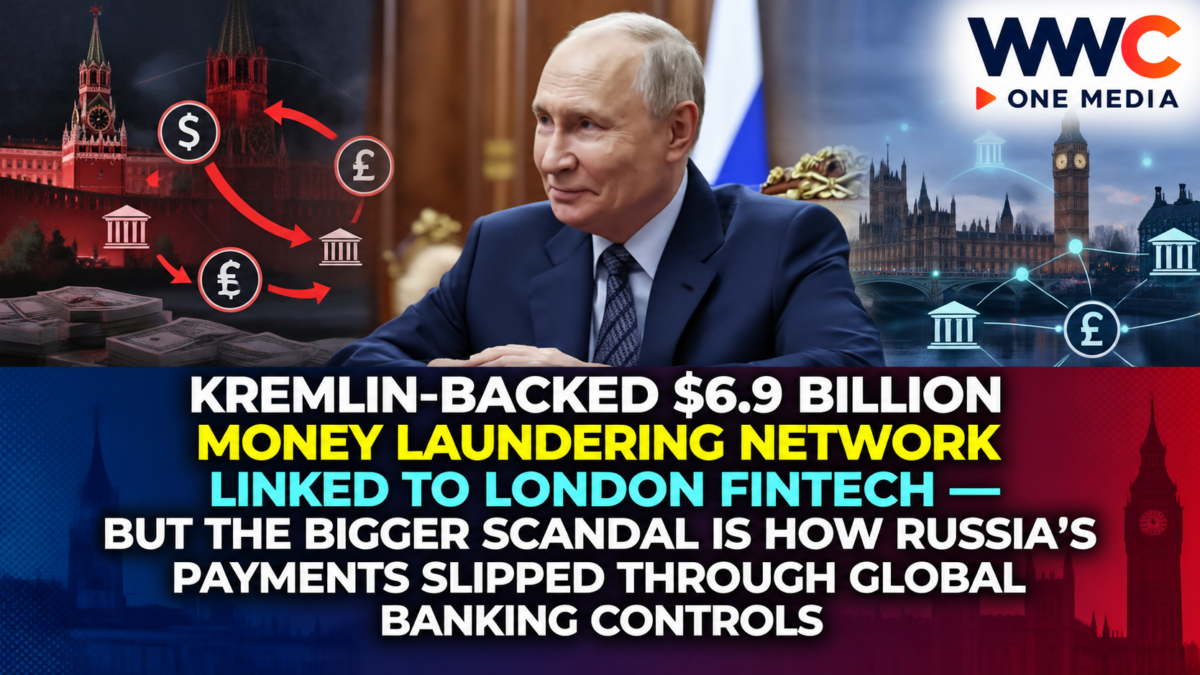
LONDON — A Kremlin-linked financial network accused of helping Russia evade Western sanctions has been connected to a London-based fintech company, exposing potentially troubling weaknesses in Britain’s financial oversight system and the global banking industry’s defenses against illicit money flows.
A Financial Times investigation published October 9 revealed that Wooshpay, a British fintech business operating through the company Swooshtransfer, appeared in documents linked to A7, a Russia-backed financial network accused of moving billions of dollars through international banking channels.
The investigation raises a sensitive question for British authorities: How did a financial network already attracting international sanctions scrutiny identify a UK-regulated fintech as a possible route for moving money overseas?
The Financial Times reported that documents associated with A7 described Wooshpay as a channel for payments in Chinese renminbi and US dollars to China and Hong Kong. An invoice referring to cashmere sewing fabric formed part of the evidence examined by the newspaper.
The revelations come as Western governments intensify efforts to disrupt financial operations allegedly helping Russia continue its war in Ukraine.
Crucially, the report’s findings should not be confused with a final legal determination that Wooshpay knowingly laundered money. The investigation raises questions about how the company’s services were used and the adequacy of controls intended to detect suspicious transactions.
London fintech caught in Russia’s sanctions-evasion controversy
Wooshpay’s appearance in A7-linked records places the company within a much larger controversy involving Russian financial intermediaries, overseas businesses and international banks.
According to the Financial Times, Wooshpay was identified in documents as having extensive payment capabilities. The investigation described a transaction of approximately $26,000 associated with the alleged payment arrangements.
The amount is relatively small compared with the billions of dollars connected to the wider A7 network, but its significance lies in the apparent use of financial infrastructure associated with a UK-regulated business.
Wooshpay’s regulatory status also matters. The investigation describes the business as registered with Britain’s Financial Conduct Authority, which oversees financial firms and payment businesses.
However, FCA registration or authorization should not be interpreted as a government guarantee that every transaction conducted through a business is legitimate.
The findings raise questions about customer identification, monitoring of payment flows and the ability to recognize front companies using misleading commercial documents.
The $6.9 billion operation behind the investigation
KEY FIGURES | A7 NETWORK INVESTIGATIONS
$6.9B+
Payments traced through global banks in the wider A7 investigation
~$26K
Specific transfer highlighted in Wooshpay-related reporting
~200
Front companies identified in leaked A7 records
268
Account-holding entities at Chinese bank identified in FT reporting
Figures come from separate FT investigations into A7. The $6.9 billion is a network-wide finding, not an amount attributed to Wooshpay.
The October 9 revelations build on earlier Financial Times reporting that traced more than $6.9 billion in payments through international banks using forged documents and complex corporate structures.
The A7 network was established to facilitate international payments involving Russia despite restrictions imposed after Moscow’s full-scale invasion of Ukraine in February 2022.
Investigators found evidence that front companies and existing businesses were used to create the appearance of legitimate commercial transactions.
The network reportedly relied on fabricated invoices, corporate documentation and overseas banking relationships to move money through established payment channels.
The Financial Times also identified transactions handled by major international financial institutions, including Standard Chartered and Citigroup.
The presence of such transactions in a bank’s systems does not, by itself, establish that the institution knowingly participated in sanctions evasion.
But the findings demonstrate how apparently routine business payments can obscure complex networks of beneficiaries and counterparties.
Chinese banking connections deepen the controversy
Another significant element of the Financial Times investigation involves Zhejiang Chouzhou Commercial Bank, a Chinese lender identified in documents associated with the A7 network.
According to the reporting, Wooshpay maintained accounts at the bank, which also handled activity involving numerous entities associated with the broader payment network.
The FT identified 268 account-holding entities at the Chinese lender, many of them non-resident businesses.
The arrangement highlights how complex financial networks can stretch across multiple jurisdictions, creating challenges for regulators attempting to determine who ultimately controls particular transactions.
The presence of accounts at the same bank does not establish criminal conduct by every account holder. However, concentrated activity involving high-risk counterparties can warrant enhanced anti-money-laundering scrutiny.
US Treasury targets A7 as a transnational criminal organization
The latest investigation follows a significant enforcement action by Washington.
On October 1, 2026, the US Treasury Department announced measures targeting A7, describing it as a Russia-linked shadow banking network used by Iran and other sanctioned actors.
The department’s Office of Foreign Assets Control designated the A7 network as a significant transnational criminal organization.
At the same time, the Financial Crimes Enforcement Network proposed restrictions on certain transactions involving the network’s sub-agents and issued guidance to help financial institutions identify suspicious activity.
US authorities allege that A7 is led by Ilan Shor, a sanctioned Moldovan businessman convicted of fraud, and uses controlled companies to disguise illicit payments as legitimate trade.
The Treasury also linked A7 to financial activity involving Iran’s Islamic Revolutionary Guard Corps and other sanctioned entities.
These are allegations and findings announced by US authorities, not proof that the London fintech identified in the FT investigation participated in those additional activities.
Britain had already moved against A7
The UK government also targeted A7 months before the latest Financial Times revelations.
On May 26, London announced sanctions designed to disrupt Russian cryptocurrency and financial networks accused of helping Moscow circumvent international restrictions.
Those measures specifically identified A7 and its exploitation of financial infrastructure in Kyrgyzstan.
Reuters reported that the British sanctions covered Russia-linked payment networks, cryptocurrency services and financial intermediaries accused of supporting sanctions evasion.
Then, on October 8, Britain announced another round of restrictions targeting 38 individuals and entities associated with Russian oil operations, military production and financial sanctions circumvention.
The successive measures show how authorities are expanding their response beyond conventional banks to payment intermediaries, digital assets and international commercial structures.
Why Britain’s financial reputation is at stake
London remains one of the world’s most important international financial centers.
Its role in banking, foreign exchange and cross-border payments makes it attractive to legitimate global businesses. But the same infrastructure can be targeted by sophisticated illicit finance networks.
The UK’s National Crime Agency has documented how Russian-speaking money laundering organizations have used international networks to move enormous sums of money.
In its 2026 assessment, the agency reported that Operation Destabilise, an investigation launched in 2022, had resulted in 129 arrests and more than £25 million seized in cash and cryptocurrency in Britain, alongside additional seizures overseas.
The agency also described links between certain money laundering operations, Russian state interests and attempts to evade international sanctions.
These findings relate to wider investigations and should not be interpreted as enforcement findings against Wooshpay.
The bigger danger: Payments that look legitimate
What makes the alleged A7 operation particularly concerning is its apparent reliance on ordinary commercial documentation.
Rather than depending solely on obscure cryptocurrency infrastructure or secretive offshore banking, the network allegedly used invoices, corporate structures and familiar payment channels.
That makes detection difficult.
A financial institution processing a cross-border payment may see a commercial invoice, a company name and a seemingly routine transaction.
But if the documentation is fabricated or the ultimate beneficiary concealed, the bank could unknowingly facilitate prohibited activity.
The Financial Times’ wider investigation therefore raises questions about whether traditional compliance controls can reliably identify coordinated networks using numerous intermediaries.
Britain’s financial services regulations require firms to maintain appropriate safeguards, but the effectiveness of those safeguards depends on implementation, due diligence and access to reliable information about customers and counterparties.
The bigger picture: Sanctions are only as strong as their weakest payment channels
The latest revelations illustrate a central difficulty confronting Western governments.
Sanctions can restrict a country’s access to financial markets, prohibit dealings with designated organizations and increase the cost of international transactions.
But determined networks may still seek alternative routes through third countries, payment businesses and companies that appear unrelated to sanctioned entities.
For London, the immediate question is whether existing supervision can identify and disrupt these arrangements before financial services are exploited.
For Washington and its allies, the challenge is ensuring that sanctions imposed on Russia and other targeted networks remain effective even as payment structures become more complex.
And for international businesses, the case reinforces the importance of verifying counterparties, understanding the actual commercial purpose of transactions and identifying who ultimately benefits from payments.
The scandal is not simply that a Kremlin-backed network allegedly moved billions through the international banking system. It is that apparently legitimate payment channels may have made portions of that activity possible.
The next test will be whether financial regulators can establish exactly what happened, determine whether any laws were broken and strengthen the systems designed to prevent similar activity.