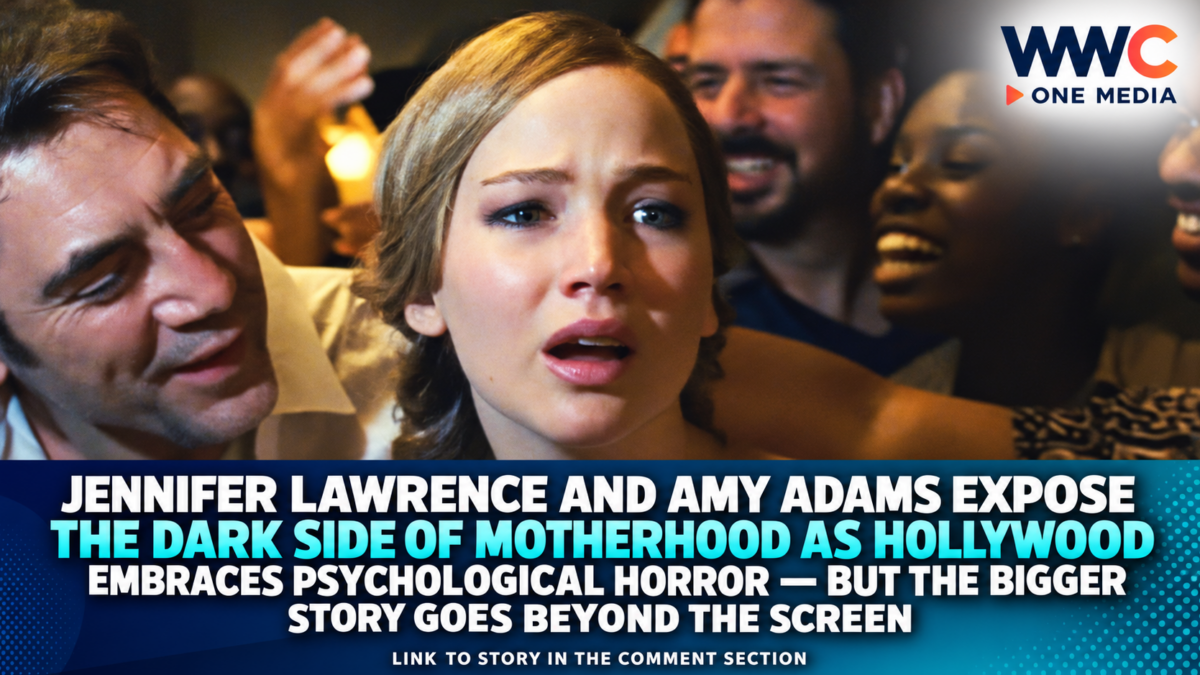
HOLLYWOOD, UNITED STATES — For decades, Hollywood has celebrated motherhood through sentimental stories of unconditional love, sacrifice and family happiness. But a growing collection of films is turning that familiar narrative upside down, depicting parenthood as an experience that can also bring anxiety, anger, isolation and a profound loss of personal identity.
At the center of the conversation are Die My Love starring Jennifer Lawrence and Nightbitch featuring Amy Adams.
Rather than presenting motherhood as an uncomplicated journey of fulfillment, the two films use psychological drama, surrealism and dark comedy to examine what happens when the demands of raising children collide with a woman’s emotional well-being.
The subject is the focus of a Bloomberg article published on October 9, 2026, examining how Hollywood is confronting the frightening and frequently overlooked experiences associated with new motherhood.
The larger cultural shift extends beyond these two productions. Films such as If I Had Legs I’d Kick You, starring Rose Byrne, have also brought maternal exhaustion and psychological distress into the spotlight.
Jennifer Lawrence confronts a psychological breakdown in Die My Love
Directed by acclaimed Scottish filmmaker Lynne Ramsay, Die My Love follows Grace, a young mother portrayed by Lawrence, whose emotional stability begins to deteriorate after moving with her partner Jackson, played by Robert Pattinson, to an isolated rural home.
The film is adapted from Argentine author Ariana Harwicz’s novel and premiered in competition at the 2025 Cannes Film Festival.
Grace’s initial excitement about building a family gradually gives way to frustration, emotional disconnection and increasingly unpredictable behavior.
Through disturbing imagery and fragmented storytelling, Ramsay explores the collapse of intimacy, creative ambition and personal freedom within a struggling relationship.
The film’s subject matter has prompted discussion of postpartum mental health. However, Ramsay has specifically resisted reducing the story to a clinical portrayal of postpartum depression, emphasizing instead the breakdown of love, sexual intimacy and a woman’s creative identity after childbirth.
That distinction is important: Grace’s behavior is fictional and should not be treated as a clinical representation of what most new mothers experience.
Critics have praised Lawrence’s physically demanding performance, even as some have questioned whether the film provides enough psychological depth to justify its extreme imagery.
TIME described Lawrence’s work as among the most complex of her career, while The Washington Post praised her acting but criticized aspects of the film’s treatment of its central character.
Amy Adams transforms into something terrifying in Nightbitch
If Die My Love portrays motherhood through emotional disintegration, Nightbitch takes an even more unusual route.
Directed by Marielle Heller and adapted from Rachel Yoder’s bestselling novel, the 2024 film follows an unnamed woman who abandons her career as an artist to become a stay-at-home mother.
Played by Amy Adams, the character struggles with exhaustion, repetitive domestic responsibilities and an increasing sense that her former identity has disappeared.
As her frustration intensifies, she begins to believe that she is physically transforming into a dog.
The bizarre premise provides a darkly comic metaphor for the powerful emotions that mothers may feel but often believe they are not permitted to express.
Speaking to the Associated Press during the film’s promotion, Adams and Heller discussed how their personal experiences of motherhood influenced the production.
Heller also connected the story to the unequal distribution of domestic responsibilities, particularly during the pandemic, when many families found themselves reconsidering traditional parenting roles.
The film ultimately asks whether society celebrates mothers while giving them insufficient space to remain individuals with their own aspirations, ambitions and emotional needs.
Rose Byrne pushes the conversation further
Another major entry in this wave of maternal psychological dramas is If I Had Legs I’d Kick You, directed by Mary Bronstein and starring Rose Byrne.
Released in 2025, the film follows Linda, a therapist struggling to care for her medically vulnerable daughter while dealing with an absent husband, a damaged apartment and increasingly overwhelming personal demands.
Rather than relying on supernatural transformation, Bronstein creates a frightening atmosphere through relentless everyday stress.
Critics have highlighted the film’s claustrophobic filmmaking and Byrne’s emotionally exhausting performance.
The Los Angeles Times described the film as an intense cinematic experience that immerses audiences in the perspective of a mother nearing emotional collapse.
Together, the three productions suggest a developing creative movement in which motherhood is portrayed not merely as a supporting element of family life but as an experience worthy of its own unsettling, complex stories.
The bigger reality: Postpartum depression affects millions of families
Although the films use exaggerated, sometimes frightening imagery, the concerns surrounding maternal mental health are grounded in a significant public-health issue.
According to the U.S. Centers for Disease Control and Prevention, approximately one in eight women with a recent live birth reported experiencing symptoms of postpartum depression in its surveillance research.
U.S. POSTPARTUM MENTAL HEALTH
1 in 8
Women with a recent live birth reported postpartum depressive symptoms in CDC research.
Historical U.S. surveillance estimate, not a 2026 global prevalence figure. Source: CDC.
Postpartum depression differs from ordinary short-lived mood changes following childbirth. Symptoms can include persistent sadness, severe anxiety, irritability, difficulty sleeping and challenges forming an emotional connection with a newborn.
In rare cases, postpartum psychosis may occur, involving symptoms such as delusions, hallucinations and severe confusion. It is a psychiatric emergency requiring urgent medical attention.
The National Institute of Mental Health emphasizes that perinatal depression is treatable and that appropriate medical support can help affected parents recover.
This medical context matters because the movies’ dramatic portrayals should not reinforce the misconception that mothers experiencing depression are inherently dangerous or incapable of loving their children.
Why Hollywood is abandoning the perfect-mother stereotype
The traditional portrayal of motherhood has often emphasized selflessness and emotional resilience.
But the recent films challenge the expectation that women should willingly surrender their careers, independence, ambitions and emotional needs without complaint.
In Nightbitch, the central character’s imaginary transformation into an animal becomes a metaphor for reclaiming a suppressed part of herself.
In Die My Love, the breakdown of a romantic relationship exposes how isolation and frustrated creative ambitions can intensify an already difficult transition to parenthood.
Meanwhile, If I Had Legs I’d Kick You examines what happens when a mother faces nearly constant responsibilities without sufficient emotional and practical assistance.
Although these movies differ significantly in tone and narrative approach, they share an underlying question: What happens when society expects mothers to care for everyone while overlooking their own need for care?
Critics remain divided over the unsettling portrayals
Hollywood’s willingness to embrace these subjects does not mean every portrayal has been universally praised.
Several critics have celebrated the performances of Lawrence, Adams and Byrne, highlighting their willingness to portray characters who are sometimes angry, resentful, exhausted or emotionally unpredictable.
Others have questioned whether the use of psychological horror risks turning genuine maternal distress into a disturbing spectacle.
The Washington Post, for example, argued that Die My Love does not sufficiently investigate its protagonist’s psychological circumstances, despite Lawrence’s powerful performance.
Meanwhile, Variety assessed Nightbitch as a more comforting and relatively straightforward allegory beneath its bizarre transformation premise.
These contrasting assessments highlight a difficult creative challenge: filmmakers want to confront uncomfortable subjects, but must also avoid reducing complex health conditions to entertainment.
The next Hollywood conversation could be even bigger
The emergence of these films points toward an expanding space for stories about the realities of parenthood.
They challenge audiences to think about how families distribute responsibilities, how women maintain their identities after giving birth, and why emotional support can become just as important as financial stability.
The stories also move mothers beyond the familiar Hollywood roles of endlessly nurturing caregiver or supporting character, making their complicated inner lives the central subject.
There is still no guarantee that this wave of films will lead to lasting changes in public attitudes or the entertainment industry.
But their willingness to depict frustration, exhaustion and emotional vulnerability could help make conversations about maternal well-being more visible.
For Hollywood, the horror is no longer necessarily a monster hiding in the darkness. Sometimes, it is the fear of losing yourself while everyone expects you to hold the family together.
And that may be the most provocative message behind Hollywood’s darker portraits of motherhood.