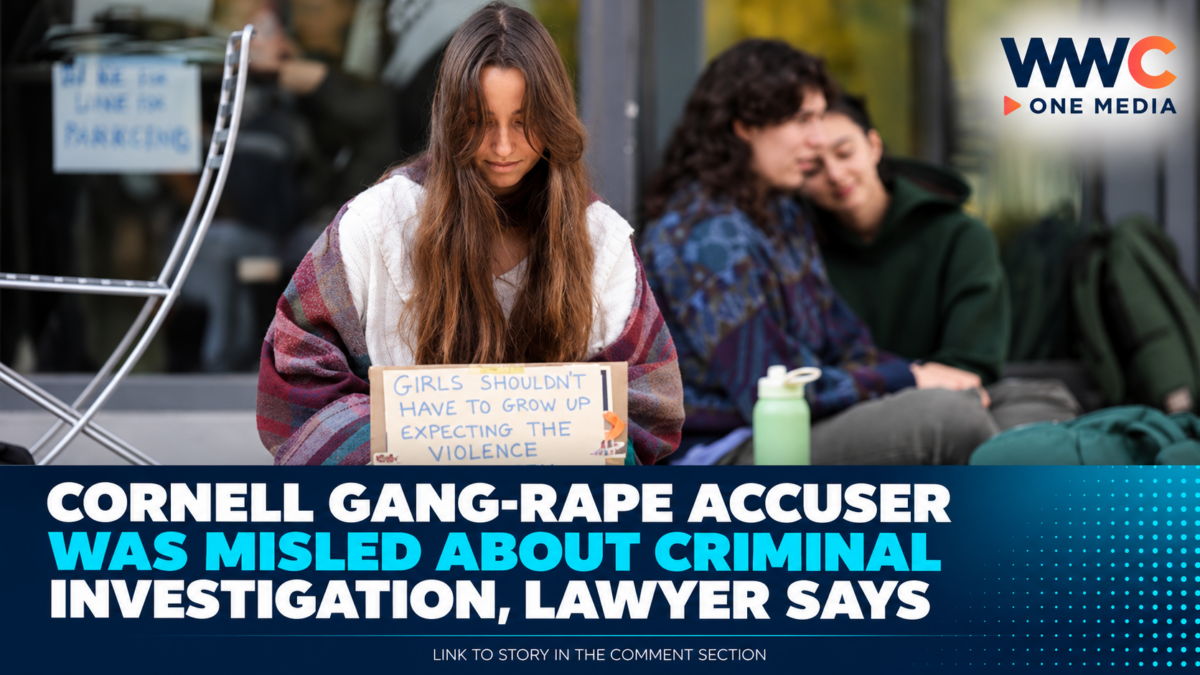
A woman who alleges she was gang-raped at a Cornell University fraternity house in 2024 was given the impression that a criminal investigation was still underway even though prosecutors had already decided not to pursue charges, her lawyer says.
The woman, identified in court documents as Jane Doe, reported the alleged assault to Cornell University Police in November 2024, several weeks after the incident at the Chi Phi fraternity house.
According to her attorney, Thomas Giuffra, she and her legal team believed investigators were continuing to gather evidence and interview witnesses. Instead, Tompkins County District Attorney Matthew Van Houten had decided within days of her substantive police interviews that his office would not move forward with a criminal case.
Giuffra told The Associated Press that he only later learned that the criminal investigation had effectively ended.
“I think she was misled,” Giuffra said, explaining that he believed investigators were still working on the case and needed additional time to build it.
The allegations have now triggered a renewed criminal investigation, a civil lawsuit and growing protests at Cornell, while New York Attorney General Letitia James has been appointed special prosecutor.
Lawyer Says Key Allegations Were Left Out
A central dispute concerns a six-page summary of Jane Doe’s account that was provided to the district attorney’s office.
Van Houten has said that, based on the summary, prosecutors concluded that the woman’s participation in drug use and sexual activity had been voluntary and consensual.
Giuffra argues that the summary did not accurately capture crucial portions of her interviews with Cornell investigators.
According to records reported by CBS News and the AP, Jane Doe told investigators during an interview that she was completely confident she had been raped. Her lawyer also says the summary did not include allegations that she had been subjected to physical violence or details concerning a message circulated among fraternity members on the night of the alleged incident.
Van Houten has said he did not receive the full interview transcripts at the time and based his 2024 decision on the information supplied to his office.
He has since said the newly surfaced information should be examined as part of the reopened investigation.
The 2024 Allegations
Jane Doe was a 20-year-old Cornell student when the alleged incident occurred in October 2024.
In a civil lawsuit filed in September 2026, she alleges that she was heavily intoxicated and pressured to consume drugs and alcohol at the Chi Phi fraternity house before several men sexually assaulted her.
She is suing seven former fraternity members, Cornell University, the fraternity and other parties.
The allegations have not been proven in criminal court, and the men named in the lawsuit have not been convicted of sexual assault. Attorneys for some of the accused have denied that their clients participated in a sexual assault, while some of the men told university investigators that the sexual activity was consensual or that they were not involved.
The lawsuit also alleges that a message was sent to a fraternity group chat inviting others to participate. Investigators obtained a screenshot of the message, which Cornell says was provided to the district attorney’s office along with Jane Doe’s sworn statement.
Cornell Conducted Its Own Disciplinary Investigation
Although no criminal charges were filed after the 2024 report, Cornell conducted its own internal investigation under its sexual-misconduct procedures.
The university has said that two of the students involved were expelled, two were suspended for at least two semesters, one had already graduated before disciplinary action could be imposed, and two were found not responsible for sexual misconduct.
Cornell has pushed back against claims that the university imposed only minor penalties, saying suggestions that the accused faced little or no consequences are inaccurate.
The Chi Phi chapter was also closed by the university in 2024 and remains barred from campus.
The university is now facing intense scrutiny over whether its police department properly handled the allegations and whether information gathered during the internal investigation was adequately communicated to criminal investigators.
Criminal Investigation Reopened
The case resurfaced publicly after Jane Doe filed her civil lawsuit on Sept. 16.
On Sept. 28, Van Houten announced that his office was reopening the criminal investigation and said prosecutors intended to review the evidence and potentially present it to a grand jury.
But the investigation was soon transferred away from the county prosecutor.
New York Gov. Kathy Hochul appointed Attorney General Letitia James as a special prosecutor after saying she had lost confidence in Van Houten’s ability to oversee the case.
James’ office is now responsible for determining whether criminal charges are warranted. The attorney general has indicated that the process could take months as investigators review the evidence.
One of the men named in Jane Doe’s lawsuit has since asked a court to remove James from the case, arguing that a social-media post she made before her appointment demonstrated bias. A spokesperson for James declined to comment on the request.
Cornell Faces Growing Campus Backlash
The controversy has also sparked protests at Cornell.
On Oct. 7, students staged a sit-in at a campus dining hall and called for reforms to the university’s handling of sexual-assault complaints. Protesters held signs supporting Jane Doe and demanded greater accountability from the university.
The pressure extends beyond students. Faculty members and alumni have also raised concerns about Cornell’s handling of the allegations and its broader approach to sexual misconduct.
Cornell President Michael Kotlikoff has acknowledged shortcomings in the university’s response and announced that the school would seek an outside review.
The university has brought in former U.S. Deputy Attorney General Sally Yates to conduct a broad examination of how Cornell handles sexual-assault and harassment complaints, including its disciplinary procedures and the role of campus police.
Questions Over the Original Investigation
The latest revelations have raised questions about what information prosecutors received in 2024 and whether investigators were given a complete picture of Jane Doe’s account.
Van Houten has maintained that his office acted on the evidence it received at the time. He has said he did not have access to the full Cornell interview transcripts and that the sworn statement presented to him differed significantly from the allegations later made in the civil lawsuit.
Jane Doe’s lawyer, however, argues that the distinction is crucial because the underlying interview records contained statements that he believes should have prompted further investigation.
The AP also reported that a Cornell police investigator attempted to get the district attorney’s office to consider additional evidence in the weeks following the alleged assault but was unsuccessful.
That account is now part of the broader examination of how the case was initially handled.
Investigation Could Take Months
The appointment of a special prosecutor means the criminal case is once again active, but it does not guarantee that charges will be filed.
James’ investigators will have to assess the original police records, Cornell’s internal investigation, witness accounts, electronic messages and other evidence before deciding whether there is sufficient evidence to prosecute.
Meanwhile, the civil lawsuit against Cornell and the former fraternity members will proceed separately.
For Jane Doe, the dispute over what happened in 2024 is now accompanied by a second question: whether the institutions responsible for investigating her allegations properly understood and communicated her account.
As Cornell faces mounting pressure from students, faculty and alumni, the independent reviews and renewed criminal investigation are expected to provide a closer examination of what happened — and why the original criminal inquiry ended without charges.