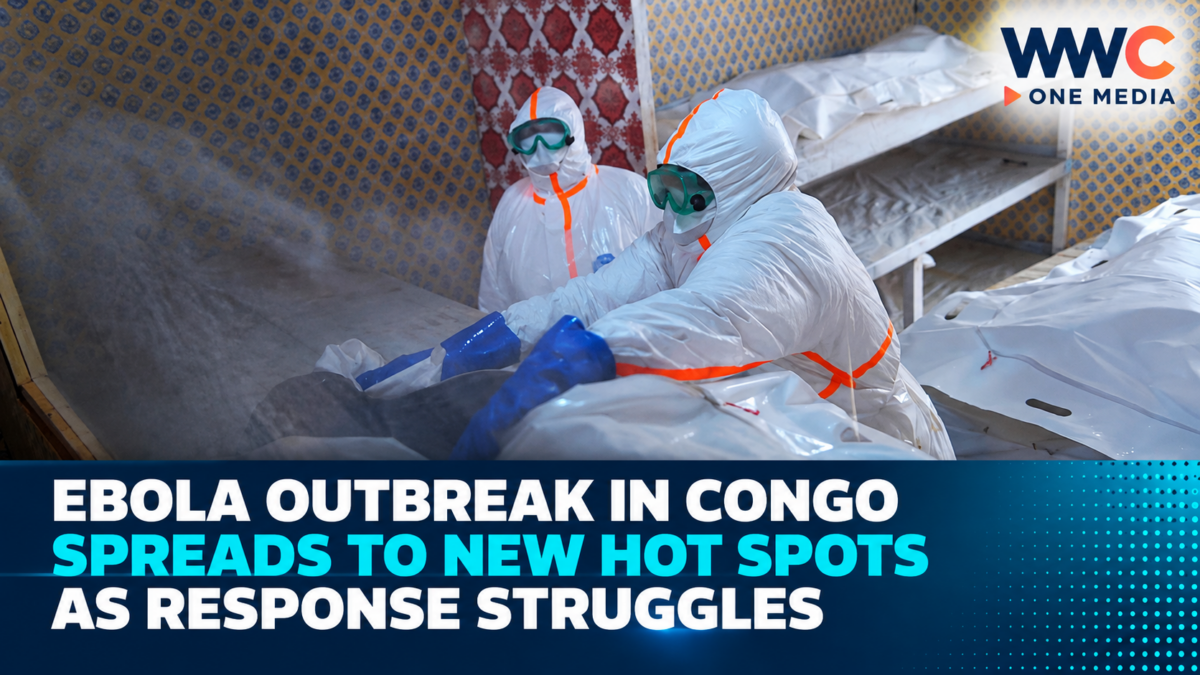
The Ebola outbreak in the Democratic Republic of Congo is spreading into new areas as health workers and aid organisations struggle to keep pace with a fast-moving crisis that has already killed more than 4,000 people.
The hardest-hit areas include the conflict-affected province of North Kivu, where the response is being hampered by shortages of health workers and supplies, population movements, insecurity and mistrust among communities.
Aid workers have described conditions on the ground as increasingly difficult, with some patients receiving little or no specialised support and regular health facilities being forced to care for people who may have Ebola.
North Kivu Emerges as a New Epicentre
North Kivu has become one of the most concerning areas in the outbreak.
The province now accounts for about 40 per cent of newly confirmed Ebola cases in Congo, up from 24 per cent at the end of August, according to Africa CDC Director-General Dr Jean Kaseya.
Doctors Without Borders (MSF) project coordinator Stephanie Hoffmann described the response in the province as “chaotic,” citing insufficient coordination and too few organisations operating in affected communities.
The outbreak has also spread across half of North Kivu’s 34 health zones. Its case-fatality rate is around 58 per cent, the highest among Congo’s seven affected provinces, according to health ministry data.
Thousands of Cases and More Than 4,000 Deaths
Congo has recorded more than 8,500 cases in the current outbreak, making it the country’s deadliest Ebola outbreak and the fastest-growing recorded Ebola outbreak, according to government figures cited by the Associated Press.
More than 4,000 people have died.
The outbreak was declared in May after the Bundibugyo virus was detected. Unlike the Zaire species responsible for several previous Ebola epidemics, Bundibugyo virus currently has no approved vaccine or specific treatment.
The World Health Organization declared the outbreak a public health emergency of international concern in May, when transmission was concentrated in parts of Ituri, North Kivu and South Kivu. WHO warned at the time that insecurity, population movement, weak contact follow-up and inadequate isolation systems were complicating efforts to contain transmission.
Contact Tracing Is Failing to Keep Up
One of the biggest challenges is identifying people who have been exposed to infected patients.
Kaseya said more than 70 per cent of new cases are coming from people who were not previously identified as contacts. Only about 23 per cent of expected contacts have been traced.
That creates a major problem because Ebola can spread through contact with infected bodily fluids, including during the care of sick people or the handling of bodies after death.
Population movement makes tracing even more difficult. People in affected parts of eastern Congo move because of conflict, economic activity and mining, while some communities remain difficult for health teams to reach.
Kaseya has called for a “village-centered” approach that gives local communities and leaders a more direct role in identifying contacts, organising safe burials and helping isolate suspected cases.
Some Families Remain Reluctant to Report Deaths
Health officials are also facing resistance and misinformation.
Michel Ngimba of Congo’s National Institute of Biomedical Research in Butembo said some families remain reluctant to report deaths or allow samples to be collected from people who died after displaying Ebola symptoms.
In some cases, families want to arrange funerals quickly without health authorities becoming involved.
That can create additional transmission risks because people who die from Ebola can remain highly infectious, making safe and dignified burial procedures an important part of outbreak control.
The problem is particularly serious when communities do not trust government officials or health workers. Previous Ebola outbreaks in the region have also been affected by misinformation and suspicion toward response teams.
Treatment Centres Under Pressure
Ebola treatment centres in North Kivu are struggling with shortages of staff and medical supplies.
Some patients have instead turned to ordinary health facilities because specialised treatment centres are unavailable or difficult to reach.
That places local healthcare workers in a difficult position: they may have to decide whether to treat potentially infected patients despite the risk to themselves and other patients or send them away without adequate care.
WHO has previously warned that weaknesses in infection prevention and control, isolation and referral systems can allow Ebola to spread inside healthcare settings.
The shortage of frontline workers is particularly concerning because Ebola response depends heavily on rapid identification, testing, isolation and treatment, as well as safe burial teams and contact tracers.
Conflict and Displacement Make Containment Harder
The outbreak is unfolding in a region already dealing with armed conflict and large-scale displacement.
Insecurity restricts the movement of surveillance teams and makes it harder to transport medical samples and supplies. People displaced by fighting may also move between communities without being tracked by health authorities.
Earlier this month, thousands of people fled an Ebola-affected displacement camp in eastern Congo after soldiers entered the site, raising concerns that people could carry the virus into surrounding communities.
WHO has warned that the combination of conflict, humanitarian needs, population mobility and porous borders increases the risk of cross-border transmission.
Kenya Reports First Ebola Case
The outbreak has now also raised concerns beyond Congo’s borders.
Kenya reported its first Ebola case after a Kenyan man who had been living in Congo travelled through Uganda and eventually reached Nairobi. He later died.
The case exposed weaknesses in regional border screening. According to Reuters, the man passed through several screening points despite showing symptoms associated with Ebola. Kenyan authorities subsequently identified dozens of contacts and placed some people under quarantine.
Kenya has since strengthened surveillance, designated additional treatment capacity and introduced measures aimed at identifying potentially infected travellers.
The development underscores the challenge facing neighbouring countries, where people routinely cross borders for work, trade and family reasons.
Researchers Race to Find Better Protection
Despite the difficulties, researchers are testing potential tools against the Bundibugyo virus.
An experimental study in Congo is evaluating obeldesivir, an antiviral drug developed by Gilead Sciences, as post-exposure prophylaxis for people who have been exposed to Ebola but have not yet developed symptoms.
More than 250 people had enrolled in the trial by early October, with researchers aiming for nearly 1,000 participants.
Vaccination efforts are also underway among some healthcare workers using the Ervebo vaccine, which is effective against the Zaire species of Ebola. However, its effectiveness against the Bundibugyo virus remains under investigation.
Because there is currently no licensed vaccine specifically approved for Bundibugyo virus and no approved specific treatment, controlling transmission still depends heavily on early detection, supportive medical care, isolation, contact tracing, infection-control measures and safe burials.
A Long Road Ahead
Nearly five months after the outbreak was declared, health officials acknowledge that containing the virus will require a much stronger response in communities where surveillance remains weak.
The high proportion of cases outside known contact chains means many infections are likely going undetected. At the same time, deaths occurring outside treatment centres make it harder for authorities to understand where transmission is happening.
For responders, the challenge is no longer limited to treating confirmed patients. They must also rebuild trust, reach communities affected by conflict, track highly mobile populations and persuade families to report suspected infections and cooperate with safe burial procedures.
The experience of the current outbreak shows how quickly Ebola can exploit gaps in healthcare and surveillance when an epidemic collides with conflict, displacement and limited resources.
Until those gaps are addressed, officials warn that new hot spots could continue emerging across Congo — and the risk of further regional spread will remain.