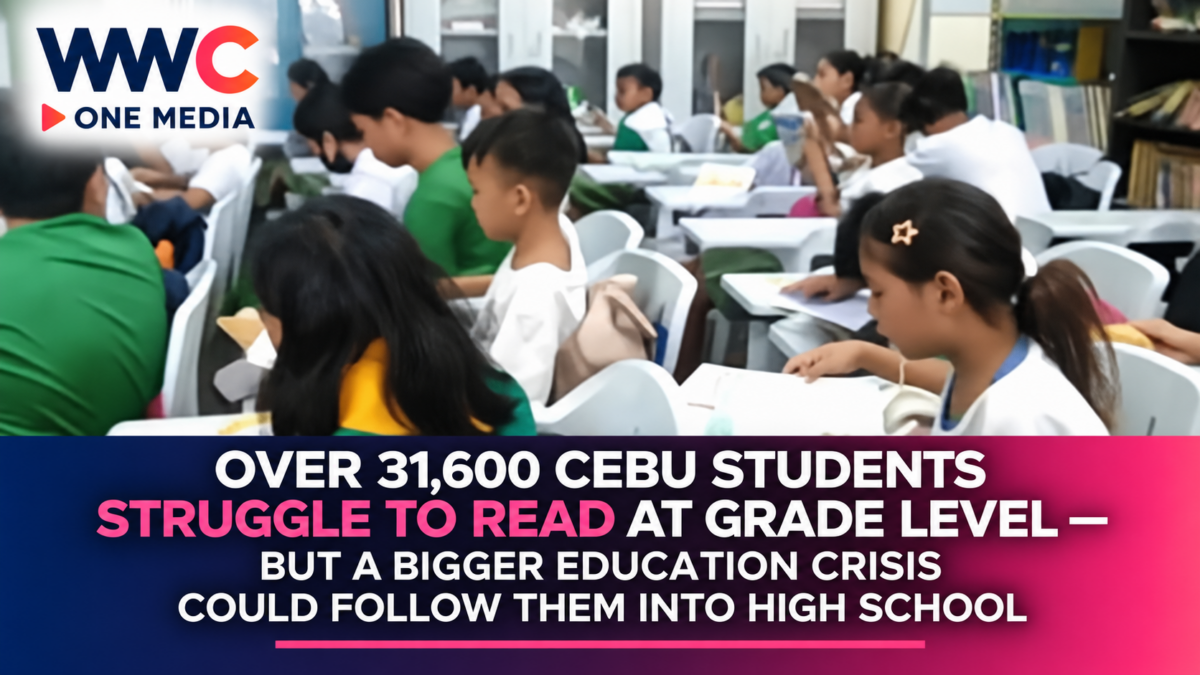
More than 31,600 Grade 1 to Grade 3 learners in Cebu Province were not reading at the level expected for their grade by the end of School Year 2025–2026, according to the Second Congressional Commission on Education (EDCOM II).
The findings, presented by EDCOM II Executive Director Dr. Karol Mark Yee during the Ramon Aboitiz Foundation’s Early Childhood Care and Development Convergence 2026 on October 1, expose a serious challenge for Philippine education: ensuring that children develop foundational literacy skills before moving into more demanding subjects.
The concern extends far beyond Cebu. Education officials warn that children who enter higher grade levels without sufficient reading proficiency risk falling increasingly behind, making it more difficult to comprehend textbooks, follow classroom discussions and succeed academically.
The figures were published by EDCOM II on October 4 and subsequently reported by InsiderPH and other Philippine education news outlets.
Cebu Among the Country’s Biggest Early-Grade Reading Challenges
According to the Department of Education’s Comprehensive Rapid Literacy Assessment (CRLA), the Schools Division Office of Cebu recorded the third-highest number of struggling early-grade readers among school divisions nationwide.
Approximately 13,300 learners, representing 11% of Key Stage 1 students assessed in the division, were classified as struggling readers.
The 13,300 figure refers specifically to the Cebu Schools Division Office, while the broader 31,600 figure covers the provincial total reported by EDCOM II. The two figures should not be interpreted as separate groups to be added together.
Several Cebu local government units registered substantial numbers of children requiring additional reading support.
Talisay City Leads Areas With Struggling Readers
EDCOM II’s data identified the following local government units with the highest reported numbers of struggling readers.
| Cebu locality | Struggling readers | Reported share |
|---|---|---|
| Talisay City | 2,933 | 22.5% |
| Toledo City | 1,331 | 10.6% |
| Consolacion | 1,211 | 16.2% |
| Liloan | 1,111 | 17.6% |
| Balamban | 865 | 17.6% |
| Minglanilla | 752 | 10.6% |
| Daanbantayan | 642 | 12.4% |
| Carcar City | 609 | 7.7% |
| Naga City | 607 | 8.6% |
| Barili | 560 | 12.0% |
Talisay City’s 2,933 struggling readers represent the highest recorded count in the published ranking, followed by Toledo City and Consolacion.
The figures highlight the importance of localized literacy programs, particularly in communities where existing classroom resources may not be sufficient to address individual learning needs.
The Bigger Warning: Reading Problems Can Follow Children Into High School
While the Cebu figures focus on children in Grades 1 to 3, education authorities are concerned about the long-term consequences.
EDCOM II warned that literacy gaps left unaddressed before Grade 4 can grow substantially as students advance through the school system.
Its final report, Turning Point: A Decade of Necessary Reform, highlighted persistent reading comprehension difficulties among junior and senior high school students.
The fundamental challenge is that students eventually need to shift from learning how to read to using reading as a tool for learning.
Without sufficient foundational literacy, understanding science, mathematics, history and other subjects becomes increasingly difficult.
This does not mean that all 31,600 affected Cebu learners are unable to read any words. The reported finding is that they are struggling to read at their expected grade level, an important distinction when assessing the severity of the crisis.
Another Crisis Behind the Classroom: 25,000 Cebu Children Affected by Stunting
EDCOM II also raised concerns about the connection between childhood nutrition and educational performance.
According to the National Nutrition Council’s 2025 Operation Timbang Plus report, approximately 25,000 children under five in Cebu Province are affected by stunting, a condition associated with long-term inadequate nutrition and other health factors.
Research cited by the commission indicates that stunted children are 16% more likely to fail a grade.
These findings reinforce the importance of tackling learning difficulties before formal schooling begins.
Adequate nutrition, early childhood education, appropriate developmental support and parental involvement all contribute to the conditions children need for effective learning.
However, the reported number of stunted children should not be interpreted as the number of struggling readers directly affected by malnutrition. The two statistics describe different populations and age groups.
EDCOM II emphasized the need for an integrated response involving schools, healthcare providers, local governments and community organizations.
Philippines Sets Ambitious National Reading Targets
Under the National Education Plan 2026–2035, the government has established targets to improve grade-level reading proficiency among Key Stage 1 learners.
NATIONAL GRADE-LEVEL READING TARGETS
0%25%50%75%100%2024–25202820312035
Source: EDCOM II, National Education Plan 2026–2035. The baseline is the end of SY 2024–2025.
The plan aims to increase the proportion of learners reading at grade level from a baseline of 47.74% at the end of School Year 2024–2025 to 95% by 2035.
Achieving that target would require substantial improvements in early-grade instruction, targeted learner support and the ability of schools to identify reading difficulties before they become entrenched.
EDCOM II is urging provinces such as Cebu to establish measurable local targets rather than relying exclusively on nationwide benchmarks.
The commission is also encouraging cooperation among universities, local government units and civil society organizations to strengthen early literacy and childhood development programs.
What Happens Next for Cebu’s 31,600 Struggling Readers?
The findings put pressure on education stakeholders to move from identifying learning gaps to delivering measurable improvements.
The published data establishes the scale of Cebu’s reading challenge, but it does not demonstrate that all affected learners have already received the targeted support they require.
Addressing the problem could involve more frequent reading assessments, structured literacy interventions, additional teacher support, stronger home-school partnerships and better access to early childhood nutrition and education services.
These are potential policy responses, not a claim that Cebu has already implemented them province-wide.
For Cebu, the challenge is therefore not simply whether schools can accommodate thousands of children. It is whether those children are acquiring the skills necessary to succeed as they progress through the education system.
The bigger question is whether Cebu can close its early-grade reading gaps before today’s struggling elementary learners become tomorrow’s struggling high school students.
And with the Philippines targeting 95% grade-level reading proficiency by 2035, the latest findings suggest that reaching that goal will require sustained action long before children enter Grade 4.