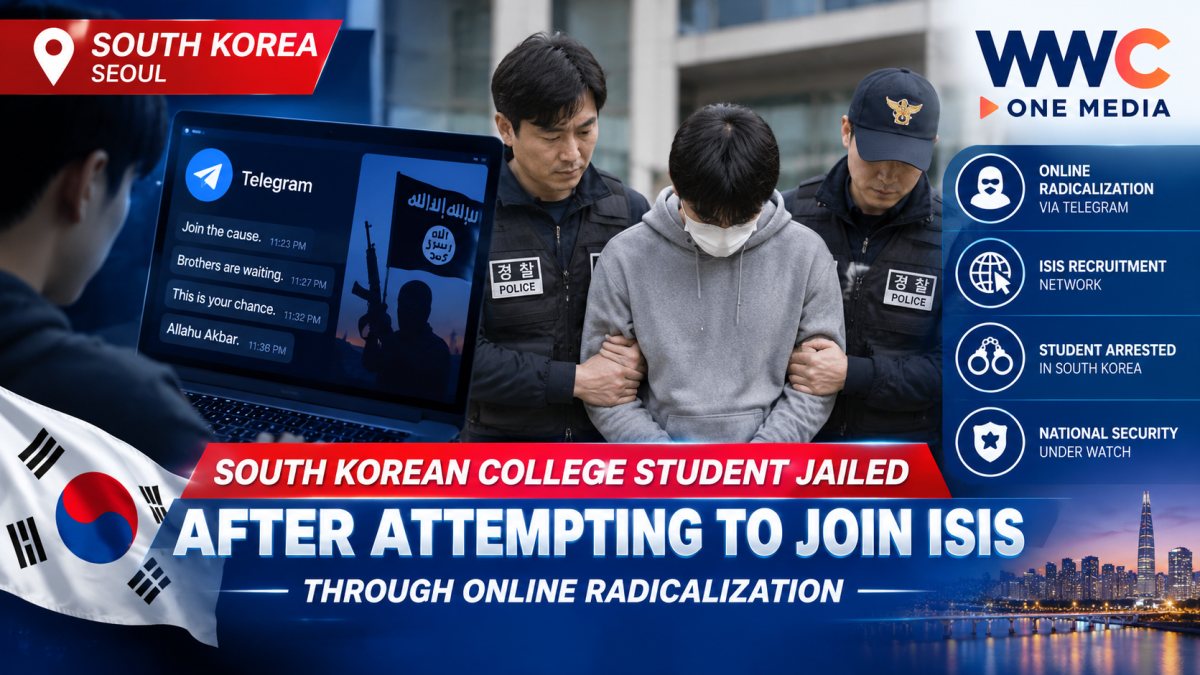
A South Korean college student has been sentenced to prison after authorities found that he had pledged allegiance to ISIS and attempted to become involved with the extremist organization, highlighting continuing concerns over online radicalization among young people.
The Cheongju District Court sentenced the 18-year-old man to an indeterminate prison term of one to one and a half years after finding him guilty of violating South Korea’s anti-terrorism law, according to officials cited by Yonhap and The Korea Times. His identity was withheld.
The case dates back to when the student was still in high school. Court officials said he accessed extremist propaganda through an encrypted online platform operated by an ISIS-affiliated group between November 2024 and February 2026, before pledging allegiance to ISIS.
Online Radicalization at the Center of the Case
According to the court, the student went beyond simply viewing extremist material.
Officials said he communicated with an ISIS contact and became involved in plans related to a potential attack overseas. The court’s findings included allegations that he sought extremist guidance and submitted a proposed attack plan for evaluation.
Because those details involve violent extremist activity, authorities have emphasized the dangers of online propaganda and recruitment rather than publicly encouraging further engagement with such material.
The case demonstrates how extremist organizations can attempt to use digital platforms to reach young people far beyond conflict zones.
South Korea Faces a Wider Online Extremism Challenge
The case comes amid broader international concern over the use of online platforms for extremist propaganda and recruitment.
South Korean authorities have increasingly focused on identifying individuals who become radicalized through internet content before their activities escalate into violence.
Governments elsewhere in Asia have also reported similar concerns. Singapore’s Ministry of Home Affairs, for example, said in July that authorities had taken action against online services carrying terrorism-related material, including content advocating ISIS and violence. The ministry said investigations had linked some such material to previous self-radicalization cases involving youths.
The issue is particularly significant for younger internet users, who may encounter manipulative extremist messaging without fully understanding its broader context or consequences.
Court Sentence Sends a Clear Legal Signal
The Cheongju ruling places the focus on the legal consequences of attempting to support or join a designated extremist organization.
The 18-year-old will serve the sentence imposed by the court following his conviction under South Korea’s anti-terrorism legislation.
The case also illustrates why authorities across the region are paying closer attention to the intersection of youth, online propaganda and extremist recruitment.
For families, schools and governments, the challenge extends beyond removing harmful material. It also involves recognizing when online manipulation may be influencing vulnerable young people and intervening before intentions turn into real-world harm.
As authorities continue confronting extremist recruitment online, the South Korean case raises a broader question: how can governments and communities identify radicalization early enough to prevent another young person from being pulled deeper into violent extremist networks?
WWC ONE MEDIA G,A