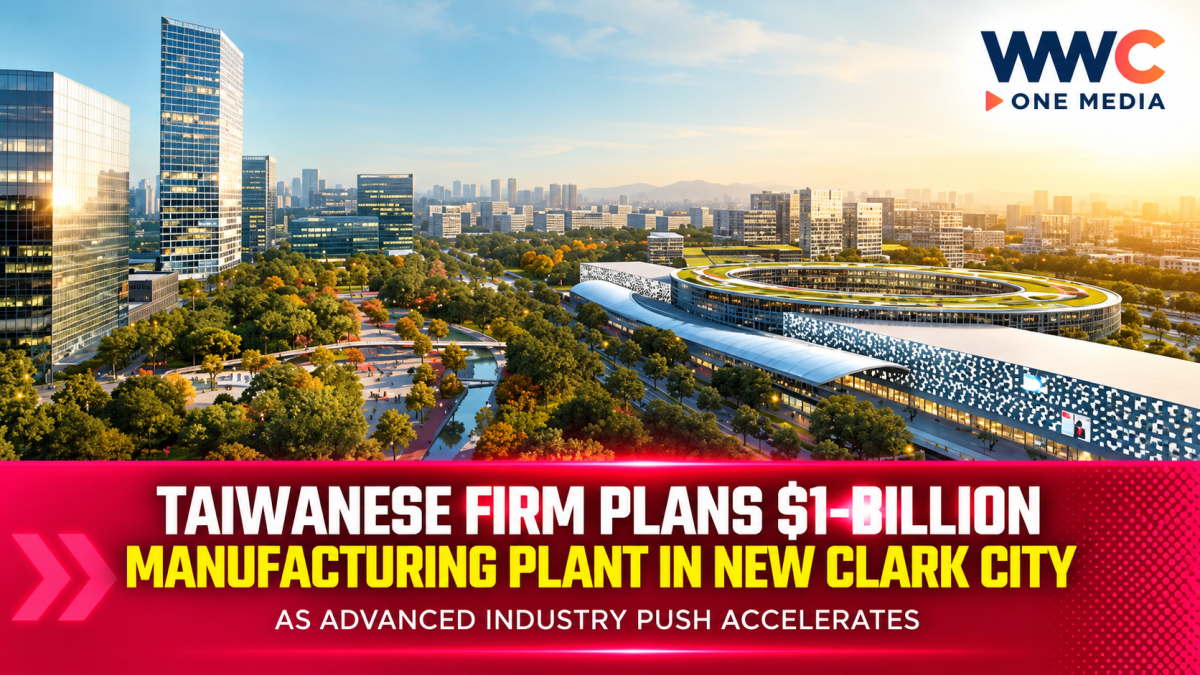
MANILA — A Taiwanese technology company is preparing to invest around $1 billion in a manufacturing facility at New Clark City, adding momentum to the Philippines’ effort to establish the area as a hub for advanced manufacturing and technology-related industries.
The Bases Conversion and Development Authority said the company has signed an agreement to establish a manufacturing facility in New Clark City, although its identity has not been disclosed at the investor’s request. An advance payment has already been received to secure the planned site.
The investment is expected to involve a first phase worth roughly $1 billion to $1.5 billion, according to information provided by BCDA officials. The Taiwanese company has secured about 30 hectares and is considering an additional 60 hectares for future expansion. It is expected to begin construction in October.
The planned facility will manufacture technology-related products, although the specific products have not yet been publicly identified. The company is also expected to send Filipino engineers to Taiwan for training before they return to help install equipment, establish production lines and train other workers.
BCDA officials have described the arrangement as an opportunity for technology transfer, with the investor bringing its manufacturing systems and operational expertise into the Philippines. The company is also expected to generate annual exports of roughly $1 billion to $1.2 billion once operations reach the projected scale.
The investment comes as New Clark City is being positioned as an advanced manufacturing center under the broader Pax Silica initiative. The planned technology hub covers about 1,600 hectares and is intended to attract industries connected to semiconductors, advanced manufacturing, technology and other high-value sectors.
The government has said the development is focused on manufacturing rather than establishing a large artificial-intelligence data center. The strategy is to attract companies that can participate in higher-value portions of global technology supply chains while creating jobs and expanding the country’s industrial capabilities.
Reliable utilities will be critical to the plan. BCDA has been working on water and power infrastructure to support the proposed industrial hub, including a planned high-technology water supply and management system and additional renewable and conventional energy capacity.
The agency has also been courting major international technology companies, including semiconductor and electronics firms, as it develops the ecosystem needed to support advanced manufacturing. Several other potential investments are reportedly under discussion, including projects involving companies from South Korea, Taiwan and Singapore.
New Clark City is part of a broader effort to strengthen industrial activity outside Metro Manila. Its location in Central Luzon gives manufacturers access to the Clark airport and logistics infrastructure while linking the area to the wider Luzon Economic Corridor.
The planned Taiwanese facility could therefore become an important anchor investment for the emerging industrial cluster. However, details such as the final product mix, employment requirements, production capacity and full construction schedule have yet to be disclosed publicly.
The project also remains subject to the normal stages of development, including planning, construction and regulatory requirements. Other proposed investments in the area are likewise still at various stages of negotiation.
For the Philippines, the proposed plant represents a significant potential addition to the country’s advanced-manufacturing pipeline, particularly as the government seeks to attract higher-value technology production and expand participation in global supply chains.
The bigger issue now is whether the $1-billion investment can become the foundation for a wider technology-manufacturing ecosystem in New Clark City, drawing more suppliers, semiconductor companies and advanced industries into the growing Central Luzon hub.