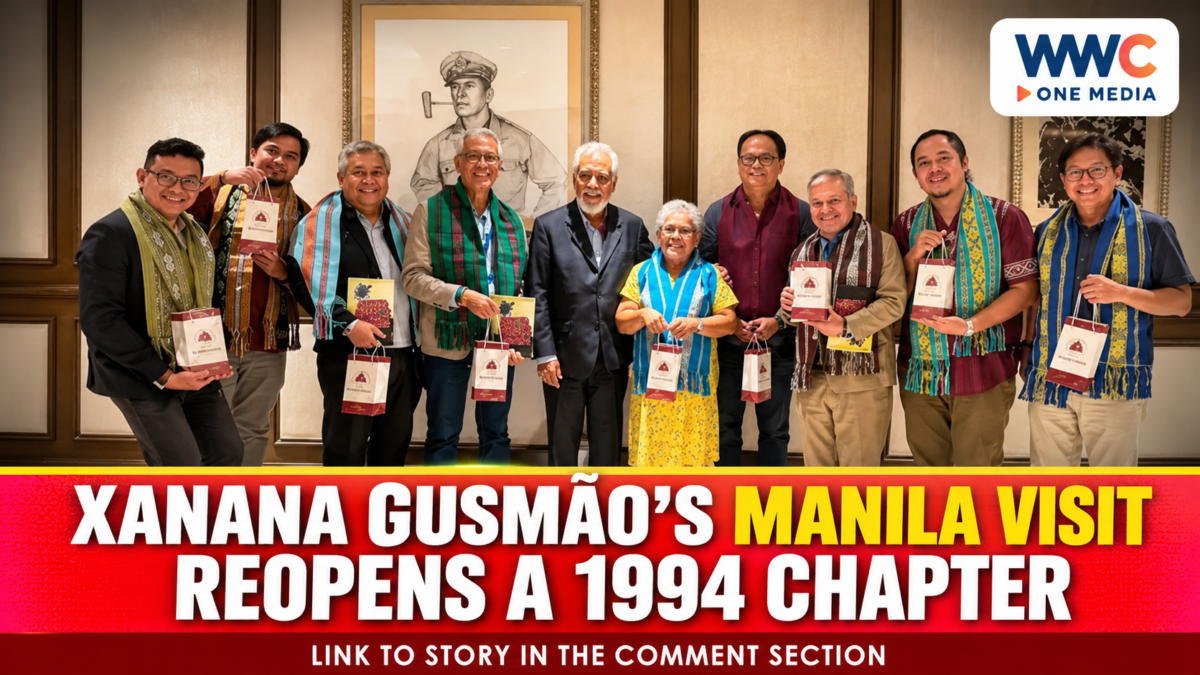
Timor-Leste Prime Minister Kay Rala Xanana Gusmão arrived in Manila on November 13, 2026, for the 49th ASEAN Summit, bringing the country’s growing regional role into focus. But decades before Timor-Leste became ASEAN’s 11th member, Filipino civil society organisations were already bringing its independence struggle before international audiences.
The historical connection is documented in United Nations records from 1994, when representatives of the Asia-Pacific Conference on East Timor (APCET) and the Philippine Solidarity for East Timor and Indonesia (PSETI) presented their positions before the UN Special Committee on decolonisation.
Those records offer a way to understand the Philippines’ contribution to the Timorese cause beyond the formal diplomatic relationship between the two countries. They also show how civil society groups attempted to keep an independence issue alive at a time when regional governments faced difficult political and diplomatic considerations.
Gusmão’s visit is confirmed by Timor-Leste’s official reporting on his departure for the Manila summit. However, the published government programme does not document a separate meeting with Filipino activists. The historical account below therefore focuses on what can be established through the public record.
The 1994 Manila conference became part of the UN record
The Asia-Pacific Conference on East Timor took place in Manila in 1994, while the territory remained under Indonesian administration.
The event became a subject of discussion at the United Nations. In the official transcript of its July 13, 1994 meeting, the UN Special Committee on decolonisation recorded testimony from Miss Lita Killup, representing APCET and PSETI.
The transcript described APCET as a new regional initiative involving civil libertarians, non-governmental organisations and people’s organisations. It also identified the Initiatives for International Dialogue (IID), a Filipino non-governmental organisation, as the coalition’s temporary base and an important organiser of the Manila conference. Digital Library+1
The conference’s significance was not limited to the gathering itself. Its participants sought to bring the East Timor question into wider regional discussion at a time when the issue remained politically sensitive in Southeast Asia.
The UN transcript also recorded the account presented by APCET’s representative about pressure surrounding the event. The statement described restrictions on foreign participants and diplomatic tensions involving the Philippines and Indonesia.
These details should be understood as testimony entered into the UN record, rather than a separate judicial finding. What the document establishes directly is that Filipino civil society representatives brought the issue before an international body and formally presented the coalition’s position.
Filipino organisations brought the issue beyond the region
The July 1994 transcript provides a particularly important record of the role played by Filipino organisations.
Killup identified IID as the organisation hosting APCET’s secretariat. The record described IID as an independent Filipino organisation working on South-South solidarity.
The same proceedings identified PSETI as part of the wider coalition. Its participation showed that the campaign was not simply a gathering of foreign advocates visiting Manila. Filipino organisations were involved in the network presenting the issue to regional and international audiences. Digital Library+1
Another section of the same UN meeting recorded a delegate’s account of the conference at the University of the Philippines in Manila, held from May 31 to June 4, 1994.
The statement described the event as a gathering of international participants and Filipino representatives. It also recorded that the conference adopted resolutions calling for the release of Xanana Gusmão and other political prisoners, a ceasefire, demilitarisation and a United Nations-supervised referendum.
These were the conference’s stated recommendations, not proof that every demand was subsequently implemented. Their inclusion in the UN proceedings, however, demonstrates that the gathering had become part of the international discussion surrounding East Timor’s political future. Digital Library
The campaign’s central demand was self-determination
The question at the heart of the movement was whether the people of East Timor would be allowed to determine their political future.
Gusmão, who became a prominent figure in the independence movement, was among the people whose release the conference called for. The UN transcript records the demand for his participation in negotiations over the territory’s future.
The campaign also called for a process that would allow the Timorese population to express its political choice under international supervision.
That demand became particularly significant in 1999, when Indonesia and Portugal signed agreements on May 5 entrusting the United Nations with organising a popular consultation.
The UN Security Council subsequently adopted Resolution 1246 on June 11, 1999, establishing the United Nations Mission in East Timor (UNAMET) to organise and conduct the consultation. Digital Library+1
On August 30, 1999, registered voters went to the polls to decide whether to accept the proposed special autonomy arrangement within Indonesia.
The final result announced by the United Nations showed that 344,580 voters, or 78.5 percent, rejected the autonomy proposal. Another 94,388, or 21.5 percent, voted in favour.
The result expressed the population’s preference to begin a transition towards independence. It was a decisive milestone in the process that led to the establishment of an independent Timor-Leste. Digital Library+1
The referendum was not the end of the difficult transition. Violence followed the announcement, and the United Nations had to support the international response to the crisis.
The historical record therefore places the 1994 conference within a much longer process involving Timorese political organisations, international diplomacy, civil society advocacy and the eventual UN-supervised consultation.
Timor-Leste has moved from independence struggle to ASEAN membership
The relationship between the Philippines and Timor-Leste has since developed into formal diplomatic and regional cooperation.
The Philippine government established diplomatic relations with Timor-Leste on May 20, 2002, according to a Presidential Communications Office statement issued during the countries’ diplomatic engagement.
In November 2023, the two governments also discussed cooperation involving commercial aviation, social security arrangements for professionals and education. These areas reflected an effort to build practical ties beyond the historical relationship formed during the independence struggle. Presidential Communications Office+1
A major regional milestone followed in October 2025, when Timor-Leste formally joined ASEAN as its 11th member.
The Philippine Information Agency’s account of the admission ceremony records that President Ferdinand Marcos Jr. and nine other ASEAN leaders signed the declaration welcoming Timor-Leste into the organisation. Gusmão was present alongside President José Ramos-Horta. Philippine Information Agency
The development transformed Timor-Leste’s position in Southeast Asia. It was no longer participating only through accession-related arrangements but had become a full member of the regional organisation.
For a broader look at the bloc’s membership and role, WWC previously examined why ASEAN matters and how its 11 members shape regional affairs.
Gusmão’s Manila agenda reflects a different chapter
Timor-Leste’s official news agency reported that Gusmão departed for Manila on November 13 to participate in the 49th ASEAN Summit and Related Summits.
The published programme included the leaders’ meetings, engagements with dialogue partners and discussions involving regional institutions. The schedule also covered meetings with China, South Korea, Australia and the United Nations, as well as the ASEAN Plus Three and East Asia Summit gatherings. TATOLI Agência Noticiosa de Timor-Leste
His participation comes as Timor-Leste works to deepen its engagement with ASEAN’s institutions and cooperation mechanisms.
The country’s membership also gives it a place in discussions affecting regional economic integration, security, energy, food supplies and digital transformation.
The Philippines, meanwhile, is completing its 2026 ASEAN chairmanship before handing the leadership role to Singapore. The Manila summit has included discussions on the region’s economic and political priorities, as examined in WWC’s report on the digital pact and the continuing test of ASEAN unity.
The present diplomatic setting is markedly different from the one surrounding the 1994 conference. Timor-Leste now participates as a member of the regional bloc whose governments once faced difficult questions about how to address the territory’s political status.
Why the historical connection still matters
The 1994 UN proceedings provide a lasting record of how civil society groups from the Philippines and the wider Asia-Pacific region tried to bring attention to East Timor’s political future.
They also show that the independence process involved more than negotiations between governments. Organisations, advocates and community networks helped keep the issue visible in international discussions.
That does not mean the conference alone secured independence. The outcome resulted from a much wider process involving the Timorese people, political leadership, international negotiations and the United Nations.
But the documentary record gives the Philippines a distinct place in that history: Filipino organisations helped create a platform where the Timorese question could be raised before regional and international audiences.
For a country that is now an ASEAN member, Timor-Leste’s history also offers a reminder of how regional cooperation has changed over time.
The organisation’s membership has expanded, and a country once at the centre of a difficult regional political question now participates in shaping ASEAN’s future.
What happens next?
Gusmão’s participation in the Manila summit forms part of Timor-Leste’s continuing integration into ASEAN.
The next stage will involve turning membership into sustained participation in the organisation’s institutions, agreements and regional programmes. The country’s preparations for a future ASEAN chairmanship in 2029 will also place greater demands on its diplomatic and administrative capacity.
For the Philippines, the historical connection provides an opportunity to recognise the role of civil society in regional affairs alongside the work of governments and international organisations.
The 1994 UN record remains an important document in that story. It shows that the push for Timorese self-determination was already being discussed in Manila long before the country became an independent state and a full member of ASEAN.
The reunion account that prompted renewed interest in this history may draw attention to the people involved, but the documented record establishes something broader: the Philippines had a civil society role in the Timorese independence debate that extended beyond a single meeting or diplomatic occasion.