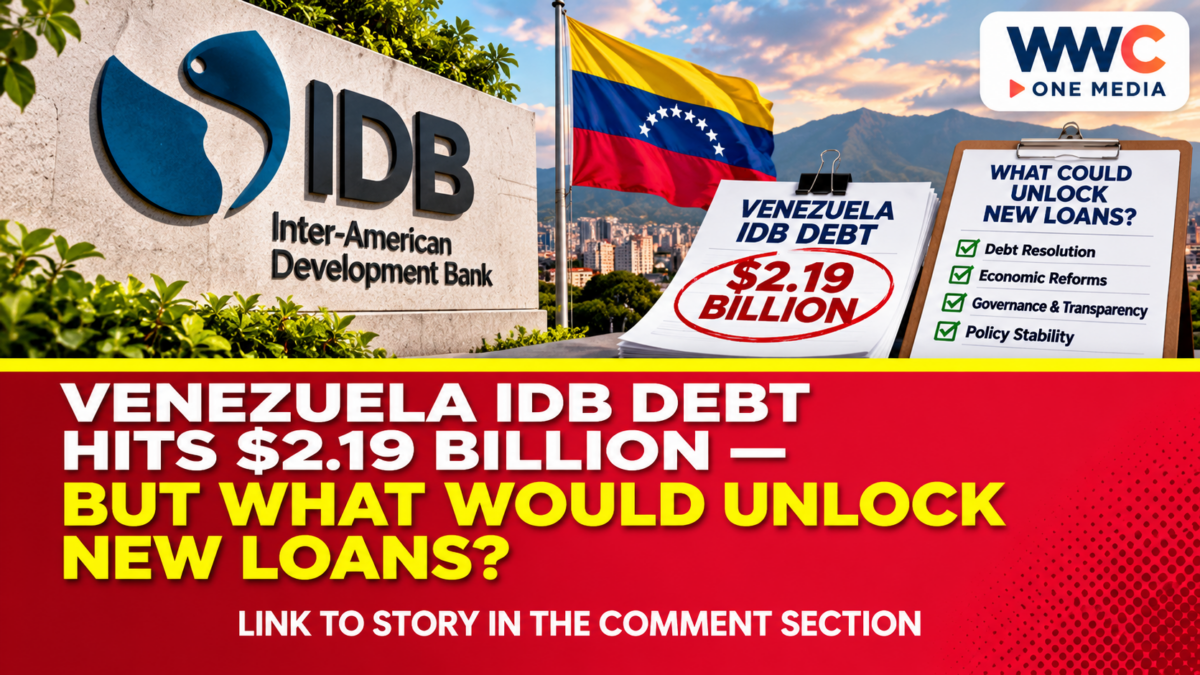
WASHINGTON / CARACAS, Nov. 14, 2026 — Venezuela’s overdue obligations to the Inter-American Development Bank (IDB) stood at US$2.187 billion at the end of 2025, the bank’s audited financial statements show. The United States has meanwhile set out a policy of economic re-engagement with Venezuela, putting fresh attention on a key obstacle to development financing: unpaid debt.
The figures explain why restoring access to a major regional lender is more complicated than announcing investment plans or reopening diplomatic channels. The IDB’s published policy prevents fresh lending to a country while its eligible sovereign-guaranteed obligations remain in arrears, and no officially documented US loan to settle Venezuela’s IDB bill was established in the records reviewed for this article.
Venezuela IDB Debt: What the Accounts Actually Show
The IDB’s 2025 annual financial report records US$2.187 billion in past-due principal and interest on Venezuela’s sovereign-guaranteed loans as of Dec. 31, 2025. Of that total, US$2.048 billion had been overdue for more than 180 days.
The same report places the outstanding loans assigned to nonaccrual status at US$2.011 billion, unchanged from when the entire Venezuelan loan portfolio entered that status in 2018. Nonaccrual status means the lender stops recognising interest income under its normal accrual method; it does not mean the debt is forgiven.
Another accounting figure needs careful handling. The IDB recorded a US$625 million individually assessed allowance for credit losses linked to Venezuela at the end of 2025, up from US$539 million a year earlier. This is the lender’s estimate of potential loss from delayed collection, not a new disbursement to Venezuela or a cancellation of what is owed.
Why Arrears Block a Return to IDB Lending
The IDB states that it stops disbursements and does not approve new loans in a country after payment arrears exceed 30 days. Loans move into nonaccrual status after arrears exceed 180 days. The bank also states that it does not renegotiate or reschedule sovereign-guaranteed loans as a matter of policy.
There is a second barrier. The IDB’s published country-strategy guidance identifies Venezuela as lacking a current country strategy and says this prevents its board from approving financing operations and eligibility for new loans and guarantees. Resolving arrears alone would not automatically approve projects or eliminate that separate requirement.
The bank’s country records show Venezuela remains represented in its governance arrangements. Membership, however, should not be mistaken for unrestricted access to financing. A shareholder can retain institutional representation while facing restrictions on new sovereign borrowing.
Washington Has Discussed Recovery, Not an Approved Loan
On Nov. 2, 2026, the US Treasury published a readout of Secretary Scott Bessent’s meeting with Venezuelan Foreign Minister Oliver Blanco. Their discussion covered economic recovery, energy production, financial-sector connections and a broader programme described as stabilisation, recovery and transition.
That is evidence of an official policy dialogue, not evidence that Treasury approved a particular loan, specified a repayment schedule or committed US taxpayer money to clear arrears at the IDB. Those details would require an identifiable official financing record.
Treasury’s sanctions office has also issued a series of Venezuela-related general licences this year. One issued on May 5 authorises certain services connected with potential debt restructuring. Such permission affects the scope of transactions that may be legally undertaken; it does not itself constitute a Treasury loan or a settlement with the IDB.
Debt Relief Is Not the Same as Economic Recovery
Venezuela’s development-financing problem sits alongside a larger question: whether productive investment can generate enough stable economic activity to support future debt payments. The International Monetary Fund announced in April 2026 that it had resumed dealings with Venezuela, but explicitly distinguished institutional re-engagement from immediate financing or a lending programme.
The IMF also identified rebuilding the production of economic data as a priority. For creditors and investors, dependable statistics help them evaluate public finances, prices, output and the risks attached to long-term contracts.
Recent discussions about Venezuela’s oil-export challenges illustrate a separate commercial test: expanding an industry is not sufficient if transport, markets and cash flow remain uncertain. That WWC coverage provides energy-market background, not evidence of a specific new IDB repayment plan.
Likewise, reporting on Chevron’s proposed production expansion in Venezuela points to the scale of future investment ambitions. Private capital projects and government debt settlement, however, follow different legal and financial paths.
What This Could Mean for Venezuela’s Recovery
Analysis: A credible arrears-clearing mechanism could remove one important obstacle to cooperation with the IDB. It could also give prospective creditors a more concrete basis for discussing Venezuela’s eligibility for development financing, provided the other institutional conditions are addressed.
But a bridge loan would change the composition of obligations, not necessarily erase them. If one creditor supplies funds to repay another, Venezuela may still owe the new lender, depending on the actual terms. Questions about interest, maturity, security and repayment sources would therefore matter as much as the headline sum.
Investment needs also extend beyond oil. WWC’s coverage of Venezuela’s electricity-sector investment debate shows why basic infrastructure remains relevant to any wider recovery discussion. Such reforms do not, by themselves, demonstrate debt-service capacity.
For Philippine readers, the broader lesson is about sovereign creditworthiness: renewed diplomacy and new investment proposals can coexist with unresolved arrears. Development lenders need documented repayments, governance approvals and viable projects before their financing programmes can function normally.
What Happens Next
The next verifiable milestones would be a formal Treasury or other government financing announcement, an IDB confirmation that overdue balances have been settled, and an updated IDB country strategy or approval process. Without those documents, it is premature to describe a US-backed rescue as agreed or completed.
Any future proposal should be assessed against three questions: who provides the funds, who becomes legally responsible for repayment, and what additional IDB steps are required before lending resumes. The answers will determine whether debt clearance leads to a practical new financing channel or simply substitutes one liability for another.
Frequently Asked Questions
How much does Venezuela owe the IDB in overdue payments? The bank recorded US$2.187 billion in overdue principal and interest on Venezuela’s sovereign-guaranteed portfolio as of Dec. 31, 2025. This is a dated balance, not a verified figure for Nov. 14, 2026.
Can the IDB make new loans to Venezuela now? Its published arrears policy bars lending until overdue payments are resolved. Venezuela also lacks a current IDB country strategy, a separate obstacle to loan approval.
Has the US Treasury confirmed a loan to pay Venezuela’s IDB arrears? No official approval, amount or executed financing agreement was established in the primary records reviewed for this article.
Did the IMF’s return to Venezuela mean immediate new money? No. Its April 2026 statement said renewed engagement did not mean immediate financing or a programme.
Would paying the arrears guarantee new development projects? No. Clearing arrears could remove one restriction, but lending decisions would still depend on the bank’s country strategy, approvals and other requirements.