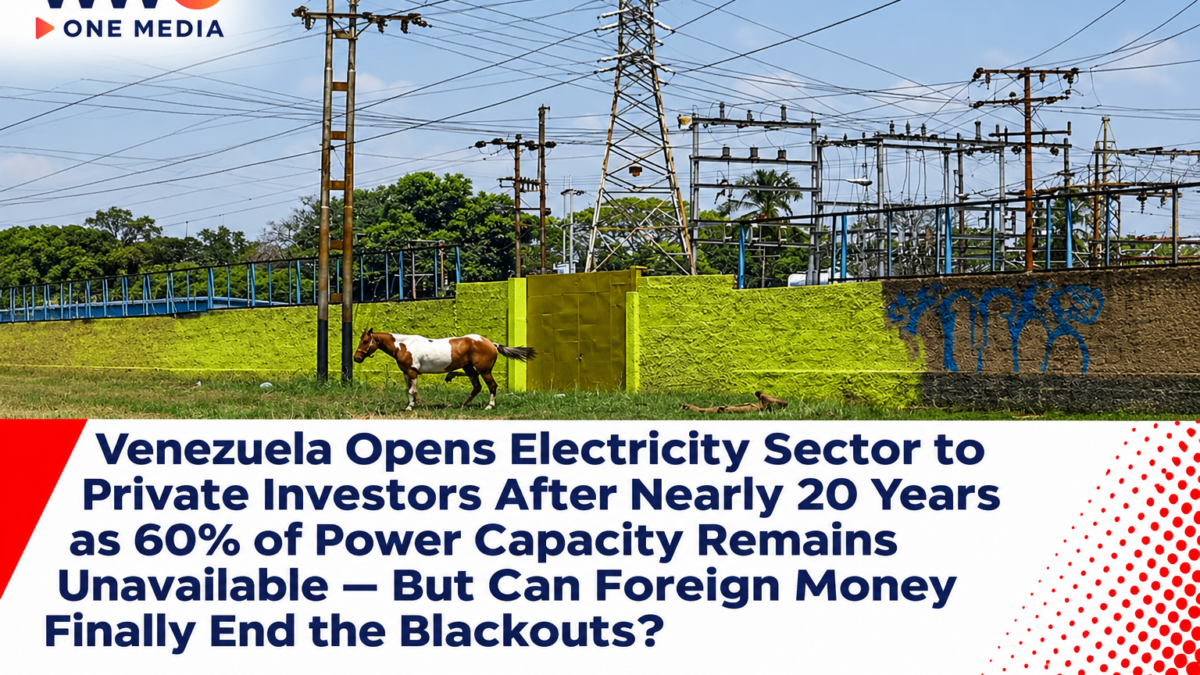
CARACAS, VENEZUELA / MANILA, PHILIPPINES — November 11, 2026 — Venezuela has taken a dramatic step toward dismantling nearly two decades of state dominance over electricity generation, approving legislation that allows private investors to help rebuild a power system plagued by blackouts, deteriorating infrastructure and chronic shortages of capital.
The country’s National Assembly approved reforms to its electricity law on November 10, opening the sector to private and foreign participation under government-authorized arrangements.
The legislation represents one of the most consequential changes to Venezuela’s energy infrastructure since the government consolidated electricity operations under state control in 2007.
But the scale of the challenge is extraordinary.
According to Reuters, less than 40% of the country’s installed electricity-generating capacity is currently available.
Millions of residents have endured repeated interruptions to electricity supplies, with outages in some regions lasting hours or days.
Those disruptions affect far more than household lighting.
They can interrupt water distribution, telecommunications, internet services, agriculture, industrial production and oil operations.
The reform is part of a broader economic opening pursued by acting President Delcy Rodríguez, whose administration is seeking foreign investment in electricity, oil, natural gas and mining.
However, potential investors still face major financial and legal uncertainties, including whether the government and state-linked customers can reliably pay for electricity and infrastructure services.
The central question is whether Venezuela’s new rules can attract the billions of dollars needed to restore reliable power—or whether investors will remain reluctant to enter a market with a long history of economic instability.
Venezuela Approves Historic Electricity Reform
Venezuela’s National Assembly voted unanimously on November 10 to approve a partial reform of the country’s electricity legislation.
The measure followed several postponements of the final parliamentary debate.
The revised framework allows private businesses and mixed public-private companies to participate in electricity generation, subject to the necessary authorization.
It also creates opportunities for companies to enter government joint ventures and obtain concessions lasting up to 25 years.
The change is significant because electricity operations have been dominated by the state since 2007, when the government moved toward nationalization and consolidated the industry under publicly controlled structures.
For years, private investment opportunities were constrained by the sector’s regulatory model and commercial risks.
Now the administration is attempting to reverse part of that approach.
National Assembly President Jorge Rodríguez argued that private participation is particularly important for industrial users and other major electricity consumers.
But allowing investors into the market does not automatically restore power.
Companies must still secure financing, repair equipment, install new capacity and establish commercially viable operating arrangements.
The law creates a framework for those activities.
Whether the framework delivers measurable results remains uncertain.
Less Than 40% of Electricity-Generation Capacity Is Available
The condition of Venezuela’s power system is the strongest argument for reform.
Reuters reported that less than 40% of installed generating capacity is currently available.
That suggests a substantial share of the country’s existing power plants cannot supply electricity as intended.
However, the percentage must be interpreted correctly.
It refers to generating capacity availability, not necessarily the proportion of households receiving electricity or the amount of daily electricity demand being met.
A power system can experience serious shortages for several reasons.
Generating units may be unavailable because of equipment failures.
Hydroelectric output may be constrained by operating conditions.
Transmission networks may be unable to deliver electricity efficiently.
Distribution systems can also suffer damage, inadequate maintenance or technical losses.
In Venezuela, years of economic crisis and insufficient investment have weakened several parts of the electricity network.
The result has been a prolonged reliability problem.
New legislation may allow private companies to contribute capital, but a comprehensive recovery will require coordinated work across generation, transmission and distribution.
Why Venezuela’s Power Grid Has Deteriorated
The electricity crisis developed over many years.
Venezuela once relied heavily on large hydroelectric facilities, supported by thermal power stations and a national transmission network.
But aging equipment, insufficient maintenance, operating problems and economic instability contributed to worsening reliability.
Hyperinflation and currency instability complicated equipment purchases and long-term investment planning.
International sanctions added restrictions and financial difficulties, although domestic governance decisions and infrastructure maintenance problems also played important roles.
The Venezuelan government has attributed electricity problems partly to sanctions, adverse weather and alleged sabotage.
Opposition figures and independent specialists have emphasized underinvestment, corruption allegations and management failures.
These explanations are contested and should not be reduced to a single cause.
The important operational fact is that the power network requires extensive repairs.
For investors, that means potential projects may involve rehabilitating existing assets rather than simply constructing new plants.
Repairing aging infrastructure can sometimes restore capacity more quickly than building entirely new facilities.
But successful rehabilitation depends on reliable access to replacement parts, engineering expertise and financing.
Power Outages Are Devastating Farms and Food Production
The consequences of Venezuela’s electricity shortages are particularly severe in agriculture.
In western Venezuela, repeated blackouts have forced farmers to change how they operate.
Reuters interviewed a dairy farmer in Táchira state who described outages lasting as long as 18 to 20 hours.
He said his business had been unable to use milking machinery and refrigeration reliably for years.
This demonstrates why electricity is essential to modern agriculture.
Dairy production requires refrigeration to preserve milk.
Food-processing businesses depend on temperature control and reliable equipment.
Farmers also need electricity for pumps, storage facilities and communications.
Long outages can increase costs, reduce production and create food-safety risks.
When businesses cannot predict when power will be available, they may delay investments or rely on expensive alternative equipment.
The consequences can extend through the food supply chain.
Restoring electricity could therefore improve economic activity well beyond the utilities sector.
But farmers and small businesses will judge the reform by actual service improvements, not by the number of investment announcements.
Blackouts Also Threaten Water Supplies and Communications
Electricity shortages have a cascading effect on public services.
Water distribution systems often require pumps to move water through pipelines and into storage facilities.
When electricity fails, those pumps can stop working.
That can reduce or interrupt household water supplies.
Telecommunications networks also depend on electricity for mobile towers, switching facilities and internet infrastructure.
Backup batteries and generators can provide temporary support, but prolonged outages may exceed their capacity.
Hospitals and clinics can also face difficulties when power supplies become unreliable, although many facilities use backup systems to protect essential equipment.
The full economic cost of electricity shortages therefore extends beyond the price of lost power generation.
Repeated outages can affect public health, business productivity, education and daily household activity.
That helps explain why the government has made grid stabilization a central part of its investment agenda.
Private Investors Can Receive Concessions of Up to 25 Years
The new legislation provides a legal route for private companies to operate in the electricity sector.
According to EFE, the reform allows qualifying private and mixed enterprises to participate in generation.
Concessions may be granted for initial terms of up to 25 years.
Long-term concessions are important because power infrastructure requires substantial upfront spending.
A company may spend years designing, financing and building a project before receiving consistent revenue.
A sufficiently long operating term can provide time to recover that investment.
However, concession duration is only one consideration.
Investors must also evaluate electricity tariffs, collection risks, operating costs, currency exposure and legal protections.
The ability to earn adequate returns will depend on the specific contract.
The law also provides mechanisms for resolving disputes, including mediation and arbitration.
But the existence of legal provisions does not guarantee that every future disagreement will be resolved quickly or that every award will be easy to enforce.
Investors will evaluate how the rules operate in practice.
The State Is Not Completely Leaving the Electricity Business
The reform should not be described as the complete privatization of Venezuela’s power grid.
The state remains a central participant through its electricity institutions.
Private involvement is allowed under authorized arrangements, including joint ventures.
The law also provides for assets associated with certain concessions to be returned or transferred to the designated state operator when the concession ends.
This is different from selling the entire electricity network outright to private companies.
The government continues to retain important regulatory and operational responsibilities.
For investors, the system resembles a controlled opening in which private capital is permitted to support selected activities while the state maintains substantial influence.
That distinction is important for understanding the political and commercial implications.
The success of the model will depend partly on how clearly responsibilities are divided between public authorities and private operators.
Oil Companies May Have to Generate Their Own Electricity
One of the law’s most significant provisions concerns Venezuela’s oil industry.
The revised legislation requires oil operators to ensure a continuous and reliable power supply for their primary activities.
That can involve building their own generation capacity, combining electricity and useful heat production, or contracting third-party electricity providers.
The objective is to reduce the dependence of energy projects on an unreliable national grid.
For oil companies, this creates an additional investment requirement.
A project may need financing not only for wells, pipelines and processing equipment, but also for the power facilities needed to operate them.
However, self-generation can provide a commercial advantage where the national network cannot guarantee consistent supply.
An oil field that operates continuously may be able to avoid production losses caused by blackouts.
The reform could therefore create opportunities for developers of dedicated power plants, gas-fired generation and related infrastructure.
But energy companies will need to assess how the additional costs affect the profitability of their investments.
ExxonMobil’s Potential Return Makes the Electricity Reform More Important
The new power legislation arrives just as major foreign energy companies are reconsidering opportunities in Venezuela.
On November 9, ExxonMobil signed a preliminary memorandum of understanding to evaluate potential oil exploration and production projects.
The agreement marked a significant step after the company’s withdrawal following the nationalization of its Venezuelan assets in 2007.
As WWC ONE MEDIA reported on ExxonMobil’s preliminary agreement and the risks surrounding its possible return, the company has emphasized the need for stable rules, strong investment protections and commercially competitive terms.
Its memorandum is not a final investment commitment.
But the relationship between electricity and oil production is important.
Drilling operations, pumps, processing facilities and other equipment need dependable power.
An oil producer considering a new project must calculate whether electricity will be reliably available and how much additional infrastructure it must build.
Venezuela’s electricity reform could help address that obstacle.
However, there is no confirmation that the law has already caused ExxonMobil to approve a specific project.
Chevron’s Venezuela Expansion Could Also Increase Power Demand
Chevron is another major energy company with commercial interests in Venezuela.
The US oil producer has pursued a substantial expansion of its Venezuelan operations under revised arrangements.
As WWC ONE MEDIA examined in its report on Chevron’s planned US$7 billion investment program, increasing petroleum production will require extensive operational investment.
That includes not only drilling and transportation infrastructure but potentially greater access to electricity.
A larger oil industry can create additional pressure on an already strained power network.
For that reason, the government is trying to encourage energy companies to participate in securing their own electricity supply.
But investors will want to know how generation costs will be allocated and whether they can recover spending through commercially viable operations.
Power-sector reform and oil-sector reform are therefore closely connected.
The country cannot sustainably expand industrial production without dependable electricity.
The Oil Export Business Is Already Facing Infrastructure Problems
Venezuela’s energy industry has also been affected by transportation and commercial challenges.
Recent reports show that crude loading and broader petroleum export measures have fluctuated as shipping costs, production conditions and buyer demand change.
As WWC ONE MEDIA reported on an October decline in Venezuelan crude loadings and higher tanker costs, even a country with enormous petroleum reserves can struggle to deliver reliable export volumes.
Electricity problems add another complication.
Oil production and processing facilities rely on functioning equipment and stable energy supplies.
Unexpected blackouts can interrupt operations or raise costs.
However, it would be inaccurate to claim that every recent fall in oil exports was caused by electricity failures.
Shipping conditions, market demand and production constraints also matter.
The broader problem is that Venezuela is trying to revive several interdependent industries simultaneously.
Progress in electricity supply could support oil production, but it cannot independently resolve every obstacle facing the petroleum sector.
Investors Face One Major Question: Will Venezuela Pay?
The biggest obstacle to new private power investment may be financial credibility.
Reuters reported that Venezuela has not yet guaranteed payments to suppliers that could help rehabilitate the grid.
This is an important concern because electricity infrastructure projects typically require predictable revenue over many years.
An operator may be reluctant to spend millions of dollars repairing a power plant if the customer cannot reliably pay for the electricity produced.
Private lenders face the same problem.
Before providing financing, banks generally want evidence that project revenue will be sufficient to cover operating expenses, debt payments and expected returns.
Venezuela’s history of hyperinflation, economic instability and contractual disputes increases the difficulty.
Investors may demand stronger protections or financial guarantees.
The government could also seek arrangements involving development banks or other international institutions.
But any such financing would need to be negotiated and approved.
The new law creates an opportunity for private participation.
It does not automatically provide the money required to restore the grid.
Venezuela Considers a Qatari Loan to Reconnect With Development Financing
Another development involves the Inter-American Development Bank.
Reuters reported that the institution is developing a two-year engagement plan for Venezuela focusing partly on electricity and social protection.
The plan could become important because multilateral development banks can help finance public infrastructure and provide technical assistance.
However, Venezuela has accumulated substantial arrears.
According to Reuters, authorities are considering a bridge loan from Qatar to help clear more than $2 billion owed to the Inter-American Development Bank.
Repaying arrears could help create a path toward renewed financing.
But the reported loan was under consideration.
It had not been confirmed as a completed transaction.
Likewise, the development bank’s engagement plan should not be described as an already approved multibillion-dollar electricity rescue package.
The distinction matters because Venezuela’s power system requires actual capital, not merely expressions of interest.
For the government, restoring access to development financing could be an important part of making the new law commercially effective.
Plans to Restore Thousands of Megawatts Remain Ambitious
Before the November vote, Venezuelan officials outlined plans to rehabilitate existing generation units and install additional electricity capacity.
Bloomberg Línea reported in October that the government and international partners had discussed restoring service reliability over a period of six to 12 months.
The wider plans included adding approximately 1,000 megawatts during the first two years of certain recovery arrangements and a further 5,000 megawatts over a longer period.
Officials also announced efforts to restore approximately 1,300 megawatts during the final quarter of 2026.
These figures are planned or targeted additions under different arrangements.
They should not be combined as though all represent separate, completed generation capacity.
Nor should they be confused with the amount of electricity currently available.
Restoring equipment requires technical work, financing, spare parts, testing and reliable grid connections.
The government may meet some targets while other projects take longer.
For consumers, the real evidence of success will be fewer outages and more reliable service.
Could Venezuela’s New Power Market Attract Foreign Energy Companies?
The reform could create opportunities for several types of international businesses.
Power-generation developers may consider thermal, gas-fired or renewable electricity projects.
Engineering companies could provide maintenance and rehabilitation services.
Manufacturers may supply turbines, transformers, cables and control systems.
Infrastructure funds might examine projects with long-term contracted revenue.
But demand alone does not guarantee investment.
Potential partners will examine the government’s ability to honor contracts and maintain regulatory stability.
They may also assess the risk of currency restrictions, political changes and future sanctions.
Some projects could be commercially attractive if they serve financially strong industrial customers.
Others may be difficult to finance if tariffs are insufficient or payments are uncertain.
The potential market is large, but the investment environment remains challenging.
What the Reform Means for Venezuela’s Households
For ordinary Venezuelans, electricity reliability is a practical necessity.
A household cannot plan its daily activities when power is regularly unavailable.
Food can spoil during extended outages.
Water pumps may stop functioning.
Mobile communications and internet access can become unreliable.
Students may struggle to study.
Small businesses can lose customers and income.
The new law offers the possibility of improved infrastructure and more dependable supply.
But those benefits are not guaranteed.
Private companies may initially prioritize industrial customers that can sign commercially attractive contracts.
Residential service improvements could take longer, particularly in regions with deteriorated distribution infrastructure.
The government will therefore face pressure to ensure that reform does not benefit only large businesses.
A successful recovery must eventually improve electricity access for ordinary households.
Could Private Investment Lead to Higher Electricity Prices?
Another important question involves tariffs.
Private companies generally need to recover their capital costs and operating expenses.
That could create pressure for tariffs that better reflect the cost of electricity supply.
However, the approved reform does not by itself establish a specific nationwide increase in household electricity prices.
The reviewed reporting does not provide a finalized tariff schedule for every customer category.
Any future changes would depend on regulations, contracts and government decisions.
There is also a trade-off between low prices and reliable service.
If electricity tariffs are too low to support maintenance and investment, the system may deteriorate.
If prices rise beyond what households can afford, financial hardship may increase.
Policymakers must therefore balance commercial viability with consumer protection.
The government’s approach to subsidies, tariff collection and financial support will be essential.
The Philippine Power Sector Offers a Different Regulatory Example
Venezuela’s electricity problems are also relevant to discussions about infrastructure reliability in other countries.
The Philippines operates under a different electricity-market and regulatory framework.
Private companies participate extensively in generation and distribution, while the government retains important regulatory functions.
Yet the country still experiences power interruptions and debates over generation reliability.
As WWC ONE MEDIA reported on the Philippine Energy Regulatory Commission’s 24 show-cause orders involving 13 generating companies, private participation alone does not eliminate operational problems.
That Philippine regulatory action is separate from Venezuela’s legislative reform.
But it illustrates an important principle.
Reliable electricity requires effective maintenance, adequate generation, sound investment and credible oversight.
The ownership structure matters, but it is only one part of the system.
For Venezuela, attracting private capital will need to be accompanied by enforceable standards and functioning infrastructure.
What Happens Next?
Several developments will determine whether the reform produces meaningful results.
First, legal implementation. The approved reform must move through the remaining applicable publication and implementation steps.
Second, private-sector participation. Investors will decide whether to pursue projects and negotiate concessions.
Third, financial guarantees. Companies and lenders will seek evidence that electricity purchases and infrastructure services can be paid for.
Fourth, grid rehabilitation. Authorities will need to prioritize repairs that restore usable generation and improve delivery reliability.
Fifth, industrial demand. Oil companies and other large users may develop dedicated electricity arrangements.
Sixth, international financing. The government’s discussions involving development lenders could affect how much funding becomes available.
Finally, the administration will need to demonstrate that the changes improve conditions for households and businesses.
A rise in the number of approved private projects would be encouraging.
But a reduction in blackouts would be a more meaningful measure of success.
The Bigger Picture: Venezuela’s Power Crisis Is Now an Investment Test
Venezuela’s decision to reopen electricity operations to private capital represents a major economic shift.
After nearly 20 years of extensive state control, the government is acknowledging that repairing the power system will require additional investment and operational capacity.
The need is urgent.
Less than 40% of installed generating capacity is reportedly available.
Blackouts continue affecting millions of people.
Agricultural businesses struggle to operate essential equipment.
And energy companies considering new investments must confront the unreliability of the national grid.
The November 10 legislation gives private firms a potential route into electricity generation and related projects.
It also creates opportunities for industrial power arrangements and long-term concessions.
But it cannot erase years of infrastructure deterioration overnight.
Investors still need confidence in payment arrangements, legal protections and regulatory stability.
The government must also ensure that improved electricity supplies eventually reach ordinary consumers rather than only the most profitable industrial customers.
Venezuela has opened its failing power sector to private investors, offering concessions of up to 25 years in an effort to restore a grid where most generation capacity is unavailable. But as foreign companies weigh the risks of unpaid contracts, deteriorated infrastructure and political uncertainty, will the new law finally bring dependable electricity back to millions of homes—or become another ambitious reform that fails to end the blackouts?