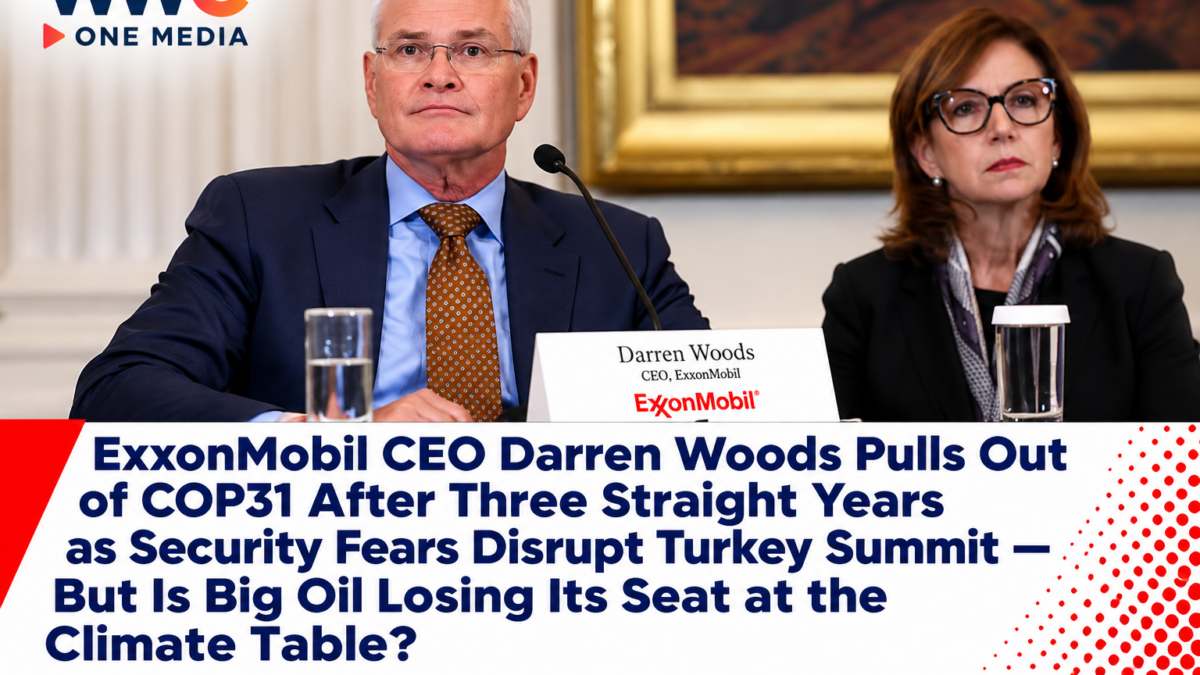
ANTALYA, TÜRKIYE / HOUSTON, UNITED STATES — November 11, 2026 — One of the world’s most influential oil executives has abruptly abandoned plans to attend the United Nations climate summit in Türkiye, raising fresh questions about the role of fossil-fuel companies in international negotiations over global warming and energy security.
Darren Woods, chairman and chief executive officer of ExxonMobil, will no longer attend the COP31 climate conference in Antalya, ending a three-year streak of participation in UN climate gatherings.
According to Bloomberg’s November 10 report, Woods had been scheduled to address a Business and Investment Summit on Thursday, November 12.
He was the only chief executive of a major oil company scheduled to speak at the conference this year.
But ExxonMobil announced that security-related logistical problems had made his participation impractical.
The cancellation comes as nearly 200 countries meet in Türkiye to discuss climate action, carbon emissions, energy investment and the future of fossil fuels.
It also follows another turbulent year for international energy markets, with the conflict involving Iran disrupting supplies and creating uncertainty for governments and businesses.
ExxonMobil has insisted that its commitment to providing affordable energy while reducing emissions remains unchanged.
And despite Woods’ absence, the company will still be represented at the summit.
But the decision raises a larger question: Can one of the world’s biggest oil companies remain influential in the global climate debate when its chief executive is no longer at the negotiating table?
ExxonMobil Confirms Darren Woods Will Miss COP31
The cancellation was announced on November 10, shortly after COP31 began in Antalya.
ExxonMobil said its team had worked to arrange Woods’ participation but could not overcome the logistical challenges posed by the security situation.
The company explained that the conditions on the ground made the visit impractical despite extensive preparation.
The statement did not identify a specific threat to Woods or disclose detailed security assessments.
That distinction is important.
The company cited a difficult security environment. It did not claim that an attack had been planned against the executive or the conference.
Woods had been scheduled to speak at a high-profile business gathering associated with COP31.
His absence will remove one of the most prominent oil-industry voices from the event’s executive-level discussions.
However, it does not mean ExxonMobil has withdrawn from the conference altogether.
The company has confirmed that its chief environmental scientist and the president of its Low Carbon Solutions business are participating.
Why Darren Woods’ Absence Is Significant
Woods has become an unusually visible representative of the petroleum industry at UN climate conferences.
He participated in climate gatherings associated with COP28 in Dubai in 2023, COP29 in Baku in 2024 and COP30 in Brazil in 2025.
His appearances were important because large oil companies have historically occupied a controversial position in international climate negotiations.
Environmental organizations argue that fossil-fuel producers have financial incentives to resist policies that could reduce demand for their products.
Oil companies counter that their expertise, capital and technology are necessary to manage the energy transition while maintaining reliable supplies.
Woods has generally supported a strategy involving emissions measurement, carbon capture, hydrogen and other lower-emissions technologies.
His participation gave ExxonMobil an opportunity to communicate that position directly to policymakers, businesses and climate advocates.
The cancellation removes his personal presence from this year’s conference.
But the company’s continued participation through other executives suggests it still wants to influence the discussions.
COP31 Opens in Türkiye Amid a Worsening Climate Crisis
The 31st Conference of the Parties to the UN Framework Convention on Climate Change is taking place from November 9 to November 20, 2026.
Türkiye is hosting the conference in Antalya, while Australia is leading the formal negotiations under a partnership arrangement.
The summit brings together governments, businesses, financial institutions, scientists and civil society organizations.
Its priorities include accelerating emissions reductions, expanding access to clean energy and securing financial support for countries vulnerable to climate change.
The conference also comes amid warnings that existing national commitments are insufficient to limit global warming to internationally agreed goals.
As WWC ONE MEDIA reported on the opening of COP31 and the urgency of translating climate pledges into measurable action, delegates face difficult questions about the pace of the energy transition.
The challenge is not simply announcing new targets.
Governments must also develop policies, financing arrangements and infrastructure capable of delivering actual emissions reductions.
For oil companies, this means growing pressure to explain how their business plans fit into the world’s climate objectives.
Why Security Concerns Are Affecting International Energy Executives
Woods’ decision follows separate travel cancellations involving energy executives in the Middle East.
In late October, Reuters and the Financial Times reported that Woods had canceled plans to attend the ADIPEC energy conference in Abu Dhabi.
Chevron upstream executive Clay Neff also withdrew from the event.
Those cancellations came amid regional security concerns linked to the ongoing conflict involving Iran.
Military operations and threats to energy infrastructure have disrupted travel, shipping and international business events across parts of the Middle East.
Woods’ COP31 cancellation involves a different conference in a different country.
It would therefore be inaccurate to suggest that the same specific security threat caused both decisions.
However, the developments demonstrate how the broader geopolitical situation is affecting senior executives’ travel plans.
Companies must consider not only the commercial value of attending an international summit but also the safety of their personnel and the practicality of transportation arrangements.
The decision to cancel a visit can reflect those operational concerns without necessarily signaling a change in corporate policy.
ExxonMobil’s Third-Quarter Profit Reaches $15.4 Billion
The COP31 development comes shortly after ExxonMobil announced another strong financial quarter.
On October 30, the company reported US$15.4 billion in third-quarter GAAP earnings, compared with approximately $7.5 billion a year earlier.
Adjusted earnings reached $17.5 billion.
Cash flow from operating activities totaled $25.7 billion, while free cash flow reached $19.1 billion.
ExxonMobil also returned $9.4 billion to shareholders during the quarter through dividends and share repurchases.
The figures reflect the strength of the company’s oil, gas and refining operations during a period of elevated energy-market volatility.
However, strong profitability does not directly establish whether its climate strategy is sufficient.
The financial results measure commercial performance.
Climate performance must be assessed using separate indicators, including greenhouse-gas emissions, emissions intensity, investment outcomes and progress against stated targets.
For investors, both issues matter.
A company can generate strong profits while still facing policy, environmental and long-term energy-transition risks.
ExxonMobil Is Still Expanding Its Oil and Gas Business
The company continues pursuing major investments in oil and natural gas production.
Its latest earnings announcement highlighted production milestones in Guyana and Canada’s Kearl oil sands operation, as well as the expansion of its interests in international LNG developments.
ExxonMobil is also exploring potential opportunities in Venezuela.
As WWC ONE MEDIA reported on ExxonMobil’s preliminary agreement to evaluate a possible return to Venezuela, the company has been examining potential investments nearly two decades after its assets were expropriated.
That agreement is preliminary and does not constitute a final investment decision.
Nevertheless, it illustrates the continuing commercial importance of oil production to ExxonMobil’s strategy.
Environmental advocates argue that further fossil-fuel expansion can conflict with efforts to reduce global emissions.
ExxonMobil maintains that oil and natural gas will remain necessary to meet energy demand while emissions-reduction technologies develop.
The disagreement reflects one of the central tensions at COP31.
Carbon Capture Remains Central to Exxon’s Climate Argument
ExxonMobil has emphasized carbon capture and storage as an important part of its lower-emissions business.
Carbon capture technology is designed to collect carbon dioxide from certain industrial operations and store it in geological formations or use it in other processes.
The company has also invested in technologies involving hydrogen, lower-emissions fuels and methane reduction.
Its third-quarter announcement highlighted progress involving carbon storage projects, including a startup associated with Nucor and approval for the Rose carbon storage development.
ExxonMobil argues that these technologies could reduce emissions from industries where electrification is difficult.
However, climate advocates have questioned whether the industry is relying too heavily on technologies that may be expensive or difficult to deploy at sufficient scale.
Carbon capture also does not eliminate every environmental impact associated with fossil fuels.
Actual benefits depend on the amount of carbon dioxide captured, the permanence of storage and the full emissions associated with the project.
For that reason, investment announcements should not automatically be treated as completed emissions reductions.
Woods’ absence means he will not personally defend this strategy at his scheduled COP31 appearance.
But the company’s Low Carbon Solutions leadership remains present to discuss it.
ExxonMobil Wants a Different Approach to Measuring Emissions
Woods has also promoted changes to the way companies account for greenhouse-gas emissions.
In a Bloomberg interview during COP30 in November 2025, he supported a system focused on more detailed measurement of emissions associated with products and their supply chains.
He argued that reliable carbon accounting could help businesses identify effective ways to reduce pollution.
The initiative has received support from other large corporations.
However, critics have warned that alternative accounting methods could weaken pressure for absolute emissions reductions if they are used to emphasize efficiency rather than overall pollution.
These competing perspectives are important.
Reducing emissions intensity means producing fewer emissions per unit of output.
Reducing absolute emissions means cutting the total amount released.
A company can improve its emissions intensity while its total emissions increase if production grows sufficiently.
Both measurements can provide useful information, but they answer different questions.
The debate about carbon accounting illustrates why major oil companies want to participate in climate-policy discussions—and why some campaigners remain skeptical of their proposals.
The UN Wants Countries to Move Beyond Fossil Fuels
COP31 is taking place against growing pressure for stronger action on fossil-fuel dependence.
United Nations Secretary-General António Guterres has warned that continued reliance on oil, gas and coal creates environmental, economic and security risks.
In reporting from Antalya on November 10, Reuters described negotiations involving a proposed roadmap for reducing fossil-fuel supply and dependence.
Türkiye is also promoting a goal of increasing electricity’s share of global final energy use to 35% by 2035.
Supporters argue that greater electrification can reduce reliance on oil in transportation, buildings and industry.
But electrification produces the greatest emissions benefits when the additional electricity comes from cleaner sources.
A shift from oil-powered vehicles to electricity generated entirely by coal, for example, may provide much smaller climate benefits than a transition supported by renewable or other low-carbon power.
That distinction has become part of the diplomatic debate.
The goal remains a proposal under discussion, not a completed binding global agreement.
Singapore Warns COP31 May Produce Few Major New Targets
Some governments are questioning whether another round of promises would be sufficient.
Singapore’s Minister for Sustainability and the Environment, Grace Fu, has warned that the summit may not produce major new national emissions targets.
Instead, she has emphasized implementing existing commitments and improving access to climate finance.
As WWC ONE MEDIA examined in its report on Singapore’s expectations for COP31, the focus is shifting toward measurable progress.
That includes investment in infrastructure, adaptation measures and practical emissions reductions.
For businesses such as ExxonMobil, this approach places greater importance on evidence.
Companies are increasingly expected to demonstrate what their projects have delivered rather than relying solely on long-term commitments.
The debate is especially important for lower-emissions technologies that may take years to reach full commercial scale.
The Iran War Is Complicating the Energy Transition
The conflict involving Iran has added a difficult economic dimension to COP31.
Disruptions to oil and gas supplies have increased uncertainty over energy prices and shipping.
Countries dependent on imported fuels have been forced to reconsider their supply arrangements.
At the same time, high fossil-fuel prices can encourage investment in energy efficiency, electrification and renewable power.
The consequences are therefore mixed.
Some governments may seek additional domestic fossil-fuel production to improve energy security.
Others may accelerate their transition toward locally generated clean electricity.
The Global Carbon Budget released during the conference points to another complication.
Researchers estimate that fossil-fuel and cement emissions could decline slightly in 2026, partly because of disrupted energy consumption and changing market conditions.
But total carbon dioxide emissions, including land-use changes, are still projected to remain extremely high.
As WWC ONE MEDIA examined in its report on the projected 0.4% decline in fossil-fuel emissions, a short-term reduction caused partly by economic or geopolitical disruption is not the same as a durable transition to low-carbon energy.
That distinction is central to the climate negotiations.
ExxonMobil’s Absence Raises Questions About Corporate Influence
Oil and gas companies have long been controversial participants at UN climate conferences.
Supporters of industry involvement argue that the transition requires cooperation with businesses that operate major energy systems.
Large companies possess technical capabilities, project-management experience and financial resources that could support new infrastructure.
Critics argue that fossil-fuel producers have a conflict of interest when negotiating policies that could reduce demand for their products.
They also question whether corporate participation can delay stronger climate measures.
Woods’ previous appearances gave ExxonMobil a visible platform in that debate.
His absence may reduce the company’s executive-level influence at this particular summit.
But it does not prove the company has been excluded from climate negotiations.
Nor does it demonstrate that fossil-fuel companies have lost their broader influence over international energy policy.
ExxonMobil still has representatives at COP31, and other energy businesses remain active in global policy discussions.
The real question is how companies use that access and whether their commitments lead to measurable results.
The United States Is Also Absent From Official COP31 Negotiations
Woods’ withdrawal comes against a broader American political backdrop.
The Trump administration has not sent an official federal delegation to COP31, according to Associated Press and other conference reporting.
The absence reflects the administration’s rejection of major elements of international climate policy.
However, American participation has not disappeared entirely.
Democratic lawmakers, state-level representatives and nongovernmental organizations are attending.
Their presence illustrates divisions within the United States over climate and energy policy.
The federal government’s absence should also not be confused with ExxonMobil’s decision.
The former reflects government policy.
The latter, according to the company, resulted from security and logistical concerns.
An American corporation may continue participating in international climate discussions even when the US administration does not.
What COP31 Means for the Philippines
The climate negotiations are especially relevant to the Philippines because of its exposure to typhoons, flooding, extreme heat and other climate-related hazards.
Developing countries are pressing wealthier nations for additional financing to strengthen resilience and support cleaner energy systems.
Climate finance can help fund flood defenses, early-warning systems, resilient infrastructure and renewable-energy investments.
But access to adequate funding remains a major challenge.
For the Philippines, the debate about oil-company participation is connected to broader questions about energy affordability and environmental responsibility.
The country continues to need reliable energy supplies while seeking to expand cleaner generation sources.
International oil-price volatility can affect fuel costs and economic conditions.
Meanwhile, climate-related disasters can impose significant financial burdens on households, businesses and public infrastructure.
A successful energy transition therefore requires both emissions reductions and realistic plans for reliable, affordable energy.
ExxonMobil’s CEO cancellation does not directly change Philippine energy policy.
But the discussions taking place at COP31 could influence future international financing, technology investment and climate cooperation.
What Happens Next?
COP31 will continue through November 20.
Negotiators are expected to focus on climate finance, adaptation, implementation of existing commitments and the proposed expansion of electrification.
Business representatives will also discuss opportunities involving lower-emissions technologies and energy infrastructure.
For ExxonMobil, its environmental and low-carbon executives remain involved in the conference.
Woods’ next public statements may clarify how the company intends to engage with the climate process following his cancellation.
Investors will also continue monitoring ExxonMobil’s oil-and-gas investment plans and the progress of its carbon-capture projects.
Several questions remain unresolved.
Will COP31 produce meaningful progress toward reducing fossil-fuel dependence?
Can governments agree on stronger implementation measures?
Will climate finance become more accessible to vulnerable countries?
And can oil companies demonstrate that their lower-emissions investments are producing measurable environmental results?
Those questions matter more than the presence or absence of any single executive.
The Bigger Picture: Exxon’s Climate Challenge Goes Beyond One Missing CEO
Darren Woods’ decision to skip COP31 ends a visible three-year pattern of participation in United Nations climate conferences.
ExxonMobil says the cancellation was caused by security-related logistical problems rather than a change in its climate commitments.
The company continues participating through senior technical and low-carbon representatives.
At the same time, ExxonMobil remains a major oil and gas producer with strong financial results.
It earned $15.4 billion in the third quarter while continuing to expand its energy portfolio.
Its lower-emissions investments include carbon capture, methane reduction and other emerging technologies.
But these initiatives are being evaluated against increasingly urgent international climate goals.
The central debate is whether the fossil-fuel industry can help deliver practical emissions reductions while continuing to invest in oil and gas production.
For ExxonMobil, the challenge is to demonstrate that its corporate strategy can reconcile energy security, profitability and climate responsibility.
ExxonMobil’s chief executive will miss COP31 after three consecutive years at UN climate conferences, leaving the company’s lower-emissions team to represent the oil giant in Türkiye. But as world leaders demand faster action and environmental campaigners question the industry’s influence, will Woods’ absence prove to be a temporary logistical setback—or a sign of a deeper divide between Big Oil and the global climate agenda?