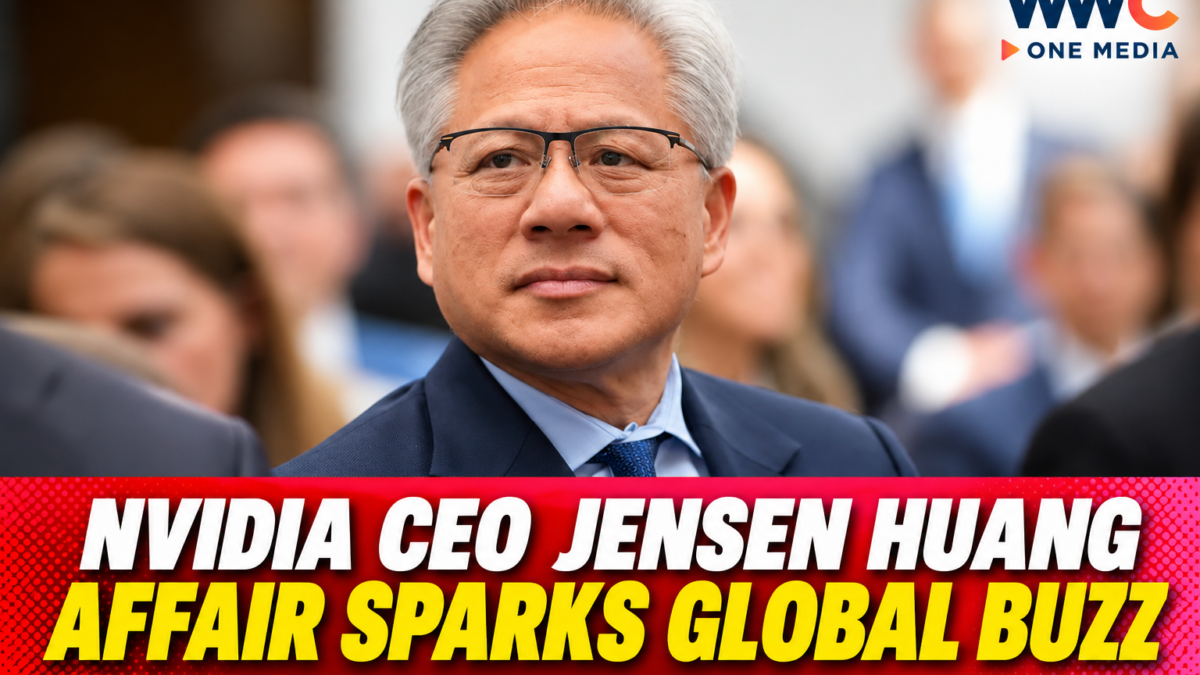
Nvidia CEO Jensen Huang Faces Shareholder Lawsuit as China Spy Allegations Trigger New Corporate Crisis
SANTA CLARA, California — November 11, 2026 — Nvidia CEO Jensen Huang is facing a growing corporate and national security controversy after a shareholder filed a lawsuit accusing the artificial intelligence chipmaker and its chief executive of misleading investors about a reported personal relationship involving a business executive suspected by US intelligence officials of gathering information for China.
The lawsuit adds another layer of pressure on Nvidia, whose advanced processors have become essential to the global artificial intelligence industry.
At the center of the controversy is Alice Huang, a former executive associated with Singapore-based Megaspeed International. US intelligence officials reportedly suspect that she gathered information for Beijing, according to earlier reporting by The New York Times.
Jensen Huang has acknowledged being unfaithful to his wife and apologized to his family and colleagues. However, he has not publicly admitted to espionage or knowingly assisting a foreign intelligence operation.
The latest lawsuit alleges that Nvidia and Huang failed to disclose information that could have affected investors’ understanding of the company’s business risks, particularly its relationship with Megaspeed and concerns surrounding the possible diversion of advanced AI chips to China.
The allegations remain unproven, and Nvidia’s independent investigation has not established that company secrets or national security information were compromised.
Shareholder Lawsuit Puts Nvidia’s Business Disclosures Under the Spotlight
The proposed class-action lawsuit was filed in federal court in San Jose, California, by investor Mark Kistenmacher.
According to reporting by the Associated Press and Reuters, the complaint accuses Nvidia and Huang of misleading shareholders about the potential risks surrounding the reported relationship and Megaspeed’s business activities.
The lawsuit seeks unspecified damages on behalf of investors who purchased Nvidia shares during the period identified in the complaint.
The central argument is that investors were not adequately informed about potential national security, reputational and commercial risks associated with the allegations.
The case also raises questions about Nvidia’s earlier assurances concerning Megaspeed.
However, a shareholder complaint represents allegations made by a plaintiff, not a judicial determination that Nvidia committed securities fraud.
The company will have an opportunity to respond through the legal process.
Who Is Alice Huang and Why Is Megaspeed Under Investigation?
Alice Huang, also identified in reporting as Huang Le, is a Chinese businesswoman who previously held senior positions in China’s financial sector before becoming associated with Singapore-based Megaspeed International.
A Reuters investigation published November 10 examined more than 30 publicly available corporate records, financial documents and company materials concerning her business background.
Reuters reported that she became Megaspeed’s controlling shareholder in 2023, although subsequent corporate ownership arrangements became more complicated.
Megaspeed operates in the cloud-computing and artificial intelligence infrastructure sector and has identified itself as an Nvidia cloud partner.
The company attracted scrutiny over suspicions that advanced Nvidia processors acquired through overseas business arrangements could have reached Chinese customers despite US export restrictions.
This distinction is important: Megaspeed’s purchase of Nvidia hardware does not, by itself, establish an export-control violation.
Investigators must determine the actual recipients, destinations, transactions and applicable licensing requirements.
The New York Times previously reported that Megaspeed purchased more than $4.8 billion worth of Nvidia chips over two years.
Separately, Reuters reported November 10 on claims published by The Information that a network of companies associated with Alice Huang and her relatives helped facilitate at least $7.5 billion in Nvidia chip shipments to Chinese firms.
These are different reported figures based on different reporting and should not be combined or treated as independently established illegal transactions.
Nvidia Launches Independent Investigation Into Its CEO
The controversy escalated on November 8 when Nvidia’s board announced an independent investigation into reports that Huang may have been the target of a foreign intelligence effort.
The announcement followed Huang’s acknowledgment to employees that he had been unfaithful to his wife.
In his message, he apologized to his family and colleagues and accepted responsibility for his personal conduct.
He also pledged to cooperate with the board’s investigation.
Nvidia’s independent directors said they had no reason to believe that national security or the company’s confidential information had been compromised.
The board nevertheless decided that an independent review was necessary given the seriousness of the allegations.
Huang remains chief executive while the investigation proceeds.
The company has not announced that he is stepping down or that a leadership change is underway.
US Government Scrutiny Could Expand Beyond Nvidia
The controversy is no longer limited to Nvidia’s corporate governance.
US lawmakers are increasingly concerned about whether existing export-control measures are sufficient to prevent advanced artificial intelligence chips from reaching restricted Chinese customers.
Reuters reported that senior Republican lawmakers requested a closed-door briefing from Huang concerning the allegations and Nvidia’s security procedures.
The request is particularly significant because Nvidia occupies a central position in America’s technological competition with China.
Advanced AI processors are used to train and operate sophisticated artificial intelligence systems, including technologies that may have military and intelligence applications.
The political pressure could also strengthen support for additional semiconductor export restrictions.
Reuters reported November 10 that lawmakers were discussing proposals including:
- The AI Overwatch Act, which would expand congressional involvement in certain advanced chip-export decisions.
- The Chip Security Act, which would strengthen chip-tracking requirements to combat diversion.
- The MATCH Act, which would encourage tighter controls involving semiconductor manufacturing equipment and China.
These are legislative proposals, not automatically enacted laws.
Their eventual impact will depend on congressional negotiations and the final legislative process.
Nvidia’s Stock Market Losses Add to Investor Anxiety
The controversy has also affected investor confidence.
According to the Associated Press, Nvidia shares fell approximately 4.3% on Monday, November 9, eliminating around $190 billion in market value in that trading session.
Reuters subsequently reported that the company’s market capitalization declined by approximately $430 billion over two trading sessions amid the widening controversy and related concerns.
These figures refer to different measurement periods and should not be presented as the same loss.
For investors, the concern extends beyond the immediate stock reaction.
Nvidia’s valuation is closely tied to expectations that demand for AI computing will continue growing rapidly.
Any uncertainty involving its leadership, export compliance, customer relationships or ability to maintain access to international markets could affect those expectations.
Nevertheless, a decline in share price does not establish that the company has committed wrongdoing.
Why This Case Matters to the Global AI Industry
Nvidia is more than a semiconductor manufacturer.
Its graphics processing units power data centers, cloud computing infrastructure and artificial intelligence systems used by major technology companies worldwide.
The company’s position makes it particularly sensitive to US-China geopolitical tensions.
Washington has imposed restrictions on certain advanced semiconductor exports to China because of national security concerns.
China, meanwhile, continues investing in domestic semiconductor development and alternative AI computing infrastructure.
The Megaspeed controversy highlights a difficult enforcement challenge: advanced chips can pass through distributors, cloud providers, overseas facilities and other intermediaries before reaching their ultimate users.
Regulators therefore need to distinguish legitimate international computing businesses from arrangements that deliberately circumvent applicable export restrictions.
For Nvidia, the challenge is maintaining its global commercial position while demonstrating that its internal safeguards and customer-verification procedures are effective.
What Happens Next?
Three developments will be particularly important in determining the direction of this story.
First, Nvidia’s independent investigation.
The board must determine whether the reported relationship created any actual security or corporate governance risks.
Second, the shareholder lawsuit.
The legal proceedings could force closer examination of Nvidia’s public statements, disclosures and internal handling of the Megaspeed controversy.
Third, government investigations and congressional oversight.
US authorities may seek additional information about chip shipments, customer networks and possible access to sensitive corporate information.
Until those processes produce verifiable findings, the allegations must remain clearly identified as allegations.
The Bigger Question: Can Nvidia Protect Its AI Dominance?
Jensen Huang has spent decades building Nvidia into one of the most influential companies in the technology industry.
Its processors have become foundational to the current AI boom, making the company’s leadership and corporate reputation particularly important to investors.
But the emerging controversy presents Nvidia with a different kind of challenge.
Beyond product innovation and competition, the company must now address questions involving corporate transparency, national security, international business relationships and investor protection.
The shareholder lawsuit does not establish that Nvidia or Huang committed fraud or espionage.
Likewise, the board investigation does not establish that company secrets were compromised.
What happens next will depend on the evidence uncovered by investigators, the outcome of the legal proceedings and the company’s ability to restore confidence.
For now, the biggest question facing Nvidia is no longer simply how quickly it can build the next generation of AI chips.
It is whether the world’s leading AI chipmaker can protect its business, leadership and reputation while caught in an increasingly sensitive US-China technology conflict.