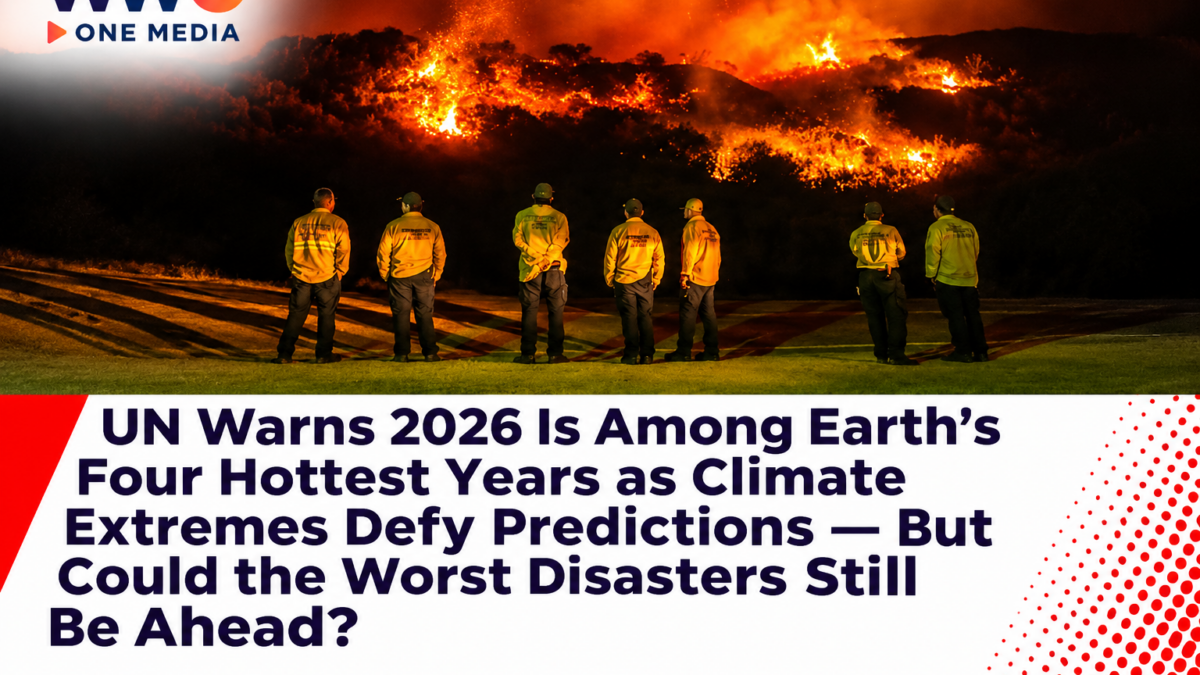
ANTALYA, TÜRKIYE / MANILA, PHILIPPINES — November 11, 2026 — Scientists can predict with considerable confidence that continued greenhouse-gas emissions will make the world hotter. What remains far harder is knowing exactly where the next devastating flood, unprecedented heatwave or prolonged drought will strike—and just how destructive it will become.
That growing challenge is at the center of a Bloomberg climate analysis published on November 10, as governments gather for the United Nations COP31 climate summit.
The warning comes as the World Meteorological Organization confirms that 2026 is expected to rank among the four hottest years ever recorded, with January-to-September global temperatures averaging approximately 1.47°C above the preindustrial baseline.
At the same time, Earth’s oceans are accumulating extraordinary amounts of heat, global sea levels have reached record highs, and an intensifying El Niño is expected to increase the risk of disruptive weather into 2027.
These developments are raising difficult questions for governments, insurers, businesses and communities.
Climate models are essential tools for understanding future risks. But the planet is a complex system where changes in clouds, oceans, ice sheets, vegetation and atmospheric circulation interact in ways that can produce unexpected regional outcomes.
The result is an increasingly uncomfortable reality: the world knows enough to understand that climate risks are growing, yet many countries remain poorly prepared for the range of disasters they could face.
With climate change pushing global temperatures toward unprecedented levels, can governments build protection fast enough—or will the next generation of extreme events expose dangers even advanced scientific models struggle to anticipate?
COP31 Opens as Global Temperatures Approach Dangerous Levels
The COP31 climate summit began on November 9 in Antalya, Türkiye, bringing together representatives from nearly 200 countries.
The conference runs through November 20.
Governments are discussing emissions reductions, clean energy, adaptation, climate finance and the implementation of commitments made under the Paris Agreement.
But the negotiations are taking place against a deteriorating climate backdrop.
The WMO’s latest report confirms that the years from 2015 through 2026 are expected to be the 12 warmest in the instrumental record.
The period from 2023 through 2026 is expected to include the four warmest years.
From January through September 2026, the global average surface temperature was approximately 1.47°C above the 1850–1900 average, with an uncertainty range of about 0.13°C.
The figure is not the finalized average for the full year.
Nor does one unusually hot year automatically establish that the Paris Agreement’s long-term temperature threshold has been permanently crossed.
The distinction matters because the Paris goals concern sustained global warming, not an individual month’s or year’s temperature.
Nevertheless, the underlying trend is clear.
Human-caused warming continues, and short-term natural climate fluctuations are adding to its effects.
As WWC ONE MEDIA reported on the opening of COP31 and the urgency of stronger climate action, the central challenge for negotiators is translating international promises into measurable emissions cuts and practical protection for vulnerable communities.
Why Climate Change Is Becoming Harder to Predict Locally
Climate scientists use sophisticated computer models to simulate how the atmosphere, oceans, land and ice respond to changing greenhouse-gas concentrations.
These models have successfully identified the broad direction of global warming.
They project increasing average temperatures, rising seas, more frequent intense heat and changes in precipitation patterns.
But predicting an individual region’s future climate is more difficult than estimating the planet’s long-term average temperature.
Local weather depends on numerous interacting processes.
Ocean temperatures can influence rainfall across distant continents.
Mountains and coastlines affect wind patterns and precipitation.
Changes in cloud cover can influence how much solar energy the planet absorbs.
Land use can change how heat and water move through the environment.
And natural variability can temporarily reinforce or weaken the effects of human-caused warming.
These processes create uncertainty about exactly how individual places will experience climate change.
For example, scientists can determine that warmer air can hold more moisture, increasing the potential for intense rainfall.
But forecasting the exact location and timing of an exceptional rainstorm months or years in advance is a different task.
Climate projections describe changing risks and possible conditions, not a calendar of future disasters.
The Earth’s Energy Imbalance Is Reaching Record Levels
One of the most important findings in the WMO report concerns Earth’s energy imbalance.
The planet receives energy from the sun and releases energy back into space.
Greenhouse gases interfere with that balance by reducing the amount of heat that escapes.
As a result, Earth retains additional energy.
The WMO says the imbalance has reached its highest level since monitoring began.
This matters because rising surface temperatures represent only part of the change.
Much of the excess energy is stored in the oceans.
The WMO estimates that the ocean absorbs approximately 90% of the excess heat accumulating in the climate system.
That heat does not disappear when air temperatures temporarily decline.
It continues affecting ocean conditions, marine ecosystems, sea levels and atmospheric processes.
The imbalance is also a reminder that the climate system can continue responding to accumulated heat over long periods.
Even when emissions stabilize, some consequences of past warming can persist.
Ocean Heat Sets Records and Raises Storm Risks
The WMO reports that ocean heat content reached a record in 2025 and has continued increasing in preliminary 2026 observations.
The upper 2,000 meters of the global ocean have accumulated exceptional amounts of energy.
This warming has major consequences.
Warmer water expands, contributing to rising sea levels.
Ocean heat can also provide energy that supports the intensification of tropical cyclones when other atmospheric conditions are favorable.
Marine heatwaves place stress on coral reefs and other ecosystems.
Warming can alter the distribution of fish and affect coastal livelihoods.
However, ocean warming does not mean that every tropical cyclone will become stronger or that every ocean region will experience identical changes.
Storm development still depends on wind shear, moisture, atmospheric circulation and other environmental factors.
The scientific concern is that the background conditions supporting damaging extremes are changing.
For coastal countries, the combination of warmer oceans and higher sea levels can increase the consequences of storm surges and coastal flooding.
Sea Levels Are Rising—and the Risks Are Uneven
Global mean sea level reached a record high in 2026, according to the WMO.
The satellite record begins in 1993.
Sea-level rise is driven primarily by warming seawater expanding and the addition of water from melting land ice.
But its consequences vary considerably by location.
Some coastlines experience additional risk because the land itself is sinking.
Others are affected by ocean circulation, tides or regional geological processes.
This means a global sea-level average cannot by itself tell a city how much flooding to expect along a particular road or waterfront.
Local planning requires detailed elevation data, drainage assessments, storm-surge modeling and information about land subsidence.
The distinction is particularly important for densely populated coastal areas.
Even modest increases in average sea level can increase the likelihood that high tides and storm surges reach infrastructure that was previously less exposed.
Waiting for absolute certainty about every local outcome can leave communities vulnerable to damage that could have been reduced through earlier planning.
El Niño Could Make Late 2026 and 2027 Even More Dangerous
The WMO says a powerful El Niño has intensified since August 2026 and is expected to increase climate risks into early 2027.
El Niño is a natural climate phenomenon involving changes in tropical Pacific Ocean temperatures and atmospheric circulation.
It can influence weather far beyond the Pacific.
Depending on the region and season, El Niño may increase the likelihood of drought, heavy rainfall or unusually high temperatures.
The WMO says El Niño typically adds approximately 0.1°C to 0.2°C to global average temperatures.
That additional warming occurs on top of the long-term increase caused by greenhouse gases.
But El Niño is not a universal drought forecast.
Some regions may experience wetter conditions, while others may become drier.
Even within a country, rainfall effects can vary considerably.
For the Philippines, the possibility of extended dry conditions makes water-supply planning and agricultural preparedness especially important.
As WWC ONE MEDIA reported on the threat of dry spells and drought across Philippine provinces through March 2027, forecasts should guide preparations without being mistaken for guarantees that every province will experience severe drought.
Climate Models Can Be Useful Even When They Are Imperfect
The uncertainty surrounding individual climate impacts can create a dangerous misunderstanding.
Some people interpret differences between projections and observed events as evidence that climate science is unreliable.
But models are not expected to reproduce the exact sequence of future weather.
They are designed to describe how climate conditions and risks change under different assumptions.
Their accuracy must be evaluated against the particular question they are trying to answer.
A projection of long-term global warming is different from a forecast of rainfall in one municipality next August.
A model may perform well at estimating large-scale warming while having greater uncertainty over regional rainfall patterns or particular extremes.
Scientists continually improve models by comparing them with observations and refining their understanding of physical processes.
Better satellite measurements, ocean monitoring and computing technology help improve assessments.
Nevertheless, some uncertainty will remain.
The appropriate response is not to ignore scientific information.
It is to use ranges of possible outcomes and prepare infrastructure for plausible risks rather than one supposedly exact future.
Climate Tipping Points Add Another Layer of Uncertainty
A major concern involves potential tipping points in the Earth’s climate system.
A tipping point refers to a threshold beyond which a system may undergo substantial change that becomes self-reinforcing or difficult to reverse.
Examples under scientific investigation include changes involving ice sheets, forest ecosystems and large-scale ocean circulation.
The precise thresholds and timing remain uncertain.
This does not mean scientists know that every proposed tipping point will be crossed within a specific number of years.
Nor does it establish that an abrupt global catastrophe is inevitable.
The concern is that some processes may respond nonlinearly to additional warming.
A system can appear relatively stable for an extended period and then change more rapidly once important conditions are altered.
Such possibilities strengthen the case for reducing emissions and examining low-probability but high-impact outcomes.
For policymakers, climate risk management must consider consequences that cannot be predicted with absolute precision.
The Paris Agreement’s 1.5°C Goal Is Under Growing Pressure
The latest UN Environment Programme assessment shows how much climate ambition has fallen behind the required pace.
Its Emissions Gap Report 2026 estimates that existing policies could lead to approximately 2.8°C of warming during this century, with temperatures potentially continuing to rise afterward.
If countries fully implement their current national climate commitments and sustain comparable action, UNEP estimates warming could be limited to about 2.6°C.
These are scenarios based on policy assumptions.
They are not guaranteed temperature outcomes.
UNEP also assessed a pathway in which warming temporarily exceeds 1.5°C before returning to or below that level by the end of the century.
To approach that pathway, global greenhouse-gas emissions would need to fall approximately 18% by 2030 and 45% by 2035, relative to 2025 levels.
The scale of the reductions demonstrates why governments are under pressure to accelerate their transition toward cleaner energy.
But emissions reductions and adaptation are complementary.
Cutting emissions limits future warming.
Adaptation helps protect people from risks already developing.
Neither can completely replace the other.
A Small Decline in Fossil-Fuel Emissions Does Not Mean the Crisis Is Over
One development at COP31 offers a limited source of optimism.
The Global Carbon Budget 2026 assessment projects that carbon dioxide emissions from fossil fuels could fall approximately 0.4% during the year.
Higher energy prices, the expansion of renewable electricity and other economic changes have contributed to the slowdown.
However, the projected decline is small.
It also does not establish that global fossil-fuel emissions have permanently peaked.
More importantly, total carbon dioxide emissions including land-use change are projected to increase.
Deforestation, land conversion and other activities can release additional carbon into the atmosphere.
As WWC ONE MEDIA examined in its coverage of the projected 0.4% fall in fossil-fuel emissions, emissions figures must be evaluated according to what they include.
A small decrease in one category does not necessarily mean total human-caused carbon pollution is falling.
And even if annual emissions decline, atmospheric carbon dioxide can continue accumulating while emissions remain greater than the amount absorbed by natural and technological processes.
The Philippines Is Already Facing Difficult Climate Decisions
The scientific uncertainty surrounding extreme weather has immediate implications for the Philippines.
The country is exposed to tropical cyclones, flooding, extreme heat, drought and sea-level rise.
Its geography and population distribution create significant challenges for infrastructure planning.
Scientists can identify many of these hazards.
But predicting the exact consequences of future storms for individual communities requires detailed local information.
A flood-risk assessment must consider rainfall, river conditions, drainage capacity, land use and the location of homes and businesses.
A coastal vulnerability study must examine sea-level change, storm surge and local elevation.
A drought plan must account for water storage, crop requirements, irrigation and expected rainfall.
The challenge is therefore translating global climate science into decisions that local governments can implement.
As WWC ONE MEDIA reported on the Philippine government’s decision to revisit long-standing flood-control planning, the value of a climate forecast depends partly on whether authorities act on the information.
Better predictions cannot prevent disasters if infrastructure remains inadequate or warnings fail to reach vulnerable communities.
Climate Finance Must Address Uncertain but Growing Losses
One of the most difficult issues at COP31 is how to finance protection against climate impacts.
Developing countries are demanding greater access to funding for adaptation and recovery.
But estimating future climate-related losses is complicated.
The cost of a disaster depends not only on the hazard itself, but also on how many people and assets are exposed.
A severe storm striking a sparsely populated area may cause less financial damage than a weaker storm hitting a densely populated coastal city.
Building standards, early-warning systems, emergency response and insurance coverage can also influence outcomes.
That means climate-loss projections should not be mistaken for fixed future bills.
They are estimates under particular assumptions.
For the Philippines, a major policy development is the government’s effort to improve its approach to climate-related loss and damage.
As WWC ONE MEDIA reported on the Department of Environment and Natural Resources and UNDP’s new loss-and-damage strategy, the country is trying to strengthen assessments of climate impacts and improve access to international support.
The initiative is important because financial planning must account for both predictable long-term pressures and potentially severe events whose precise timing remains uncertain.
Yolanda Remains a Warning About Coastal Vulnerability
The Philippines’ experience with Super Typhoon Yolanda, internationally known as Haiyan, demonstrates why disaster preparedness matters.
The 2013 catastrophe caused extensive destruction across the central Philippines.
Its impact revealed the vulnerability of coastal settlements to extreme winds and storm surges.
But no single historical disaster can provide a complete description of the storms future generations will face.
Changing climate conditions, population growth and development patterns can alter risk.
Coastal ecosystems may also influence exposure.
Mangroves can help reduce wave energy and provide ecological benefits, although their protective effectiveness depends on their extent, condition and local geography.
As WWC ONE MEDIA reported on Eastern Samar’s renewed calls for mangrove protection and disaster preparedness on Yolanda’s thirteenth anniversary, conservation and infrastructure planning are part of a broader resilience strategy.
Nature-based protection should complement effective evacuation systems, hazard mapping and resilient construction—not replace them.
Why Better Forecasting Alone Will Not Be Enough
The WMO emphasizes the importance of observations, forecasts and early-warning systems.
But forecasting is only one part of protecting communities.
A warning can identify the possibility of dangerous rainfall.
Local authorities must still determine whether to evacuate residents or close vulnerable roads.
A seasonal outlook can identify elevated drought risk.
Water managers must then assess supplies and develop conservation measures.
A long-term sea-level projection can show growing coastal exposure.
Planners must decide where to build, strengthen or relocate infrastructure.
Effective adaptation therefore depends on institutions, financing and public communication.
Governments should also avoid treating one projection as the only possible outcome.
Infrastructure designed to withstand a wider range of plausible conditions may offer stronger protection than projects based on a single expected scenario.
The objective is to make decisions that remain useful even when future conditions differ from today’s estimates.
COP31 Faces a Difficult Choice Between Ambition and Implementation
Negotiators in Antalya are considering ways to accelerate emissions reductions while protecting vulnerable populations.
Türkiye has promoted a goal of raising electricity’s share of global final energy consumption to 35% by 2035.
Supporters argue that electrification can reduce dependence on fossil fuels in transportation, heating and industry.
Critics warn that electrification produces much smaller climate benefits if the additional electricity is generated from high-emissions sources.
That debate illustrates a recurring problem.
A policy target may sound straightforward, but the actual emissions benefits depend on how it is implemented.
Similarly, climate-adaptation commitments must lead to functioning infrastructure and effective services.
Countries need measurable progress rather than only additional promises.
The scientific uncertainty surrounding some climate impacts makes preparation more important, not less.
Waiting until every future hazard can be predicted precisely would leave people exposed to risks that are already growing.
The Bigger Picture: The Greatest Climate Risk May Be Failing to Prepare for Uncertainty
Global warming has reached a stage where its broad scientific direction is firmly established.
Greenhouse gases are trapping more heat.
Oceans are warming.
Sea levels are rising.
And many extreme-weather risks are increasing.
The WMO’s latest assessment confirms that 2026 is among the hottest years ever observed.
UNEP warns that existing government policies remain insufficient to achieve the Paris Agreement’s temperature goals.
Yet the exact geography, timing and severity of future climate disasters remain difficult to forecast.
That uncertainty is not a reason to dismiss the threat.
It is a reason to invest in stronger monitoring, climate-resilient infrastructure, early-warning systems and emissions reductions.
For countries such as the Philippines, the need is especially urgent.
Communities cannot afford to wait for scientists to identify the exact date of the next devastating storm or drought.
Governments must make decisions using the best available evidence while acknowledging the range of possible outcomes.
The world is entering a period of record ocean heat, rising seas and increasingly dangerous weather extremes, even as scientists refine their understanding of how the climate system will respond. But with COP31 struggling to close the gap between promises and action, will governments prepare for the risks they already understand—or could the most devastating consequences emerge in places where the world least expects them?