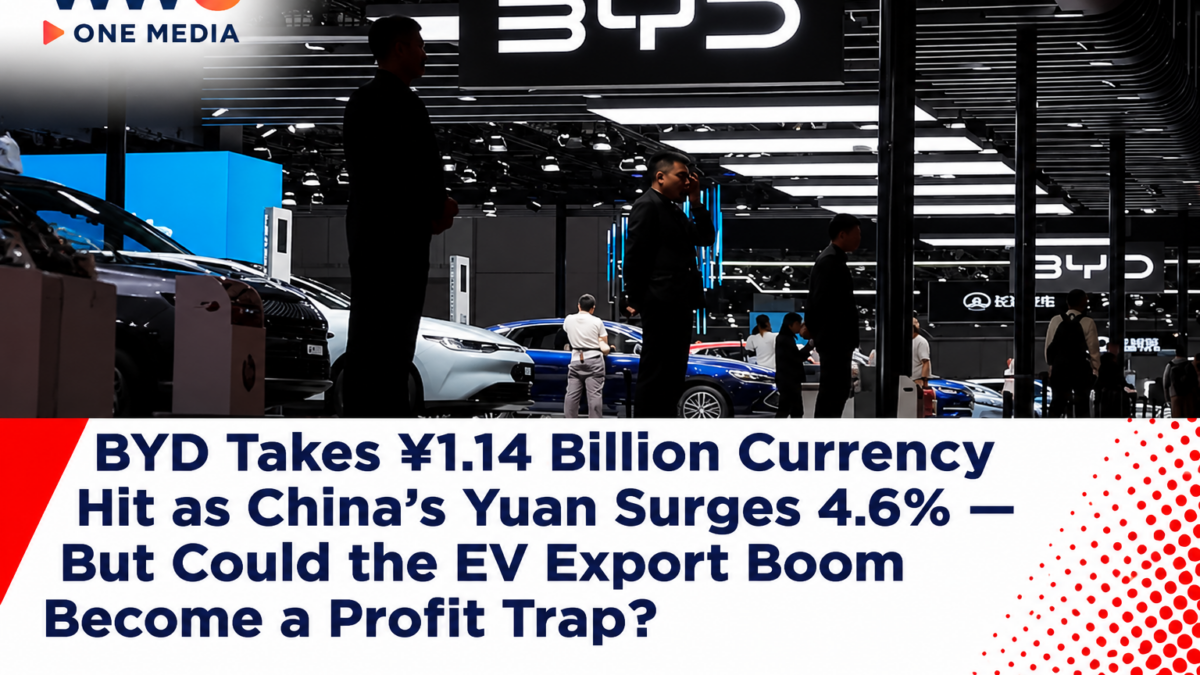
BEIJING / HONG KONG / MANILA — November 11, 2026 — China’s electric-vehicle giants are conquering overseas markets at a remarkable pace, but an unexpected financial threat is beginning to undermine their success: their own country’s strengthening currency.
As BYD, Geely, Chery and other Chinese automakers expand across Europe, Asia and emerging markets, the yuan’s rally is reducing the value of some international earnings when converted back into Chinese currency.
The problem comes at an especially difficult moment.
Domestic vehicle demand remains weak, price wars are putting pressure on profitability, and export markets have become increasingly important to manufacturers seeking new growth.
According to Bloomberg’s November 10 reporting, BYD recorded a 1.14 billion yuan, or approximately US$171 million, foreign-exchange-related cash impact, while Geely’s currency losses weighed on its reported earnings.
Geely’s underlying profit measure increased 41% during the first nine months of 2026, but reported net profit growth was limited to 6.7%.
Meanwhile, the onshore yuan had appreciated approximately 4.6% against the US dollar during the year, making it one of Asia’s strongest-performing currencies.
For China’s automakers, this creates a difficult financial paradox.
They need overseas sales to escape the brutally competitive domestic market.
But a stronger yuan can make their export earnings worth less, reduce their pricing flexibility and complicate the economics of international expansion.
Chinese automakers are selling more vehicles around the world than ever before. But could the currency supporting China’s broader financial strength become a serious threat to the profitability of its electric-vehicle revolution?
The Yuan Rally Creates a New Problem for Chinese Automakers
Chinese exporters face a basic currency challenge.
Many foreign customers pay for goods in dollars, euros or other currencies.
But Chinese companies often report their earnings in yuan and pay substantial domestic expenses in the same currency.
When the yuan strengthens, the value of foreign-currency revenue can decline after conversion.
For example, imagine an automaker receives $10,000 for a vehicle sold abroad.
At an illustrative exchange rate of 7.20 yuan per dollar, that payment is worth 72,000 yuan.
If the yuan strengthens to 6.90 per dollar, the same $10,000 payment is worth only 69,000 yuan.
The difference is 3,000 yuan, or about 4.2%, before considering changes in costs, financial hedges and contractual arrangements.
That is a simplified example, not a calculation of the actual currency loss on a specific BYD or Geely vehicle.
The actual effect varies depending on the currency used for payment, where the car is manufactured, when revenue is recognized and how the company manages foreign-exchange exposure.
But the principle explains why strong overseas sales do not automatically guarantee stronger profits.
BYD Records a ¥1.14 Billion Foreign-Exchange Impact
BYD has become one of the most influential automotive manufacturers in the world.
Its vehicles are increasingly visible in Europe, Southeast Asia, Latin America and other regions.
The company’s international expansion has helped compensate for intense competition at home.
Yet its financial reporting demonstrates the risks associated with currency movements.
Bloomberg reported that BYD suffered a foreign-exchange-related cash impact of 1.14 billion yuan.
That is approximately $171 million using the conversion cited in the report.
The amount is significant, but it requires careful interpretation.
It should not be described as a company-wide net loss.
BYD remains a major revenue-generating manufacturer with profitable operations.
Nor should the currency impact be assumed to represent an equal loss on every exported vehicle.
Foreign-exchange effects can arise from cash balances, receivables, payables and other financial exposures, not just the conversion of completed vehicle sales.
Nevertheless, the figure demonstrates that currency management has become an important issue for the company’s international strategy.
Geely’s Underlying Profit Growth Is Partly Eroded by Currency Losses
Geely Automobile is confronting a similar problem.
According to Bloomberg, Geely reported a net foreign-exchange loss during the first nine months of 2026, compared with a foreign-exchange gain during the corresponding period a year earlier.
The shift affected its reported financial performance.
While Geely’s underlying profit measure increased 41%, its reported net profit grew by only 6.7% over the same nine-month period.
However, the gap between those two growth rates should not be attributed entirely to the yuan without examining the definitions and reconciliation of the company’s financial measures.
Underlying and reported earnings can differ because of several adjustments.
The key finding is that foreign-exchange movements were a material headwind.
For investors, this illustrates why a company’s operational performance may appear stronger than its headline profit growth.
A carmaker can manufacture more vehicles, expand sales and improve certain aspects of its business while currency movements create additional financial pressure.
China’s October Vehicle Exports Jump 68.2%
The latest export data demonstrate why Chinese manufacturers are so determined to expand internationally.
According to Reuters, citing the China Passenger Car Association, passenger-vehicle shipments overseas increased 68.2% year over year to approximately 932,000 units in October 2026.
That followed 923,000 overseas shipments in September.
Domestic passenger-vehicle sales, meanwhile, fell 27.3% to approximately 1.65 million vehicles in October.
The contrast is extraordinary.
Chinese automakers are finding strong overseas demand while struggling to maintain momentum at home.
However, those figures cover the broader passenger-vehicle market, not exclusively battery-electric cars.
The export total includes different propulsion types, and it should not be labeled as 932,000 fully electric vehicles.
The figures nevertheless demonstrate how international markets have become increasingly important for China’s automotive industry.
As WWC ONE MEDIA examined in its report on China’s anticipated seven-million-car export boom, overseas growth is giving manufacturers new opportunities while exposing them to tariffs, shipping expenses and other commercial risks.
The yuan’s appreciation adds another challenge to that list.
BYD’s Overseas Shipments More Than Double
BYD’s October results demonstrate the strength of its international strategy.
Reuters reported that the company sold 490,168 vehicles during the month, an increase of 11% from a year earlier.
Its overseas shipments rose approximately 102.8% to 170,194 vehicles.
That expansion helped offset weaker domestic demand.
The results underline the increasingly global nature of BYD’s business.
A manufacturer that once depended heavily on China’s home market is developing a much broader international customer base.
But the strategy introduces new operating and financial complexities.
More overseas sales mean greater exposure to foreign-currency receipts, local regulations, distribution expenses and international competition.
Companies may also need to support after-sales service, spare parts and charging infrastructure in new markets.
The financial success of the strategy depends not only on how many vehicles are sold, but also on how much profit remains after all those costs.
China’s Domestic Price War Is Forcing Automakers Abroad
The pressure to expand overseas is rooted in conditions inside China.
Competition among automakers has become intense.
Companies are using discounts, new features and frequent model launches to attract buyers.
Chinese manufacturers benefit from large domestic supply chains and substantial production capacity.
But the same advantages have contributed to a crowded market where competitors struggle to maintain pricing power.
When manufacturers compete aggressively on price, profit margins can shrink even if sales remain strong.
This helps explain why companies are looking abroad.
Foreign markets may offer higher selling prices or opportunities to establish stronger brand positions.
For some models, overseas gross profit per vehicle can be substantially higher than domestic gross profit.
However, higher overseas margins can be reduced by tariffs, freight charges, sales commissions, local taxes and foreign-exchange losses.
The potential benefit of international expansion is therefore real, but it is not guaranteed.
The Yuan Has Strengthened Nearly 5% Against the Dollar
China’s currency has experienced a substantial rally during 2026.
Bloomberg reported that the onshore yuan had strengthened 4.6% against the US dollar at the time of its November 10 coverage.
Reuters independently reported earlier in November that the currency had gained nearly 5% against the dollar and approximately 9% against the euro during the year.
The differences reflect reporting dates and currency measurements.
The broader trend is consistent.
Yuan appreciation is making foreign-currency revenue less valuable when translated into yuan, all else being equal.
But currency strength also has potential advantages.
A stronger yuan can lower the local-currency cost of imported materials, machinery and other products priced in foreign currencies.
Companies with foreign-currency debt may also benefit when the yuan appreciates.
The net impact depends on the balance between foreign revenue, overseas costs, imports, borrowing and hedging arrangements.
That is why the effect differs across automakers.
Reuters Finds Chinese Exporters Already Have Thin Profit Margins
The pressure extends beyond electric vehicles.
In its November 5 analysis, Reuters examined the financial performance of thousands of Chinese-listed companies.
The median net profit margin among 5,209 Chinese companies with market values of at least $100 million was approximately 4.9% during the first half of 2026.
For a comparison group of 9,733 international companies, the median was around 8.9%.
A separate Natixis study found particularly thin margins, approximately 2%, in strategic industries including electric vehicles, batteries, solar equipment, wind technology and semiconductors.
These are broad industry comparisons, not precise profit margins for BYD or Geely individually.
But they help explain the vulnerability.
A company operating on narrow margins can experience substantial pressure from relatively modest changes in exchange rates.
Standard Bank estimated that a 1% appreciation in the yuan’s real effective exchange rate could reduce average export margins by around 30 basis points.
That is a model-based estimate, not a guaranteed outcome for every exporter.
Nevertheless, it shows why the currency is becoming a major concern for Chinese manufacturers.
Beijing Faces a Difficult Currency Policy Dilemma
Chinese policymakers are confronting competing pressures.
A stronger yuan can increase the international purchasing power of Chinese consumers and reduce the cost of imports.
It can also respond to the country’s enormous merchandise trade surplus and substantial export revenues.
However, rapid appreciation can weaken the competitive position of manufacturers that depend heavily on overseas markets.
For Beijing, export growth remains important because domestic consumption has struggled to recover fully.
Reuters reported that the People’s Bank of China has taken steps intended to moderate the pace of yuan appreciation.
These include changes affecting foreign-exchange reserve requirements and the management of daily exchange-rate expectations.
The central bank has not announced that it intends to engineer a sharp, sustained currency depreciation.
Its challenge is to limit disruptive exchange-rate movements while maintaining broader financial stability.
The government must also manage pressure from international trading partners who argue that the yuan remains undervalued despite its recent rise.
Foreign Governments Still Argue the Yuan Is Too Cheap
The currency debate has an international dimension.
European policymakers and some international financial institutions argue that the yuan remains undervalued relative to China’s economic strength.
They contend that a relatively cheap currency can increase the international competitiveness of Chinese exports.
China’s manufacturers, however, argue that even the recent appreciation has created serious problems because their profit margins are already thin.
These positions are not necessarily contradictory.
A currency may appear undervalued according to one long-term economic model while its short-term appreciation causes immediate financial pressure for particular exporters.
That distinction helps explain why disagreements persist.
Governments focus on trade balances, industrial competitiveness and the international monetary system.
Individual businesses focus on production costs, orders and profits.
For Chinese electric-vehicle manufacturers, the problem is practical: they must continue competing internationally regardless of where policymakers believe the exchange rate should eventually settle.
Tariffs Add Another Financial Burden
Currency appreciation is not the only obstacle confronting Chinese automakers.
The European Union imposes additional countervailing duties on certain battery-electric vehicles manufactured in China, on top of its standard vehicle import tariff.
The rates vary by producer and applicable arrangements.
These measures were introduced after European authorities investigated alleged subsidies and competitive injury involving Chinese electric vehicles.
As WWC ONE MEDIA analyzed in its report on China’s automotive manufacturing capacity and international overcapacity accusations, the dispute involves more than competition between Chinese-owned and Western-owned car brands.
Some Western companies also manufacture vehicles in China for export.
That complicates the politics of import restrictions.
For Chinese automakers, tariffs can raise the delivered cost of vehicles or force companies to accept lower margins.
When combined with a stronger yuan, those barriers can reduce the profitability of international sales.
Manufacturers may respond by adjusting prices, cutting costs or changing where vehicles are produced.
But every response involves trade-offs.
Overseas Factories Could Reduce Some Currency Risks
One possible response is to manufacture more vehicles closer to foreign customers.
Chinese automakers are increasingly developing production facilities outside China.
Local assembly or manufacturing can provide several advantages.
It may reduce freight expenses.
Depending on local rules and the amount of manufacturing performed, it may also help companies meet applicable trade requirements.
Producing vehicles in the same currency area where they are sold can reduce certain forms of exchange-rate mismatch.
For example, a factory earning euros and paying a significant share of its wages and local expenses in euros may be less exposed to changes in the euro-yuan rate than a factory producing entirely in China for European customers.
But local production does not eliminate currency risk.
Imported components may still be priced in yuan, dollars or other currencies.
Companies may also need to finance factories, manage unfamiliar labor regulations and establish new supplier networks.
Overseas manufacturing can reduce some risks while introducing others.
Foreign-Exchange Hedging Becomes More Important
Another response involves financial hedging.
Exporters can use instruments such as forward contracts and currency options to manage exchange-rate exposure.
A forward contract allows a company to arrange an exchange rate for a future transaction.
That can make expected revenue more predictable.
Currency options can provide protection against certain adverse movements, although they may involve premiums or other costs.
Hedging is not a guaranteed source of profit.
It is a risk-management strategy.
A company that locks in an exchange rate may give up some benefit if the currency later moves in its favor.
The effectiveness of a hedge also depends on its size, timing and the transactions being protected.
Reuters reported in September that Chinese financial regulators had encouraged banks to promote currency hedging among corporate customers.
The effort reflects concern about exporters’ exposure to a stronger yuan.
For automakers planning large international expansion programs, treasury and financial management are becoming increasingly important.
China’s Global Auto Expansion Could Face a Profitability Test
The latest developments illustrate why investors cannot judge automakers solely by vehicle shipments.
A manufacturer may report substantial export growth while encountering rising costs.
Shipping expenses can increase.
Tariffs may reduce pricing flexibility.
Currency movements can change the value of overseas earnings.
Research and development spending may remain elevated as companies compete on technology.
For investors, the key measures include operating margins, net profit, cash generation and the return on overseas investment.
Vehicle sales remain important, but they are not sufficient.
The recent earnings reports from Chinese automakers show this distinction.
BYD and Geely have benefited from international demand while facing financial pressures that complicate their results.
The question is whether their overseas businesses can generate sustainable returns as the market becomes more competitive.
Could Some Automakers Turn to Robotics for Growth?
The pressure on China’s automotive industry is also encouraging interest in related technologies.
Electric-vehicle companies have expertise in batteries, electric motors, sensors, software and manufacturing automation.
Some are applying that experience to robotics.
Companies associated with XPeng, BYD, Chery and other automotive groups have explored humanoid robots or automated systems.
As WWC ONE MEDIA reported on China’s EV companies expanding into robotics, some manufacturers see advanced robotics as a possible future business opportunity.
But these investments are not an immediate solution to yuan-related foreign-exchange losses.
Robotics markets have their own technology challenges, capital requirements and uncertain commercial demand.
The connection is broader.
Automakers facing tougher competition are searching for additional sources of growth.
Whether those projects become profitable remains to be seen.
The Philippines Is Becoming an Important Market for Chinese EV Brands
The international expansion of Chinese automakers is increasingly visible in the Philippines.
BYD has expanded its local lineup and distribution network as Filipino motorists show growing interest in electrified vehicles.
According to figures reported by BYD Cars Philippines, the brand sold 28,399 vehicles during the first eight months of 2026.
That represented approximately 99% growth from the comparable period in 2025.
Plug-in hybrids accounted for a substantial majority of those sales.
As WWC ONE MEDIA examined in its report on BYD’s Philippine sales boom, local demand is being supported by expanding consumer choices and interest in reducing fuel consumption.
However, Philippine retail sales should not be confused with China’s factory-export figures.
They measure different stages of the commercial process.
For Filipino car buyers, a stronger yuan could influence the cost of imported vehicles.
But that does not mean showroom prices will automatically rise in direct proportion to the currency’s appreciation.
Pricing depends on distributors, contracts, taxes, transport costs, competition and the manufacturer’s strategy.
A company may absorb some currency pressure to protect market share.
Alternatively, it may adjust prices or offer fewer discounts.
The outcome will depend on market conditions.
Could the Yuan Rally Make Chinese EVs More Expensive?
Currency appreciation creates several possible outcomes for overseas consumers.
If a Chinese automaker wants to maintain the same yuan-denominated revenue per vehicle, it may need to charge a higher price in foreign currency when the yuan strengthens.
That could make its cars less competitive.
Alternatively, the company could maintain foreign-currency prices and accept lower yuan-denominated revenue.
It could also seek savings through manufacturing efficiency, local sourcing or changes in logistics.
The final effect depends on how much pricing power the company has.
A brand facing little competition may find it easier to raise prices.
A manufacturer operating in a crowded market may need to absorb more of the pressure.
For electric vehicles, where buyers often compare specifications and prices closely, passing on currency costs could be particularly difficult.
This is why the yuan’s rally is becoming a strategic concern rather than merely an accounting issue.
What Investors Should Watch Next
Several developments will determine whether China’s automakers can manage the currency challenge.
The first is the direction of the yuan.
Further appreciation could increase pressure on exporters with unhedged foreign-currency exposure.
The second is domestic vehicle demand.
A recovery in China’s home market could reduce manufacturers’ dependence on overseas sales.
The third is export profitability.
Investors will monitor whether rapid shipment growth translates into stronger earnings and cash flow.
The fourth is international trade policy.
Tariffs, quotas and other restrictions could change the economics of exporting to major markets.
The fifth is overseas manufacturing.
New facilities may reduce certain costs but require substantial capital investment.
Finally, companies’ foreign-exchange hedging strategies will be important.
Strong operational performance must be supported by effective financial risk management.
The Bigger Picture: China’s EV Success Is Facing a Hidden Financial Threat
China’s automotive industry has achieved an extraordinary international expansion.
Its manufacturers have developed competitive electric and hybrid vehicles, large-scale manufacturing systems and growing global distribution networks.
Exports are accelerating even as domestic sales struggle.
BYD, Geely, Chery and other companies are competing increasingly effectively against established automotive brands.
But the financial picture is becoming more complicated.
The yuan’s 2026 appreciation is reducing the value of some overseas earnings.
Foreign-exchange losses are affecting reported results.
Tariffs and shipping costs are increasing the burden of international expansion.
And domestic price competition continues limiting profitability.
For Beijing, the challenge is balancing currency stability with the need to preserve export growth.
For automakers, the challenge is converting global sales success into sustainable profits.
And for investors, the central question is whether rapid international expansion can overcome the financial costs associated with currency movements, regulation and global competition.
China’s automakers are exporting record numbers of vehicles, but the yuan’s 4.6% rally has created a costly new obstacle. With BYD reporting a ¥1.14 billion foreign-exchange impact and Geely facing currency-related earnings pressure, can China’s EV giants protect their profitability as they conquer overseas markets—or could the world’s fastest-growing automotive export business become a financial trap?