
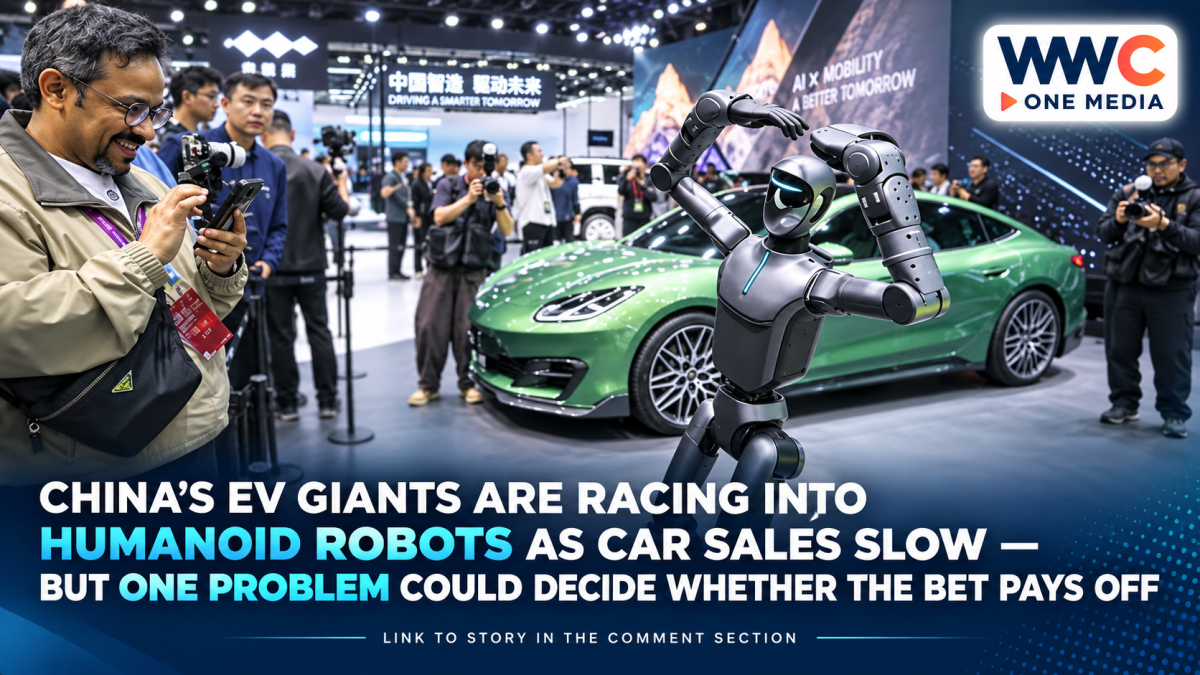
BEIJING — China’s electric-vehicle companies spent the past decade transforming themselves from automotive challengers into some of the world’s most aggressive technology manufacturers.
Now, with growth at home slowing and profit margins under pressure, several are looking beyond the car.
Humanoid robots are rapidly emerging as the next major bet.
Companies linked to XPeng, BYD, Chery, NIO, Xiaomi and other Chinese automotive groups are developing robots, investing in robotics companies or testing machines inside factories and retail environments, as the technologies behind smart EVs increasingly overlap with what engineers call embodied AI. CNBC described the push as an effort by automakers to find a second growth engine as competition in China’s EV industry intensifies.
But the shift raises a much bigger question:
Can China repeat its EV success in humanoid robots—or is the industry racing ahead of actual customer demand?
XPeng Is Moving Fastest From Cars to Humanoids
Among Chinese automakers, XPeng has made one of the clearest moves.
On September 8, the company announced that the first production-line-built version of its IRON humanoid robot had autonomously walked off a newly commissioned manufacturing line.
XPeng says more than 80% of the line’s core manufacturing processes are automated, with production methods adapted from its automotive operations.
That distinction matters.
Humanoid robot prototypes have become increasingly common. Building them repeatedly, reliably and cheaply enough for commercial deployment is a much harder challenge.
XPeng wants to begin mass production by the end of 2026, initially using IRON in its own stores and corporate campuses. Broader deliveries to customers in China and overseas are planned for 2027.
The company is not treating robotics as a side project.
Its robotics business recently raised more than $900 million, valuing the unit at over $6.3 billion. XPeng said the financing was the largest single private funding round yet recorded in China’s embodied-AI sector. IDG Capital led the round, while Tencent and Alibaba participated as strategic investors.
CEO He Xiaopeng has also taken personal leadership of the robotics business.
Why Car Companies May Have an Unexpected Advantage
At first glance, making an electric SUV and building a humanoid worker appear to be completely different businesses.
Underneath the surface, however, they share a surprising amount of technology.
Modern intelligent EVs already depend on:
- batteries and power-management systems;
- electric motors;
- cameras and other sensors;
- AI processors;
- autonomous-navigation software;
- sophisticated supply chains; and
- large-scale precision manufacturing.
Humanoid robots require many of the same capabilities.
That crossover is one reason analysts see automakers as potentially formidable competitors in robotics.
Reuters reported that carmakers view expertise in sensors, batteries, software and supply-chain management as transferable to humanoid machines.
Perhaps even more importantly, automakers have something many robotics startups lack: their own factories and stores where robots can immediately be tested.
Instead of waiting for outside customers, a manufacturer can put machines to work internally, collect operating data and improve them over time.
That could become a major advantage in physical AI, where high-quality real-world data is critical.
China’s Car Market Explains Why the Timing Matters
The robotics push is arriving during one of the most difficult periods China’s auto industry has experienced in years.
China’s domestic passenger-car sales fell 23.7% year over year in August 2026, according to China Passenger Car Association data reported by Reuters.
It was the 11th consecutive month of declining domestic sales.
China’s new-energy vehicles—which include battery EVs and plug-in hybrids—also recorded weakness.
Retail NEV sales reached approximately 1.005 million units in August, down 10.1% from a year earlier, marking the eighth consecutive month of year-over-year declines, according to CPCA data.
That does not mean Chinese EV demand has disappeared.
In fact, NEVs represented a record 65.2% of passenger-car retail sales in August because sales of conventional gasoline cars deteriorated even faster.
The more accurate picture is therefore a maturing and intensely competitive domestic market, rather than the end of China’s EV boom.
The Other Side of the Story: China Is Exporting More Cars Than Ever
There is another number that changes the entire narrative.
While domestic sales weakened, Chinese passenger-vehicle exports jumped 77.5% year over year in August to roughly 894,000 vehicles, according to Reuters citing CPCA data.
Exports of electric and plug-in hybrid vehicles surged 154.7%.
BYD and Geely were among manufacturers posting strong overseas shipments.
That means China’s automakers are not abandoning cars.
They are effectively pursuing two expansion strategies simultaneously: pushing aggressively into overseas auto markets while developing robotics and AI businesses that could become future growth engines.
Profit Margins May Be an Even Bigger Problem Than Sales
Sales growth is only part of the pressure.
CNBC reported, citing data referenced by Counterpoint Research, that the average profit margin across China’s vehicle manufacturing industry fell to around 1.5% during the first half of 2026.
Years of price competition have forced manufacturers to offer more technology at increasingly aggressive prices.
That has been good for many consumers, but it makes profitability harder.
It also creates a powerful incentive for automakers to find businesses where their existing investments in AI, batteries, chips and automation can generate additional revenue.
Humanoid robots fit that strategy remarkably well.
Chery Has Already Delivered Thousands of Robots
XPeng is hardly alone.
Chery Automobile, China’s largest vehicle exporter in recent years, has built a robotics affiliate called AiMOGA Robotics.
According to Reuters, AiMOGA had delivered more than 3,000 robots globally by August, including about 2,000 outside China, and was operating in more than 60 countries and regions.
The company is targeting 10,000 deliveries next year.
Its humanoid machines initially appeared in Chery dealerships, but AiMOGA has begun expanding into other applications, including public services and traffic management.
More than 100 units had already been deployed in Chinese cities for public-safety-related tasks, according to the company executive interviewed by Reuters.
AiMOGA is also considering an initial public offering to fund further expansion.
Its leadership nevertheless offered a notably cautious forecast: humanoid robots could require roughly a decade before reaching the stage of rapid widespread adoption.
BYD Wants Robots in Its Car Showrooms
The world’s biggest electric-vehicle manufacturers are also paying attention.
BYD Executive Vice President Stella Li said earlier this year that the company is developing humanoid robots and ultimately wants to place two or three robots in each BYD showroom.
She envisioned machines explaining vehicle features, demonstrating cars and assisting sales staff rather than fully replacing human workers.
BYD is also exploring heavier automation within manufacturing.
Li said advances in artificial intelligence and energy efficiency would still be necessary before humanoid robots could become truly practical in unpredictable household environments.
That caveat is important.
A robot capable of performing a repetitive factory task is very different from one able to function safely and independently inside someone’s home.
NIO Is Taking the Investment Route
Not every automaker is building its own humanoid from scratch.
NIO Capital, the investment arm associated with EV maker NIO, has backed robotics specialist LimX Dynamics.
NIO Capital participated again when LimX raised $200 million in Series B financing in February and remained an investor when the robotics company later completed a nearly $200 million pre-IPO round.
That approach gives an automaker exposure to the robotics sector without requiring it to manufacture its own humanoid immediately.
China Already Has a Huge Robotics Supply-Chain Advantage
China’s broader manufacturing ecosystem may be just as significant as the automakers themselves.
Reuters recently reported that Chinese manufacturers accounted for about 95% of global humanoid shipments in 2025, highlighting how quickly the country’s robotics supply chain has expanded.
China also has deep manufacturing capability in components such as motors, batteries, actuators, electronics and increasingly sophisticated robotic hands.
Those are precisely the kinds of scale advantages that helped Chinese companies push down EV and battery costs.
If the same industrial machine is successfully applied to humanoids, robot prices could fall much faster than many current forecasts assume.
But Building Robots Is Easier Than Finding a Business Model
This is where the excitement meets reality.
Despite extraordinary investment, humanoid robots remain technically immature for many everyday applications.
Machines can walk, run, lift boxes, navigate controlled environments and perform demonstrations—but reliability, dexterity, battery life, safety and autonomous decision-making remain significant obstacles.
Even some of China’s most advanced machines are still being tested on relatively controlled tasks such as moving objects inside factories or climbing stairs.
That makes the next stage very different from the EV race.
Consumers already understood what a car was supposed to do. Manufacturers mainly needed to make electric versions cheaper, more practical and more desirable.
With humanoids, companies must first prove which jobs people will actually pay robots to perform.
Investors Are Starting to Ask Harder Questions
The warning signs are already visible.
China’s enthusiasm for humanoid robotics has produced soaring private valuations and blockbuster stock-market interest.
But regulators are reportedly beginning to scrutinize the sector more closely.
Reuters reported on September 9 that Chinese securities regulators were raising the bar for humanoid-robotics companies seeking stock-market listings after the highly volatile debut of Unitree Robotics.
Companies may increasingly need to demonstrate recurring revenue, progress toward lowering losses or genuine technological innovation before receiving listing approval.
Unitree’s stock initially surged dramatically after listing before losing roughly 45% from its post-IPO high, according to Reuters.
That volatility points to a growing divide between investor enthusiasm and proven commercial economics.
XPeng’s IRON Could Become an Important Test Case
That is why XPeng’s production push matters beyond one robot.
The company is moving from staged demonstrations into manufacturing.
IRON has 76 degrees of freedom, including 21 in each hand, and uses three XPeng-developed Turing AI processors delivering up to 2,250 TOPS of computing performance, according to the company.
Those specifications sound impressive.
But the number investors will ultimately care about is not TOPS, degrees of freedom or how humanlike the robot walks.
It will be how many outside customers actually buy one—and whether XPeng can make money selling them.
China May Be Trying to Repeat the EV Playbook
The parallels with China’s electric-car rise are difficult to ignore.
First comes government and private investment.
Then dozens of competitors enter.
Supply chains expand.
Prices fall.
Factories become more efficient.
Competition eliminates weaker players.
And the survivors expand overseas.
Chery’s robotics chief has explicitly compared the current robotics industry with an earlier stage of China’s EV sector and expects consolidation as competition intensifies.
But history does not guarantee the same outcome.
Humanoid robotics faces technological problems that electric vehicles never did at comparable scale, especially around intelligence, manipulation and operating safely in unpredictable environments.
Cars Made China an EV Superpower. Robots Could Be the Next Battle.
China’s auto companies are therefore not simply switching from electric vehicles to robots.
They are trying to transform themselves into something broader: physical-AI companies capable of building machines that perceive, navigate and interact with the real world.
For XPeng, that means IRON.
For Chery, it means AiMOGA.
For BYD, it could mean humanoids working alongside humans in factories and showrooms.
And for NIO, it includes financing some of the companies building the underlying technology.
The opportunity could eventually be enormous.
But amid shrinking domestic auto sales, razor-thin industry margins and increasingly lofty robotics valuations, China’s automakers now face a test far harder than making a robot walk across a factory floor.
They have to prove someone outside their own company actually needs it.




Leave a Reply