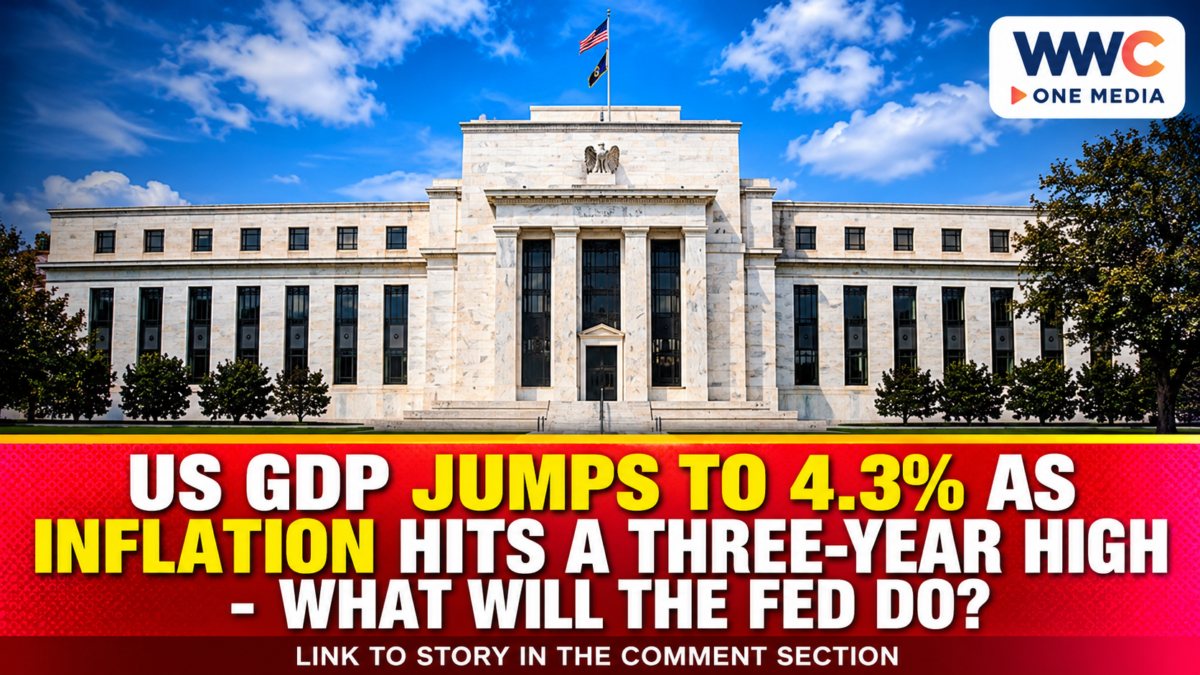
WASHINGTON, D.C. — November 26, 2026 — The US economy is growing faster than initially estimated, but the latest inflation figures are creating a difficult challenge for the Federal Reserve: economic activity is accelerating even as price pressures remain stubbornly high.
The US Bureau of Economic Analysis (BEA) revised third-quarter real gross domestic product (GDP) growth upward to an annualised 4.3%, a significant increase from its earlier estimate of 3.4%.
The stronger growth figure arrived alongside October inflation data showing that the Personal Consumption Expenditures (PCE) price index increased 3.8% over 12 months. Core PCE inflation, which excludes food and energy, reached 3.3% — its highest level in approximately three years.
Both measures remain above the Federal Reserve’s 2% inflation objective.
The combination puts policymakers in a complicated position. Strong economic growth suggests the economy has considerable momentum, but persistent inflation makes it harder for the central bank to justify easing monetary policy.
For businesses, consumers and investors, the question is whether the United States can maintain its growth momentum without forcing another round of interest-rate increases.
US GDP Growth Revised Sharply Higher
The BEA’s second estimate showed that real US GDP increased at an annual rate of 4.3% during July, August and September 2026.
That was 0.9 percentage point higher than the advance estimate of 3.4%.
The revised figure also represented an acceleration from the 2.2% growth recorded in the second quarter.
Three major areas contributed to the expansion: investment, consumer spending and government spending. These gains were partly offset by a decline in exports.
Imports increased during the quarter. Because imports are subtracted when calculating GDP, their increase partly offset the contribution from domestic economic activity.
The revision was driven primarily by stronger estimates for investment and consumer spending.
One important measure of underlying domestic demand also improved. Real final sales to private domestic purchasers, which combines consumer spending and gross private fixed investment, increased at a 5.8% annualised rate. That was 0.9 percentage point above the previous estimate.
The numbers indicate that domestic demand remained a significant source of economic momentum.
However, the 4.3% figure is an annualised quarterly growth rate, not a claim that the US economy expanded by 4.3% in just three months. The actual quarter-to-quarter increase was approximately 1.1%.
The BEA is scheduled to publish its third estimate of third-quarter GDP on December 23.
Core Inflation Reaches a Three-Year High
The stronger GDP report was accompanied by another warning from the inflation data.
October’s headline PCE price index increased 0.3% from September and 3.8% compared with October 2025.
Core PCE inflation also increased 0.3% during the month, while its annual rate reached 3.3%, up from 3.1% in September.
The annual core reading is particularly important because it strips out food and energy prices, which can fluctuate sharply.
The Federal Reserve uses PCE inflation as its preferred measure when assessing price stability. Its long-term objective is to keep inflation at 2%.
October’s figures therefore indicate that inflation remains substantially above the central bank’s target.
There is one important qualification: the monthly increase in both headline and core PCE was 0.3%, while headline PCE had risen 0.5% in September. This means the monthly pace slowed, even though annual inflation increased.
The data also revealed a gap between nominal spending and inflation-adjusted consumption.
Current-dollar personal consumption expenditures increased 0.3% in October, but real PCE declined by less than 0.1%. In other words, spending increased in dollar terms without producing meaningful growth in the volume of goods and services purchased.
That distinction matters because households can spend more money while receiving little additional purchasing power.
WWC ONE MEDIA previously examined the pressure on American households in its report on US consumer confidence and the question of whether Americans can actually spend more.
The Federal Reserve Faces a Difficult December Decision
The latest figures complicate the Federal Reserve’s next monetary-policy decision.
At its October 27–28 meeting, the Federal Open Market Committee maintained the federal funds target range at 3.75% to 4%.
However, the decision was not unanimous.
Two members, Lisa D. Cook and Beth M. Hammack, preferred to increase the target range by a quarter of a percentage point at that meeting.
The committee’s official statement also said inflation remained elevated and that additional information would help determine the appropriate monetary-policy position.
The next scheduled FOMC meeting is December 8–9.
The October decision does not establish that the Fed will raise rates in December. Policymakers will have to assess further economic information before making their next decision.
Nevertheless, the latest combination of strong GDP growth and elevated inflation gives policymakers a reason to remain cautious about declaring victory over rising prices.
For households, higher interest rates can increase the cost of borrowing for mortgages, credit cards and other loans. Businesses can also face more expensive financing when they need capital for expansion, equipment or working capital.
WWC ONE MEDIA previously explored the debate over further tightening in its report on the Federal Reserve’s rate-hike debate and its implications for housing.
Strong Growth Does Not Mean Every Household Is Better Off
The GDP revision presents a positive picture of overall economic activity, but aggregate growth does not show how evenly the benefits are distributed.
The October personal income report showed that personal income increased by US$201.8 billion, or 0.7%, during the month.
Disposable personal income increased 0.8%, while the personal saving rate stood at 4.1%.
However, the BEA’s technical notes show that part of October’s income increase reflected government social benefits, primarily one-time payments associated with a Medicare Improvement Fund premium rebate.
That detail matters when interpreting the headline income increase. A one-time payment does not necessarily indicate that households have experienced a permanent improvement in their regular earnings.
The contrast between nominal spending and real consumption also deserves attention. When prices rise, households may need to spend more simply to maintain their existing consumption.
The saving rate provides another measure of household financial behaviour, but it does not establish that every income group has the same capacity to save.
For businesses, the figures create a mixed environment: overall economic activity remains strong, but inflation and borrowing costs can affect consumer demand and investment decisions.
WWC ONE MEDIA has also examined the pressure from rising household borrowing in its report on the increase in US consumer debt and credit-card borrowing.
What the Numbers Mean for Global Markets
The United States remains a major influence on global financial conditions. Changes in its economic outlook and monetary policy can affect currency markets, international investment and borrowing costs.
If the Federal Reserve keeps interest rates higher for longer, US dollar-denominated assets may remain attractive to international investors.
That can influence capital flows and exchange rates, although the impact on individual economies depends on their own monetary policies, growth prospects and financial conditions.
For Asia-Pacific economies, the combination of stronger US demand and persistent inflation creates competing possibilities.
Strong American consumption can support demand for imported goods and services. However, higher US interest rates can make international financing more expensive and influence currency movements.
Trade policy adds another uncertainty. Changes in US tariffs and import rules can affect the costs faced by manufacturers and exporters that depend on American customers.
WWC ONE MEDIA previously examined the latest US tariff investigation and its potential implications for international supply chains.
The latest GDP and inflation releases do not establish that any particular Asian economy will experience a specific currency or trade impact. Those effects will depend on future policy decisions and actual market conditions.
What Happens Next?
The next major test will be whether US inflation continues rising or begins to moderate before the Federal Reserve’s December meeting.
The central bank will also have to assess employment conditions, household spending and the durability of business investment.
The BEA’s third estimate of third-quarter GDP is scheduled for December 23, while its next Personal Income and Outlays report, covering November, is scheduled for the same day.
For now, the US economy is showing considerable growth momentum, but inflation remains a serious challenge.
The 4.3% GDP figure gives policymakers evidence that economic activity is expanding strongly. The 3.3% annual core inflation rate, however, shows that the fight against rising prices is far from over.
That leaves the Federal Reserve facing a difficult balance: controlling inflation without unnecessarily weakening the economy.
The next policy decision could shape borrowing costs, investment expectations and financial-market sentiment well beyond the United States.