
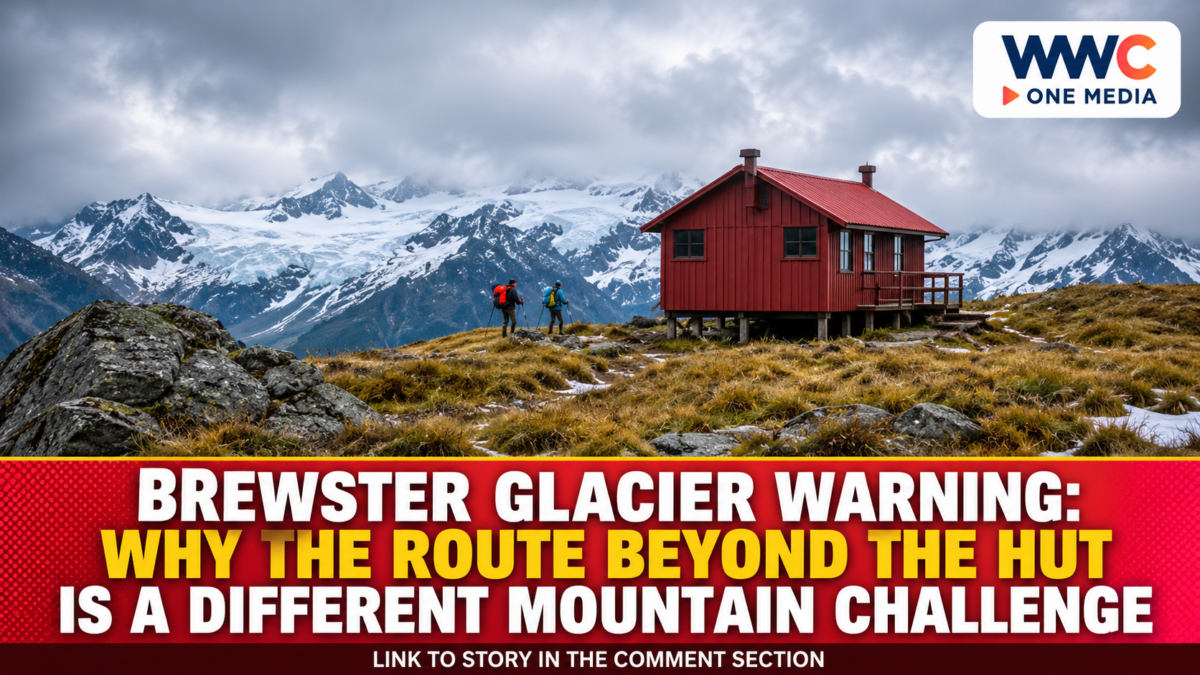
New Zealand’s Department of Conservation (DOC) says it has completed seven visitor-safety improvements around Brewster Track and Brewster Hut after the February 2025 death of French tourist Maëlle Favregros, whose case prompted renewed attention to the hazards beyond the marked walking route. The update, released on November 26, 2026, makes a critical distinction for visitors: the managed track ends at the hut, while the onward journey towards Brewster Glacier crosses challenging, unmarked alpine terrain.
The distinction is important because a route that appears to be a continuation of a popular hiking destination may actually require a different level of experience, equipment and navigation. The safety measures now in place improve warnings and preparation information, but they do not turn the glacier approach into a managed walking track.
Brewster Glacier: where the official track ends
DOC’s description of Brewster Track says the route begins near Fantail Falls on State Highway 6, crosses the unbridged Haast River and climbs through beech forest towards Brewster Hut in Mount Aspiring National Park.
The agency classifies the walk as steep and rough. Its current track information says the route ends at Brewster Hut. There is no official track from the hut to Brewster Glacier or Mount Armstrong.
That final point is central to understanding the safety issue. The New Zealand Mountain Safety Council (MSC) describes the additional journey to the glacier as approximately 1.5 kilometres beyond the hut, through exposed and difficult alpine terrain. It says there are no officially marked or managed tracks along that section.
The difference is not simply a matter of trail difficulty. A managed route has an established alignment and official visitor information. Beyond the hut, walkers are entering terrain where navigation, weather judgement and the ability to recognise natural hazards become much more important.
DOC warns that the landscape beyond the hut is more difficult than it may appear, with steep drops and a risk of becoming lost or falling. It also warns that ice around the glacier face and caves is unstable.
What the coroner’s findings established
Favregros, a 23-year-old French tourist, died on February 21, 2025, after falling while walking near Brewster Glacier. The Department of Conservation’s November 26 statement says the coroner found that she fell while crossing slippery, rocky terrain beyond Brewster Hut, in an area that was neither marked nor managed as a track.
The Mountain Safety Council’s account of the findings says Favregros had hiking and trail-running experience in France and travelled towards the glacier with a friend after learning about the trip through AllTrails. The pair reached the hut, set up a tent and later continued towards the glacier.
The coroner’s findings, as summarised by the council, emphasised planning the entire route, including side trips from the hut. They also stressed the need to use official information, remain on marked routes where possible and assess whether personal skills and equipment match the terrain and weather.
The recommendations also identify hazards such as slippery rock, loose scree, cliffs, glaciers and snow. Turning back or choosing a safer alternative was presented as a legitimate safety decision.
Seven safety improvements completed
DOC says it reviewed the incident and identified seven actions to improve visitor safety. All seven have been completed.
The measures include additional warning signs at the track’s car park, inside Brewster Hut and in the hut toilet. The signs warn visitors about the risks of continuing beyond the hut onto unmarked terrain.
DOC also worked with the Mountain Safety Council to produce a safety video explaining the hazards beyond Brewster Track. The council says the wider interagency effort included DOC, MSC and New Zealand Police, with the taskforce established in April 2024.
The council also records changes to DOC’s online track information and booking emails, as well as a targeted safety campaign. The official Brewster Track video was produced in 2025 with DOC, Land Search and Rescue New Zealand, MetService and Police, and launched in November that year.
These steps matter because warnings need to reach visitors before they commit to a route, not only after they arrive at a difficult section. Signage, booking information and a route-planning video address different points in the visitor journey.
Rescue figures underline the continuing challenge
The Mountain Safety Council reported seven further search-and-rescue incidents in the Brewster area during 2025 after Favregros’ death. It recorded six incidents in 2024 and seven in 2023, as well as a fatality in 2020.
The council also said that in the 12 months after the Brewster Track safety video was released, there were two rescues in the area. That figure is a useful update, but it should not be treated as proof that the video alone caused a reduction. The published statement does not provide a controlled evaluation separating the effects of the video from weather, visitor numbers, other safety changes or differences in reporting.
The wider lesson is that a rescue count is only one measure of risk. A location can remain hazardous even when fewer incidents are recorded, particularly where conditions vary and visitors have different levels of experience.
WWC has previously examined how Mount Fuji’s seasonal trail restrictions affect visitor safety. The settings differ, but both cases show why visitors need to understand the limits of access and the conditions attached to a mountain route.
What visitors should check before setting out
DOC’s current Brewster Track guidance tells visitors to check the weather and assess the Haast River before crossing. The river has no bridge, and the agency warns that rain or snowmelt can make the crossing unsafe or prevent a return crossing later in the day.
The department also warns against travelling beyond the hut in rain, low cloud or whiteout conditions. Reduced visibility can disorient walkers, while wet rock increases the risk of slipping.
DOC says a distress beacon, emergency shelter and spare food are essential for the trip, even as a summer day walk. It also recommends sturdy footwear with good grip and says visitors should have experience navigating remote alpine terrain before considering travel beyond the hut.
For people without the necessary experience, fitness or equipment, DOC identifies alternative walks, including the Blue Pools Track. Its guidance also says visitors should stay well back from the unstable glacier face and ice caves.
Other WWC coverage has looked at how authorities manage access to sensitive outdoor destinations, including the closure of Cebu’s Spartan Trail during a protected-landscape investigation. In a different setting, the principle is similar: public access depends on understanding the conditions and respecting official warnings.
What happens next
The seven improvements identified by DOC are reported as complete, but the terrain beyond Brewster Hut remains unmanaged. Visitors should therefore treat the glacier approach as a separate alpine undertaking rather than assume the marked track continues to the ice.
The Mountain Safety Council’s recommendations remain relevant: plan the full route, use official sources, understand the hazards and match the trip to the group’s skills and equipment. Its coverage of the debate over mountain rescue costs and preparation also highlights why preparation and realistic route choices matter before an emergency occurs.
For Brewster visitors, the immediate practical step is to check DOC’s latest track information and the safety video before departure. The completed warnings can inform decisions, but they cannot remove the hazards of an unmarked alpine environment.
Frequently asked questions
Where did Maëlle Favregros die?
She died after a fall near Brewster Glacier in Mount Aspiring National Park, New Zealand, on February 21, 2025.
Does the official Brewster Track continue to Brewster Glacier?
No. DOC says the managed Brewster Track ends at Brewster Hut. The terrain beyond the hut is unmarked and is not managed as an official track.
What safety improvements did DOC complete?
DOC says it completed seven actions, including warning signs at the car park and inside Brewster Hut, and a safety video produced with the Mountain Safety Council.
Is the route beyond Brewster Hut suitable for ordinary visitors?
DOC advises that people should not attempt the off-track section unless they have experience in remote New Zealand alpine terrain and can navigate in thick cloud. The agency warns that the terrain is more difficult than it looks.
What should hikers check before visiting Brewster Track?
Visitors should check the weather, assess the unbridged Haast River, review DOC’s track guidance and safety video, and carry appropriate equipment, including a distress beacon, emergency shelter and spare food.










