
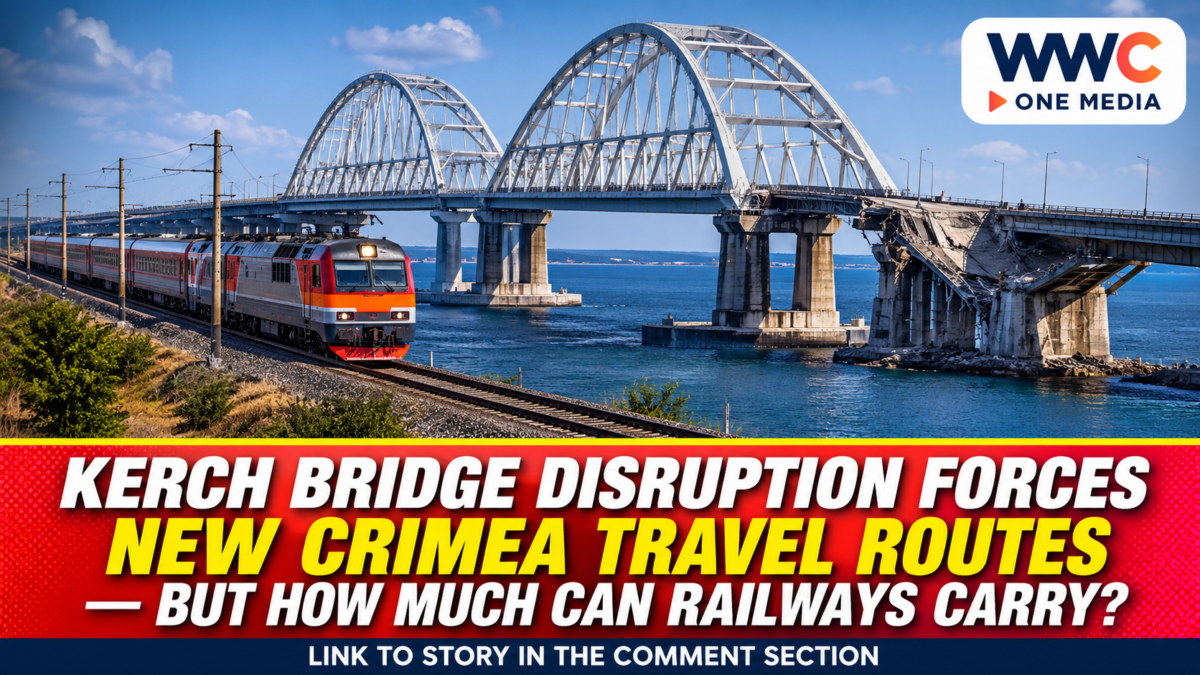
Russia’s Transport Ministry published revised passenger travel instructions on November 24, outlining train, bus and connecting transport arrangements for people travelling between Russia’s Krasnodar region and Crimea after disruptions to the Kerch Bridge. The instructions show how authorities are reorganising passenger movement around the affected road connection while keeping railway services in use.
The new arrangements put greater emphasis on transfers between long-distance trains, suburban rail services and buses. They also expose a practical challenge for passengers: reaching Crimea is no longer simply a matter of buying one ticket and travelling directly to the final destination.
The Kerch Bridge is a combined road and railway crossing over the Kerch Strait. Disruptions to its road section therefore have consequences beyond individual motorists, affecting passenger transfers, regional transport planning and the movement of goods. The latest government guidance provides a clearer picture of the alternative travel system, but it does not settle every question about the bridge’s condition or its repair timetable.
Kerch Bridge transport shifts towards train-and-bus connections
The November 24 instructions identify Kerch-Yuzhnaya Novy Park railway station in Kerch as the point where Tavria long-distance passenger trains currently begin and end their journeys within Crimea.
Grand Service Express operates the Tavria services. Passengers continuing to other destinations on the peninsula are transferred to buses coordinated with train arrivals and departures.
The listed onward destinations include Simferopol, Sevastopol, Vladislavovka and Sem Kolodezey. The ministry identifies specific Sevastopol connections for trains No. 7/8 and No. 91/92.
This arrangement allows passenger journeys to continue through a combination of transport services rather than relying on a direct train connection to every destination.
The ministry also says passenger trains are operating at full capacity on the railway section. That statement describes the passenger service arrangement; it should not be interpreted as an engineering assessment of the entire bridge or proof that every part of the crossing is operating without restrictions. Situation Monitor
Passengers must check whether their rail ticket includes the bus transfer
The ministry’s instructions make an important distinction between passengers whose railway tickets end in Kerch and those whose tickets already identify an onward destination.
Travellers whose rail tickets list Kerch but who need to continue to Simferopol, Sevastopol, Vladislavovka or Sem Kolodezey must obtain a separate bus voucher for the onward journey.
The ministry says the voucher can be purchased through the relevant online service, at a railway ticket office operated by the Southern Suburban Passenger Company, or directly on the train.
Passengers whose railway tickets already list one of the relevant onward destinations do not need to purchase a separate bus voucher under the stated arrangement.
The distinction matters because a passenger may assume that a ticket covering the railway journey also covers the final road connection. Under the temporary system, that is not necessarily the case.
Travellers should check the destination printed on their ticket and confirm the transfer requirements with the carrier before departure. A missed connection or misunderstanding over ticket coverage could create additional costs and delays.
Alternative routes involve regional trains and other connections
The ministry also outlines several ways to reach Crimea when a direct journey is unavailable.
One option involves taking a Federal Passenger Company long-distance train to a city served by Tavria trains, then transferring to a suburban railway service and a bus.
Another uses suburban trains operating between Anapa and Kerch. The ministry also identifies flights to Moscow, Adler or Krasnodar as possible starting points for journeys that continue by rail and bus.
These options create a more complicated travel chain. Passengers may need to coordinate several timetables, operators and ticket conditions instead of relying on one direct service.
The wider lesson is that transport resilience depends on connections between different modes of travel. A railway can remain operational while passengers still face disruption if the buses, stations and ticketing arrangements needed to complete their journeys are not properly coordinated.
That challenge is relevant to infrastructure planning elsewhere in the region. WWC’s coverage of the proposed transport links supporting Vietnam’s Gia Binh airport examines why airports, railways and road connections need to be planned as one wider transport system.
Road restrictions and public operating guidance need to be read separately
A November 18 statement from the Russian Transport Ministry said vehicle movement on the road section of the Kerch Bridge had been temporarily suspended while passenger trains continued to operate according to schedule.
The same statement described additional long-distance and suburban train planning, bus connections from several Crimean stations to Kerch, and the possible use of the Kerch ferry crossing for passengers and freight. Министерство транспорта Российской Федерации
However, the ministry’s general vehicle-access page currently states that passenger cars and buses can travel in both directions across the road section under normal operating conditions. It also says that crossings can be temporarily suspended for security reasons. Министерство транспорта Российской Федерации
These records should not be treated as if they were published at the same time. The November 18 notice describes a specific disruption, while the general access page provides broader operating guidance without a clear last-updated date beside the status statement.
That difference makes it difficult to use the general page alone to establish the exact time at which a particular restriction was lifted. Travellers need dated operational announcements, not just general information pages, to make decisions about immediate departures.
Freight movement remains a separate infrastructure concern
Passenger travel is only one part of the transport system affected by a disruption at a major crossing.
The ministry’s November 18 statement said the Kerch ferry crossing could be used for passenger and freight transportation if necessary. The November 24 passenger instructions focus on the train-and-bus arrangements for travellers, rather than providing a complete account of freight operations.
That distinction is important. Passenger trains, buses, road vehicles, rail freight and ferry services have different operating requirements. A statement that passenger trains are running does not automatically establish that every freight category is moving normally.
The issue is familiar to businesses that rely on several transport links to move goods. WWC’s report on shipping operators’ proposed expressway corridors and RoRo reforms examines how roads, ports and ferries function together in the movement of products across the Philippines.
For companies, a disruption at one crossing can create additional transfer requirements, scheduling complications and pressure on alternative routes. The extent of those effects depends on the available capacity and the specific type of cargo involved.
The repair question remains separate from the travel instructions
The passenger guidance explains how people can continue travelling, but it does not provide a complete engineering assessment of the damaged road section.
It also does not establish a confirmed date for full restoration of road traffic. A travel arrangement can be introduced while inspections, technical assessments and repair planning continue.
This is where public communication becomes especially important. Travellers need to know which services are operating, while businesses need clarity about freight access and transport capacity. Those are related questions, but they require separate, specific updates.
The ministry’s public guidance should therefore be read alongside dated announcements from the relevant railway, bus and ferry operators. A general statement about normal vehicle movement should not be used as a substitute for a time-stamped notice covering a specific interruption.
The wider economic implications of infrastructure disruption are also worth considering. WWC’s analysis of the Philippines’ proposed ₱1.47-trillion infrastructure programme and the challenge of delivering projects explains why infrastructure performance depends not only on funding or construction, but also on implementation, coordination and the ability to deliver reliable services.
What happens next
The next important developments are clearer, dated updates on road access, passenger railway operations, freight arrangements and the progress of technical assessments.
Passengers should confirm their train destination, bus voucher requirements and connecting schedules before travelling. Those using alternative routes should also check whether the relevant suburban train or ferry service is operating on the day of departure.
For businesses, the key question is whether alternative freight arrangements can maintain predictable movement between Crimea and the Krasnodar region. Passenger services and freight services should not be assumed to have identical access or capacity.
For now, the November 24 instructions provide a practical framework for passenger travel. They do not, however, resolve the wider uncertainty surrounding the road section’s repair schedule or establish that every part of the transport network has returned to normal.
Frequently asked questions
How can passengers travel to Crimea while the Kerch Bridge road section is restricted?
The November 24 instructions describe long-distance trains to Kerch-Yuzhnaya Novy Park, followed by connecting buses to destinations elsewhere in Crimea.
Do passengers need a separate bus ticket from Kerch?
Passengers whose railway tickets list Kerch but who need to continue to a destination covered by the transfer arrangement must obtain a separate bus voucher. If the onward destination is already listed on the railway ticket, the ministry says a separate voucher is not required.
Which destinations are served by the connecting buses?
The ministry identifies Simferopol, Sevastopol, Vladislavovka and Sem Kolodezey. It specifies Sevastopol connections for trains No. 7/8 and No. 91/92.
Are passenger trains operating across the Kerch Bridge?
The November 24 ministry guidance says passenger trains are operating at full capacity on the railway section. Passengers should still check the latest carrier information for timetable changes.
Is the Kerch Bridge open to cars and buses?
The ministry’s general vehicle-access page currently describes passenger-car and bus traffic as operating in both directions under normal conditions. A separate dated notice describes a temporary road restriction. Travellers should check the latest dated operational announcement before departure.










