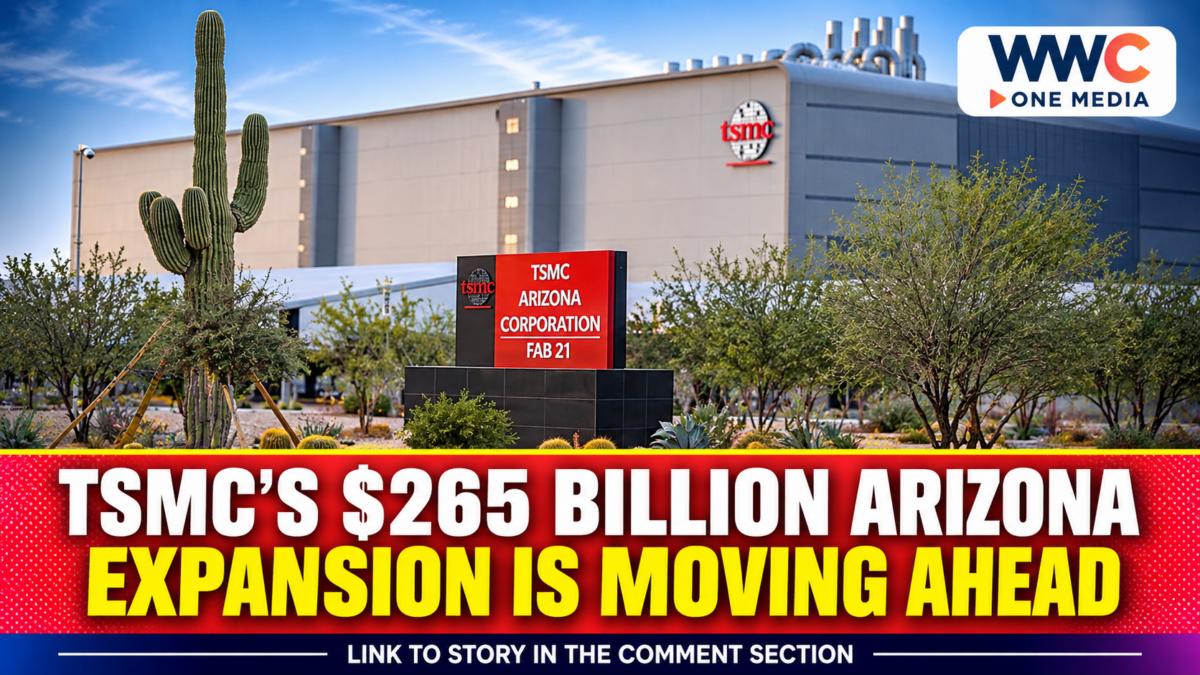
PHOENIX, Arizona — Taiwan Semiconductor Manufacturing Co. is advancing a multibillion-dollar semiconductor manufacturing programme in Arizona, where its plans now cover six logic wafer fabrication plants, two advanced-packaging facilities and a research and development centre. The company’s latest public project information places the total planned Arizona investment at US$265 billion, making the site one of the largest overseas manufacturing commitments in its history.
The scale of the project matters beyond the construction site. TSMC is building capacity closer to major US customers at a time when demand for advanced processors, artificial intelligence infrastructure and high-performance computing is reshaping the semiconductor supply chain. But the investment is not a single factory project: it is a phased industrial programme whose value will depend on construction, equipment installation, production schedules, operating costs and customer demand.
TSMC Arizona expansion: a manufacturing network, not one factory
TSMC’s Arizona project began in 2020, when the company selected Phoenix for its first advanced US semiconductor manufacturing site. Its current project information says the original US$12 billion investment has grown to US$265 billion.
The company’s stated Arizona plan includes six semiconductor logic wafer fabs, two advanced-packaging facilities and an R&D centre. The expansion is intended to support production of advanced chips used in artificial intelligence, high-performance computing and advanced mobile applications.
That distinction is important. A wafer fabrication plant manufactures semiconductor wafers, while advanced packaging connects and integrates chips into finished components. Both stages are increasingly important as computing systems become more complex and customers demand greater processing performance.
The Arizona programme therefore extends beyond simply moving some chip production to the United States. It is intended to establish a broader manufacturing and technology base that can support several stages of advanced semiconductor production.
The scale of the buildout also connects with a wider industry trend. WWC’s earlier report on TSMC’s rapid factory construction and the pressure of AI demand examined why chipmakers are racing to add capacity while customers seek more production slots.
Production milestones show how the project is being phased
The company’s published milestones provide a clearer picture of how the Arizona programme is progressing.
TSMC says its first Arizona fab began high-volume production using its N4 process technology in the fourth quarter of 2024. The structure of its second fab was completed in 2025, with volume production using N3 technology targeted for the second half of 2027 on the company’s Arizona project page.
The third fab broke ground in April 2025. TSMC says that facility is planned for N2 and A16 process technologies, with volume production targeted by the end of the decade.
Those milestones show why a groundbreaking ceremony, by itself, is not a reliable measure of how much manufacturing capacity is already available. Semiconductor facilities require specialised equipment, installation, process qualification and production ramp-up before they can operate at commercial scale.
In its October 2026 third-quarter earnings call, TSMC executives also discussed the pace of overseas capacity expansion. The company said the second Arizona fab had completed construction and was undergoing equipment move-in and installation, with volume production expected in the third quarter of 2027.
The difference between a construction milestone and a production milestone is central to understanding the project’s timeline. A completed building does not automatically mean that its planned output is already entering the market.
Why the investment matters to the US chip supply chain
The Arizona expansion is part of a wider effort to increase advanced semiconductor manufacturing capacity in the United States.
TSMC’s project information identifies demand from US customers as a reason for expanding its local footprint. Producing closer to customers can strengthen supply-chain resilience and give technology companies another manufacturing location for advanced chips.
The company’s October earnings discussion also described strong customer demand and the need to expand capacity. Executives said more overseas fabs would be ramping up and discussed the cost implications of operating facilities outside Taiwan.
That cost issue is significant. New overseas plants require major spending on construction, equipment, labour, utilities and supplier networks. The company has indicated that overseas expansion can affect its cost structure, meaning that additional capacity does not automatically translate into the same economics as production at established facilities in Taiwan.
For customers, however, access to additional capacity may be valuable if demand for advanced chips continues to rise. For the United States, the project adds to domestic manufacturing capability in a sector considered strategically important for technology, communications and industrial production.
WWC has also examined how the geography of chip production is changing in its coverage of TSMC’s evaluation of a possible second US manufacturing hub in Texas. That possibility remains separate from the confirmed Arizona programme.
The financial commitments behind the Arizona buildout
TSMC’s third-quarter 2026 consolidated financial statements identify TSMC Arizona Corporation as a wholly owned subsidiary based in Phoenix and engaged in manufacturing, sales and testing of integrated circuits and other semiconductor devices.
The filing also details financial support and commitments associated with the US subsidiary. It records a parent-company guarantee for TSMC Arizona, with an amount actually drawn of US$11.274513 billion as of September 30, 2026. The same table lists an ending guarantee balance of US$15.290936 billion.
These figures should not be confused with the US$265 billion total investment plan. A guarantee is a financial commitment supporting obligations; it is not the same as cash already spent on construction. The total project investment is a broader company figure covering the planned Arizona programme.
The filing also says TSMC Arizona is eligible to apply for an investment tax credit on qualified investments. It describes a 35% credit rate effective January 1, 2026, following amendments to relevant regulations. The company’s filing notes that grant agreements include construction timelines and other conditions that must be met.
Those details show that the project is supported by a combination of corporate capital, financing arrangements and government incentives. They also show why readers should distinguish between announced investment, financial guarantees, tax incentives and actual construction expenditure.
What the expansion could mean for Taiwan and its customers
TSMC’s overseas buildout raises a strategic question for Taiwan: how can the company expand manufacturing closer to customers while maintaining the technological and operational advantages of its home base?
The company’s own earnings discussion indicates that overseas expansion carries cost implications. It also says the company intends to continue expanding capacity to meet customer demand.
For customers, a larger US manufacturing footprint could provide another source of advanced chips. But the Arizona facilities will not instantly replace Taiwan’s role in TSMC’s global production network. The project is being developed in stages, and each facility must meet its technical and production targets.
The expansion also has implications for suppliers. Semiconductor manufacturing depends on equipment makers, materials companies, construction contractors, logistics providers and specialised workers. A larger Arizona operation can create opportunities across that ecosystem, although the pace and scale of those opportunities will depend on the facilities that are actually completed and brought into production.
WWC’s coverage of Nvidia’s supply-chain expansion and the wider AI manufacturing network explores how chip production depends on a network of suppliers, packaging capacity and manufacturing partners—not only the company designing the processor.
What happens next
The next major indicators will be the progress of equipment installation at the second Arizona fab, its planned production start, and the construction and qualification milestones for the later facilities.
TSMC’s published Arizona information identifies a long-term programme involving six logic wafer fabs, two advanced-packaging facilities and an R&D centre. The company’s third-quarter disclosures provide additional detail on the financial structure supporting the US subsidiary.
A reported public ceremony should not be confused with a new production milestone. The company records reviewed for this report establish the scale and development stages of the Arizona programme, but do not independently confirm the reported December 4, 2026 ceremony or the attendance of US President Donald Trump.
For now, the clearest measure of progress is the company’s documented construction and production timetable. The investment is substantial, but its ultimate impact will be determined by how quickly the facilities become operational and how effectively they serve the customers driving demand for advanced chips.
Frequently asked questions
How much is TSMC investing in Arizona?
TSMC’s current Arizona project information lists the planned investment at US$265 billion.
How many semiconductor facilities are included in the Arizona plan?
The company’s plan includes six semiconductor logic wafer fabs, two advanced-packaging facilities and an R&D centre.
Is TSMC already producing chips in Arizona?
Yes. TSMC says its first Arizona fab began high-volume production using N4 process technology in the fourth quarter of 2024.
When is the second Arizona fab expected to begin production?
TSMC’s October 2026 earnings discussion said the second fab was undergoing equipment move-in and installation, with volume production expected in the third quarter of 2027.
Has TSMC confirmed a December 4, 2026 groundbreaking ceremony with President Trump?
The official company and regulatory records reviewed for this report do not independently confirm that specific ceremony or the president’s attendance.