
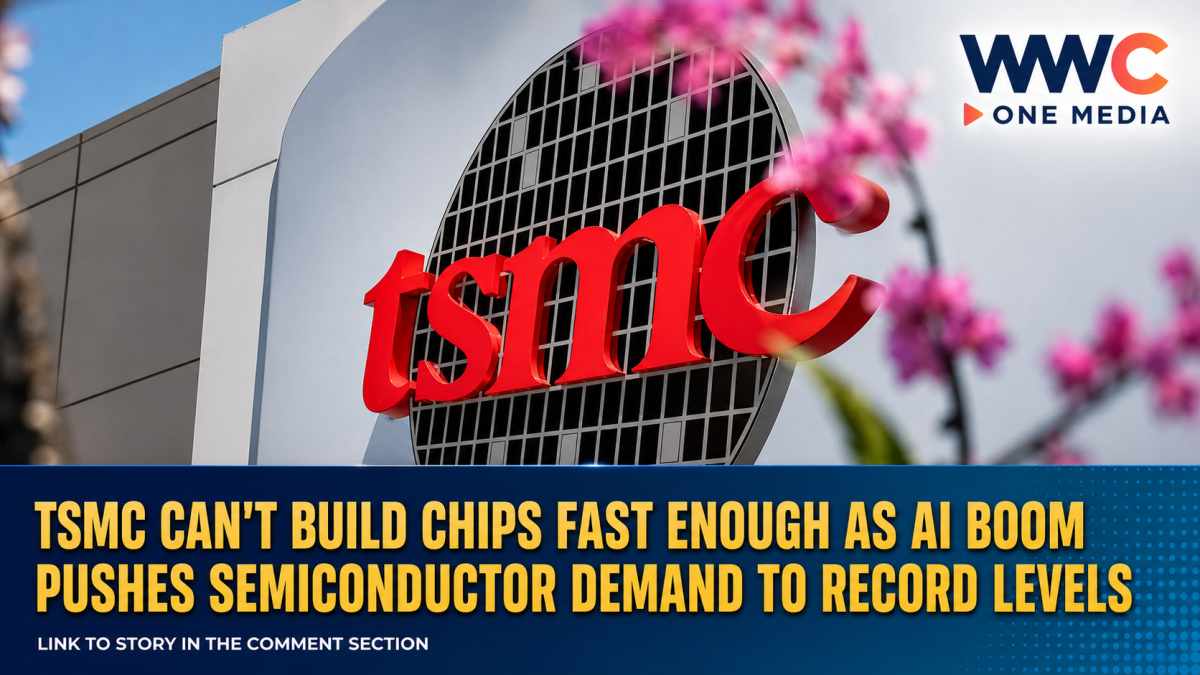
TAIPEI — Taiwan Semiconductor Manufacturing Co. is expanding production at a pace rarely seen in the chip industry, yet even the world’s largest contract chipmaker says it is struggling to build capacity fast enough for the artificial-intelligence boom.
TSMC Senior Vice President and Deputy Co-Chief Operating Officer Cliff Hou told executives at SEMICON Taiwan 2026 that demand for advanced chips, packaging and computing infrastructure has accelerated far beyond the patterns the semiconductor industry was accustomed to over the past three decades.
Taipei Times reported that TSMC is working on 25 semiconductor fabrication and advanced-packaging facilities worldwide this year, including 13 in Taiwan, compared with a historical pace of roughly five or six factory projects annually.
A separate report by Focus Taiwan, citing the same SEMICON discussion, described TSMC as simultaneously advancing 13 fabs in Taiwan and another five or six overseas. The difference appears to reflect differing definitions or counts of fabrication and packaging projects, so the numbers should not be treated as directly interchangeable.
What is much harder to dispute is the direction of demand.
Hou said TSMC’s equipment requirements have increased dramatically within months. Using the company’s estimate at the end of last year as a baseline, equipment requirements reportedly climbed to 1.5 times that level after the first quarter and approximately 1.9 times by July.
That nearly twofold jump offers a glimpse of how quickly AI infrastructure spending is forcing semiconductor companies to rewrite expansion plans that normally take years to execute.
AI Demand Is Moving Faster Than Semiconductor Factories Can Be Built
Building cutting-edge fabs is not like adding servers to a data center.
Advanced semiconductor plants require enormous quantities of specialized equipment, clean-room infrastructure, skilled engineers, construction workers, power and water. Production technologies can also take years to develop and qualify before large-scale manufacturing begins.
TSMC Chairman and CEO C.C. Wei said during the company’s July earnings conference that developing technology, preparing capacity and bringing products into high-volume manufacturing can take more than five years.
Despite those long lead times, TSMC said AI-related demand remains “extremely robust,” with customers and major cloud service providers continuing to signal strong multi-year requirements for computing capacity.
That demand is already showing up in TSMC’s financial results.
The company generated US$40.2 billion in second-quarter 2026 revenue, up 33.7% from a year earlier, while net income jumped 77.4% year-on-year to NT$706.56 billion.
Advanced technologies of 7 nanometers and below accounted for 77% of wafer revenue, while high-performance computing — the segment most closely associated with AI accelerators, data centers and advanced computing — represented 66% of total company revenue.
TSMC subsequently reported July revenue of NT$467.58 billion, up 44.7% year-on-year, taking revenue for the first seven months of 2026 to NT$2.87 trillion, 37% higher than the same period a year earlier.
TSMC Raises the Spending Stakes
The production race is becoming increasingly expensive.
Reuters reported in July that TSMC raised its 2026 capital-expenditure forecast to US$60 billion to US$64 billion, up from its previous US$52 billion-to-US$56 billion range, as AI-related demand continued to accelerate.
At the same time, the company announced another US$100 billion investment in Arizona, bringing its planned US investment to roughly US$265 billion.
TSMC said the additional investment would support more logic-chip fabs using 2-nanometer and more advanced technologies, along with advanced-packaging facilities serving major American customers.
But the overseas push does not mean TSMC is abandoning Taiwan.
Wei said the company is also building 13 leading-edge semiconductor and advanced-packaging fabs in Taiwan over the next several years, while continuing further investment on the island.
The expansion illustrates a broader transformation: AI chip manufacturing is no longer simply about producing more silicon. The bottleneck is increasingly spread across advanced fabrication, CoWoS-style packaging, substrates, high-bandwidth memory, power infrastructure and the equipment required to connect everything together.
MediaTek Is Already Asking for Capacity Through 2029
The pressure is not theoretical.
MediaTek CEO Rick Tsai said at SEMICON Taiwan that his company has asked TSMC and chip-packaging giant ASE Technology Holding for additional capacity covering 2027 through 2029.
MediaTek is aggressively expanding beyond smartphone processors into custom AI accelerators for large cloud companies.
The Taiwanese chip designer previously said its first major AI ASIC project for a US hyperscaler was expected to generate roughly US$2 billion in fourth-quarter 2026 revenue, with substantially more contribution expected afterward.
Reports have linked that project to Alphabet’s Google, although MediaTek has not publicly identified the customer.
By August, MediaTek had raised its ambitions further, targeting as much as 20% of the serviceable market for customized AI accelerators in 2027, while expecting more than US$2 billion in data-center-chip revenue during 2026.
Then came another major vote of confidence.
Nvidia agreed to invest US$3.5 billion in MediaTek through convertible bonds, deepening the companies’ partnership around AI infrastructure technologies including Nvidia’s NVLink ecosystem.
That relationship is significant because the AI boom is increasingly moving beyond Nvidia’s own GPUs toward customized chips built by hyperscalers — and companies such as MediaTek want a bigger piece of that market.
The Next AI Bottleneck May Be the Supply Chain Itself
TSMC is not the only company warning about capacity.
Unimicron chairman Chien Shan-chieh said booming AI demand has intensified shortages of semiconductor substrates while forcing manufacturers to develop larger and more complicated designs.
He also pointed to another vulnerability: many essential semiconductor equipment and materials suppliers are relatively small Japanese companies that are themselves facing capacity constraints.
ASE chief executive Tien Wu argued that the scale of those interdependencies means no single company — not even TSMC — can solve the problem alone.
That creates an unusual situation.
AI companies are pouring hundreds of billions of dollars into computing infrastructure, chipmakers are spending tens of billions on new plants, and suppliers throughout the semiconductor chain are expanding simultaneously.
Yet adding money does not automatically create capacity overnight.
Factories require workers. Advanced packaging requires equipment. Equipment manufacturers need their own suppliers. Power grids must accommodate enormous new loads. And every new generation of AI hardware is becoming more complicated.
The question is therefore shifting from whether AI demand exists to whether the physical supply chain can scale quickly enough to satisfy it.
Taiwan’s Chip Industry Is Going Global
The expansion is also changing the geography of the semiconductor business.
Foxconn chairman Young Liu told the SEMICON Taiwan gathering that Taiwan’s technology industry should evolve from “Made in Taiwan” to “Made with Taiwan.”
His argument is that Taiwan can retain its technological expertise, engineering capabilities and intellectual property while manufacturing increasingly takes place closer to customers around the world.
That shift is already underway.
TSMC is dramatically expanding in Arizona while maintaining leading-edge investments at home. Taiwanese suppliers are following major customers into the United States, Japan and other markets. Taiwan’s government separately said Taiwanese companies are planning another US$20 billion of US investment, excluding previously announced TSMC projects.
The challenge will be maintaining Taiwan’s technological advantage while dispersing more production internationally.
The Bigger Question
For now, the numbers suggest the AI semiconductor cycle remains extraordinarily strong.
TSMC’s revenue is rising rapidly. High-performance computing has become its dominant business platform. Capital spending is climbing. Advanced packaging is expanding. Customers are securing capacity years in advance.
But the industry’s greatest strength could also become its biggest test.
When companies are building factories five times faster than they historically did and still say capacity is insufficient, the AI boom is entering a stage where success depends not merely on designing better chips, but on whether the entire industrial system behind them can expand fast enough.
And that may determine whether today’s unprecedented AI investment cycle keeps accelerating — or eventually runs into a physical wall.
WWC ONE MEDIA J.M.D




Leave a Reply