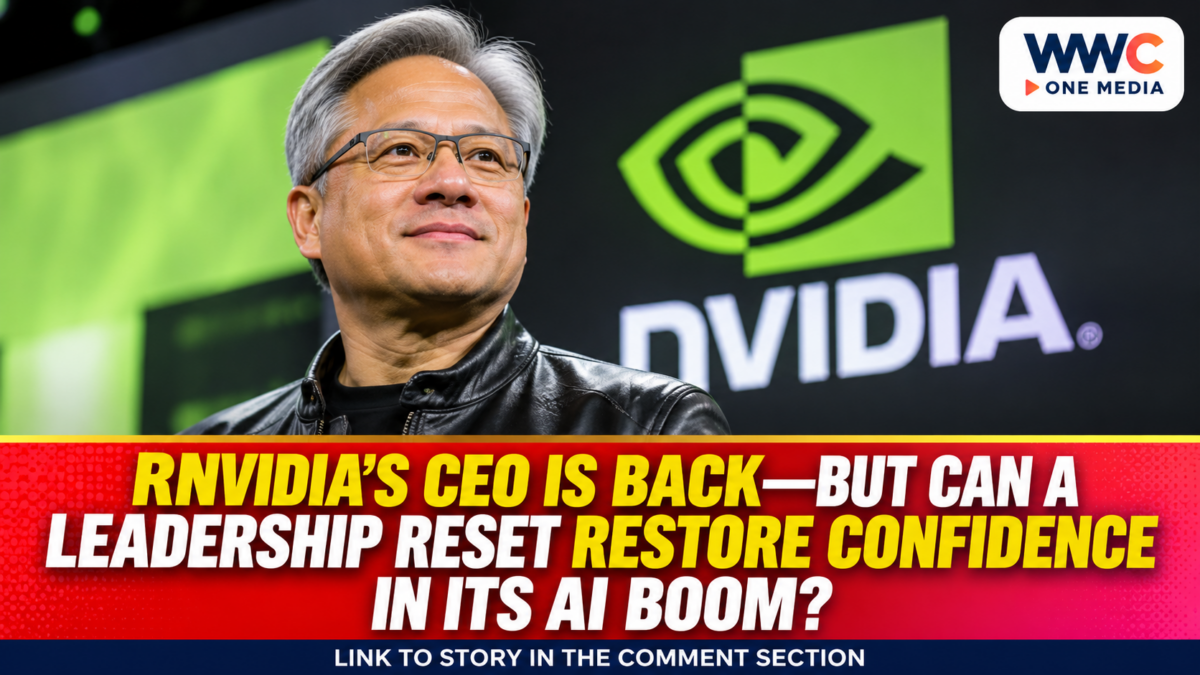
NVIDIA has reinstated Jensen Huang as president and chief executive officer, reversing the leadership change announced less than two weeks earlier, while the company continues to report exceptional growth in its artificial intelligence business. The board’s decision, effective November 22, comes alongside new governance and compliance measures that place national security, export controls and executive oversight more visibly on the company’s agenda.
The leadership change is significant, but it does not settle the larger questions facing the chipmaker. NVIDIA’s latest results show extraordinary demand for its computing platforms, while its expanding supplier commitments reveal how much manufacturing capacity and infrastructure are needed to sustain that growth.
NVIDIA CEO reinstatement is now part of the official record
NVIDIA’s November 23 announcement and its Form 8-K filed with the US Securities and Exchange Commission establish that the board reinstated Jen-Hsun Huang as president, chief executive officer and a member of the board, effective immediately on November 22.
The filing also confirms that Colette M. Kress will continue as executive vice president and chief financial officer after her period as interim chief executive.
The change reverses the board’s November 11 decision to accept Huang’s resignation and appoint Kress as interim CEO while it searched for a permanent successor. The company’s latest announcement says the board voted unanimously to reinstate Huang after discussions and meetings with him.
The board also said it had received input from senior levels of the US government and was confident the reinstatement posed no national security risk.
The return restores the company’s familiar leadership structure, but it does not mean every governance issue has been closed. NVIDIA said an independent-director committee’s investigation would continue to its conclusion.
Record revenue gives the company a powerful operating foundation
NVIDIA’s latest quarterly results provide important context for the leadership story.
For the third quarter of fiscal 2027, ended October 25, the company reported revenue of $115.8 billion, up 103% from the same period a year earlier. Data Center revenue reached $107.6 billion, a 110% year-on-year increase.
Net income under generally accepted accounting principles was $65.3 billion, compared with $31.9 billion in the corresponding quarter a year earlier. Diluted earnings per share were $2.70, against $1.30 in the prior-year period.
Those figures show that the business was producing substantial growth during the leadership transition. They do not, however, establish how investors should value the shares or guarantee that the same growth rate will continue.
For its fourth fiscal quarter, NVIDIA projected revenue of $130 billion, plus or minus 3%. The company also stated that its outlook did not assume any Data Center compute revenue from China.
That qualification matters. It shows that the company’s own planning does not depend on a recovery in that particular market to reach its stated revenue outlook.
AI infrastructure growth depends on more than chip demand
NVIDIA’s November 17 supply-chain announcement offers another measure of how the company is preparing for future demand.
The company said it was expanding commitments with Amkor Technology, Foxconn, Kinsus Interconnect Technology, Samsung Electro-Mechanics, Siliconware Precision Industries and TSMC. The arrangements cover areas including substrates, advanced packaging, wafer production and contract manufacturing.
One agreement calls for Kinsus to expand advanced ABF package-substrate manufacturing capacity dedicated to NVIDIA by more than 3.5 times its current level. Production is expected to begin in the second half of 2027, with the additional capacity targeted for the third quarter of 2028.
NVIDIA also disclosed multiyear arrangements supporting Amkor’s expansion in Arizona and South Korea, totaling nearly $3 billion. Separately, its agreement with SPIL is intended to expand advanced packaging operations in Taiwan.
These commitments illustrate a central feature of the AI business: selling more processors requires a much wider industrial network. Packaging capacity, component availability, manufacturing schedules and power-intensive data-centre construction all influence how quickly computing systems can be delivered.
That wider supply chain also creates opportunities and exposure for companies beyond the United States. WWC’s coverage of Ayala’s IMI and the expanding AI data-centre supply chain examines one Philippine manufacturer seeking to participate in the broader infrastructure market.
Governance and export controls are now part of the business test
NVIDIA’s November 23 announcement did more than confirm Huang’s return. It also disclosed the formation of a National Security and Export Control Committee made up solely of independent directors.
The committee is intended to oversee trade compliance and national security risks. NVIDIA said it was engaging counsel with national security experience and beginning a search for a chief compliance officer who would report to the Nominating and Corporate Governance Committee.
The company also said it would continue cooperating with ongoing government investigations and inquiries. Its announcement separately confirmed that the independent committee examining matters involving Huang would continue its work.
These disclosures are important because advanced AI processors are not ordinary consumer products. Their development, sale and deployment can involve export restrictions, customer screening and national security considerations.
The regulatory environment affects not only chip designers but also data-centre operators and regional technology supply chains. WWC has examined how new US AI-chip rules could affect Southeast Asian data centres, including the compliance questions facing facilities that serve customers across borders.
Malaysia’s efforts to strengthen oversight of advanced chip movements provide another example of how regional governments are responding. The issue is explored in Malaysia’s proposed data-centre disclosure and chip controls.
For NVIDIA, the commercial challenge is to expand sales while maintaining controls that satisfy regulators, customers and shareholders.
What happens next?
The immediate priorities are clearer leadership, continued oversight and execution against the company’s growth plans.
Huang has returned to the top job, but the board’s independent investigation is not finished. The National Security and Export Control Committee is also being established, and the company has said it will recruit a chief compliance officer.
On the operating side, investors will have to assess whether NVIDIA can convert its current demand into sustained shipments while its suppliers expand capacity over several years. Its next quarterly results will provide a fresh opportunity to compare actual performance with the $130 billion revenue outlook for the fourth quarter.
The central question is no longer simply who leads NVIDIA. It is whether the company can maintain its growth, manage its supply chain and strengthen oversight at the same time.
Frequently asked questions
Has Jensen Huang returned as NVIDIA CEO?
Yes. NVIDIA’s November 23 announcement and SEC Form 8-K confirm that the board reinstated Huang as president and CEO, effective November 22, 2026.
Why was Colette Kress serving as interim CEO?
NVIDIA’s November 12 filing said the board accepted Huang’s resignation on November 11 and appointed Kress, the company’s executive vice president and chief financial officer, as interim CEO while it searched for a successor.
How much revenue did NVIDIA report in its latest quarter?
NVIDIA reported $115.8 billion in revenue for the third quarter of fiscal 2027, up 103% from a year earlier. Data Center revenue was $107.6 billion.
Is NVIDIA’s board investigation finished?
No. The company said the independent-director committee’s investigation would continue to its conclusion.
What is NVIDIA expecting for its next quarter?
The company projected fourth-quarter fiscal 2027 revenue of $130 billion, plus or minus 3%. Its outlook did not assume any Data Center compute revenue from China.