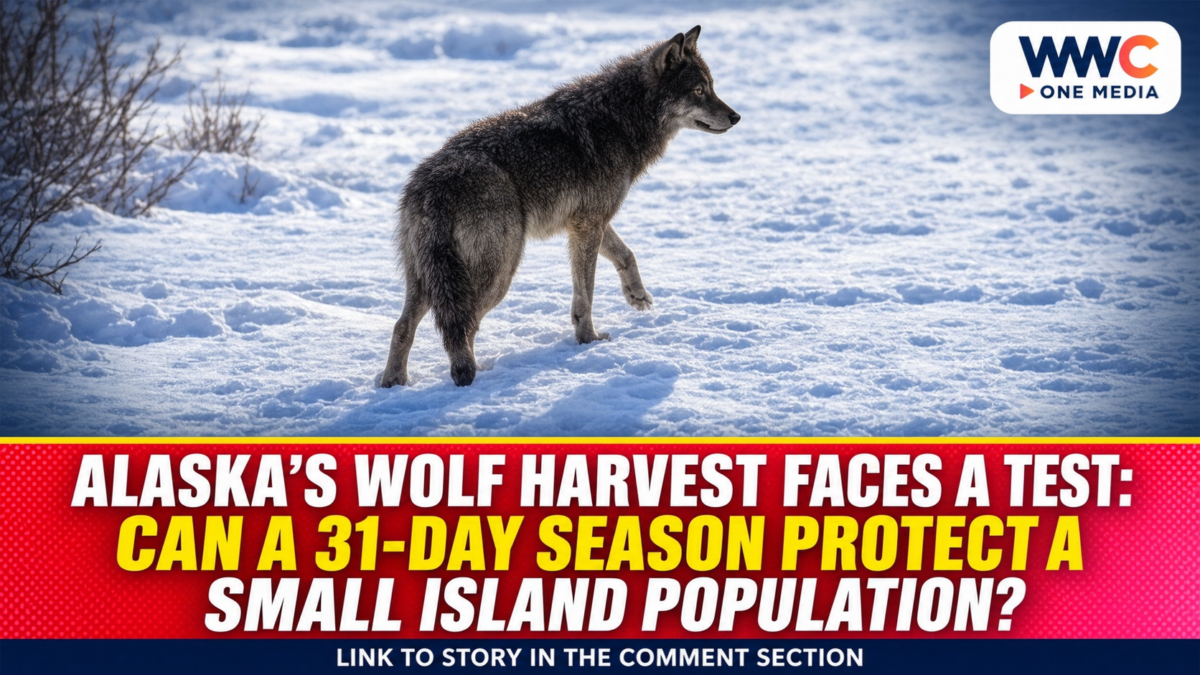
Alaska wildlife managers have set a 31-day wolf trapping opportunity in Game Management Unit 2, with state and federal hunting and trapping seasons scheduled to close at 11:59 p.m. on December 15, 2026. The decision follows a population estimate of 187 wolves in the unit, a figure that officials say remains consistent with a longer-term pattern supporting the limited season.
The decision offers a practical case study in a difficult conservation question: how can wildlife agencies permit harvesting while keeping a population within a sustainable range? In this part of southeast Alaska, the answer depends on repeated population surveys, harvest records and a season length that managers can adjust.
Wolf harvest rules are tied to a defined management area
The current decision applies to Game Management Unit 2, an area centred on Prince of Wales Island and nearby islands in southeast Alaska. It is not a statewide change to Alaska’s wolf rules, nor does it establish a general hunting policy for every wolf population in the United States.
The Alaska Department of Fish and Game and the USDA Forest Service determined that trappers would have 31 days of opportunity beginning November 15. The state and federal wolf hunting seasons in Unit 2 began September 1 and are set to close at the same December 15 deadline.
A temporary federal special action also amended the federal subsistence regulations for Unit 2. It specifies that wolves taken must be sequentially numbered, with the date and location recorded, and that hides must be sealed within 15 days.
The regulations state no numerical harvest limit for the unit under the amended season terms. That makes the duration of the season and the population-monitoring system especially important parts of the management framework.
What the latest wolf population estimate shows
The department’s fall 2025 preharvest estimate for Unit 2 was 187 wolves. The agency said it had high confidence that the true population was within a range of 125 to 279 wolves, expressed as a 95% confidence interval.
That interval matters. The figure of 187 is an estimate, not a count of every wolf living in the area. The confidence range communicates the uncertainty that remains when biologists use field samples and statistical methods to estimate a wildlife population.
The estimate was slightly lower than those recorded from 2021 to 2024. However, the department said the longer-term trend remained stable and could support a 31-day season.
The agency also reported that, from 2021 through 2025, a 31-day season was associated with harvests of 45 to 74 wolves while the population estimates ranged from 187 to 268. Across seasons since the strategy began in 2019, season lengths varied from 21 to 62 days and recorded harvests ranged from 62 to 164 wolves.
These figures provide the basis for the department’s management position. They do not mean that every future season will produce the same result. Weather, trapping effort, animal movements and changes in prey availability can affect both harvest totals and the ability to estimate population size.
Why managers use season length as a control
Unit 2’s population estimate is not produced immediately after a season ends. The department says the process takes about 10 months, with results used to guide management in the following year.
Its monitoring system uses DNA-based spatially explicit capture-recapture methods. Biologists and partners collect wolf hair from scented sampling stations, then use genetic material from the follicles to identify individual animals. Samples from harvested wolves can also contribute to the analysis.
The method has involved cooperation among the Alaska Department of Fish and Game, the U.S. Forest Service and the Hydaburg Cooperative Association. The Forest Service has collaborated on the project since 2013, while the association joined in 2016 and expanded the study area.
Because the population estimate arrives with a delay, managers use season length as a practical tool for adjusting harvest opportunity. A shorter season can reduce the period in which trapping occurs; a longer season provides more opportunity. The approach is adaptive, but it depends on reliable sampling and careful interpretation of the results.
This is the broader conservation issue: management cannot be judged only by whether a season is open or closed. It must also be judged by the quality of population monitoring and whether later estimates support the decisions made.
The conservation question goes beyond the harvest total
The Alaska Department of Fish and Game describes wolves as predators whose abundance is influenced by harvest, disease and prey availability. In southeast Alaska, Sitka black-tailed deer are an important food source, alongside mountain goats and beavers.
The department’s statewide estimate of 7,000 to 11,000 wolves should not be confused with the much smaller Unit 2 estimate. Statewide figures provide broad context, but they cannot substitute for local population monitoring.
There is also a wider ecological point. Wildlife conservation involves more than counting animals or recording removals. Habitat quality, prey populations, genetic diversity and the ability of animals to move across landscapes can all influence long-term outcomes.
WWC has reported on the release of rescued endangered wildlife in Zamboanga del Norte, a different conservation setting that illustrates the importance of species-specific assessment and suitable habitat. The protection of Samar’s rare rafflesia and its forest habitat similarly shows why biodiversity work must consider the wider ecosystem, not just one visible species.
The same principle applies when evaluating a harvest policy. A stable estimate over several years is useful evidence, but continued monitoring is necessary to determine whether the population remains resilient as conditions change. The documented wildlife impacts of Indonesia’s forest fires offer another reminder that habitat conditions can shape wildlife outcomes beyond what a single population figure captures.
What happens next
The Unit 2 season is scheduled to close on December 15, 2026. Hunters and trappers must follow the applicable state or federal reporting, marking and sealing requirements.
The next important evidence will be the next population estimate and the harvest information collected during the current season. Those records will help show whether the 31-day approach continues to produce results consistent with the management target.
For now, the official record supports a narrower conclusion than either blanket approval or rejection of wolf harvesting. Alaska’s managers have set a defined season based on a local estimate and a longer monitoring history. Whether that approach remains sustainable will depend on what the next round of data shows.
Frequently asked questions
How long is the 2026 wolf trapping season in Alaska’s Unit 2?
The 2026 trapping season runs from November 15 through 11:59 p.m. on December 15, giving trappers 31 days of opportunity.
How many wolves are estimated to live in Unit 2?
The fall 2025 preharvest estimate was 187 wolves, with a 95% confidence interval of 125 to 279.
Is the 31-day season a statewide Alaska wolf rule?
No. The decision discussed here applies to Game Management Unit 2 in southeast Alaska. Other areas have separate regulations and management conditions.
Why do wildlife managers use DNA sampling?
DNA from wolf hair follicles can help identify individual animals. Researchers use those identifications, along with sample locations and other data, to estimate population size.
Does the 187-wolf estimate mean exactly 187 wolves are present?
No. It is a statistical estimate. The department reported a 95% confidence interval of 125 to 279 wolves, reflecting uncertainty around the estimate.