
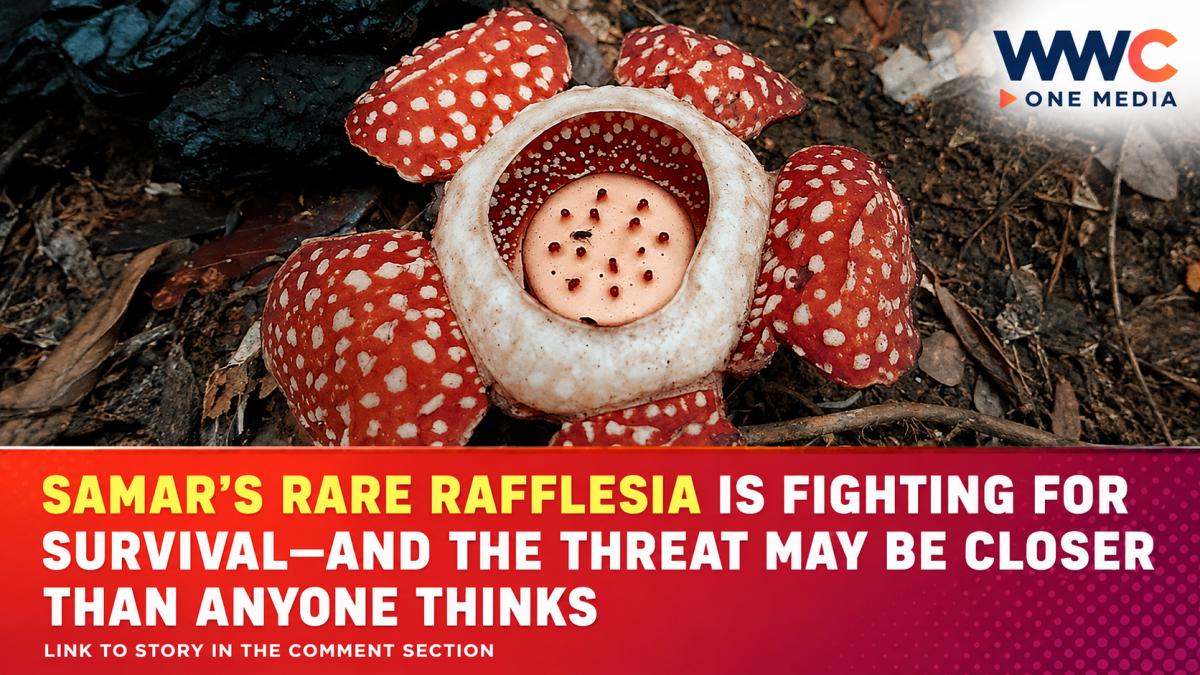
TACLOBAN CITY, Philippines — A rare flower found only in Samar is once again at the center of an intensified conservation campaign as environmental officials work with local communities to protect its remaining forest habitat.
The focus is the Samar rafflesia (Rafflesia manillana), an endangered species whose survival is closely tied to the forests of Basey, Samar.
The Protected Area Management Office of the Samar Island Natural Park (PAMO-SINP), together with the local government of Basey, has launched a communication, education and public awareness campaign urging residents to help safeguard the species and the habitat where it grows. The move came after conservation personnel observed signs of possible illegal timber poaching and other human disturbances around areas supporting the rare plant.
A rare flower with an extraordinary life cycle
Unlike ordinary flowering plants, the rafflesia does not have leaves, stems or roots. It is a holoparasitic plant, meaning it depends entirely on a host plant for nutrients.
For Rafflesia manillana, that relationship is particularly important because it relies on a specific host vine. Any disturbance to the surrounding forest—including the removal of vegetation or damage to the host—can therefore threaten the plant even if the flower itself is never directly touched.
The species is also famous for producing one of the world’s most unusual flowers. Its blooms are relatively short-lived and are associated with an odor resembling decaying flesh, which helps attract flies that serve as pollinators.
The species was rediscovered after 15 years
The renewed conservation push follows an important development earlier in 2026.
DENR personnel documented Rafflesia manillana in the Samar Island Natural Park during surveys conducted in May and June, recording 24 visible buds and flowers, including one fully bloomed flower.
The population was documented in Sitio Bagong Silang, Barangay Guirang, Basey, Samar—the only confirmed distribution of the species in current records.
The discovery was especially significant because the plant had not been officially documented since March 2011, meaning the 2026 survey provided the first confirmed documentation in roughly 15 years.
The rediscovery offered a measure of hope for conservationists, but it also highlighted how little is known about the species’ present population and how vulnerable its remaining habitat may be.
Why protecting the forest matters
Conservation officials emphasize that saving the Samar rafflesia cannot be separated from protecting the forest around it.
Because the plant depends on its host vine and the conditions of an intact forest ecosystem, activities such as timber poaching, vegetation clearing and other forms of habitat disturbance can potentially disrupt its ability to survive and reproduce.
The Samar Island Natural Park itself is a major biodiversity stronghold. Covering more than 333,000 hectares across Samar, Northern Samar and Eastern Samar, it contains extensive forest ecosystems and provides habitat for numerous threatened and endemic species.
That means the effort to protect one unusual flower is also part of a much larger battle to preserve Samar’s remaining forests.
Communities urged to become the first line of defense
During the recent awareness campaign, residents were encouraged to watch for activities that could threaten the rafflesia and its habitat and to report suspected illegal activities to authorities.
Officials also discussed Republic Act No. 11038, or the Expanded National Integrated Protected Areas System (E-NIPAS) Act of 2018, which strengthens protection for ecosystems and biodiversity within designated protected areas.
The approach reflects a broader conservation strategy in Samar: protecting biodiversity while involving communities that live alongside the forest.
The Philippine Information Agency has also reported continuing conservation and community-based efforts within Samar Island Natural Park, including initiatives designed to encourage local residents to become stewards of the park’s natural resources.
More than a flower at stake
For conservationists, Rafflesia manillana represents far more than a rare botanical curiosity.
Its survival depends on an intricate relationship involving the plant, its host vine and the forest ecosystem. Protecting the species therefore means protecting the ecological conditions that allow that relationship to continue.
The DENR has said monitoring of the species will continue, including efforts to strengthen biodiversity monitoring and scientific research.
The latest conservation campaign underscores a simple but urgent reality: the future of Samar’s rare rafflesia will depend not only on finding the flowers, but on keeping the forest where they can still exist.
And after a 15-year gap between documented sightings, conservationists now have something precious to protect—but also much more to learn about how many of these extraordinary plants remain hidden in Samar’s forests.



Leave a Reply