
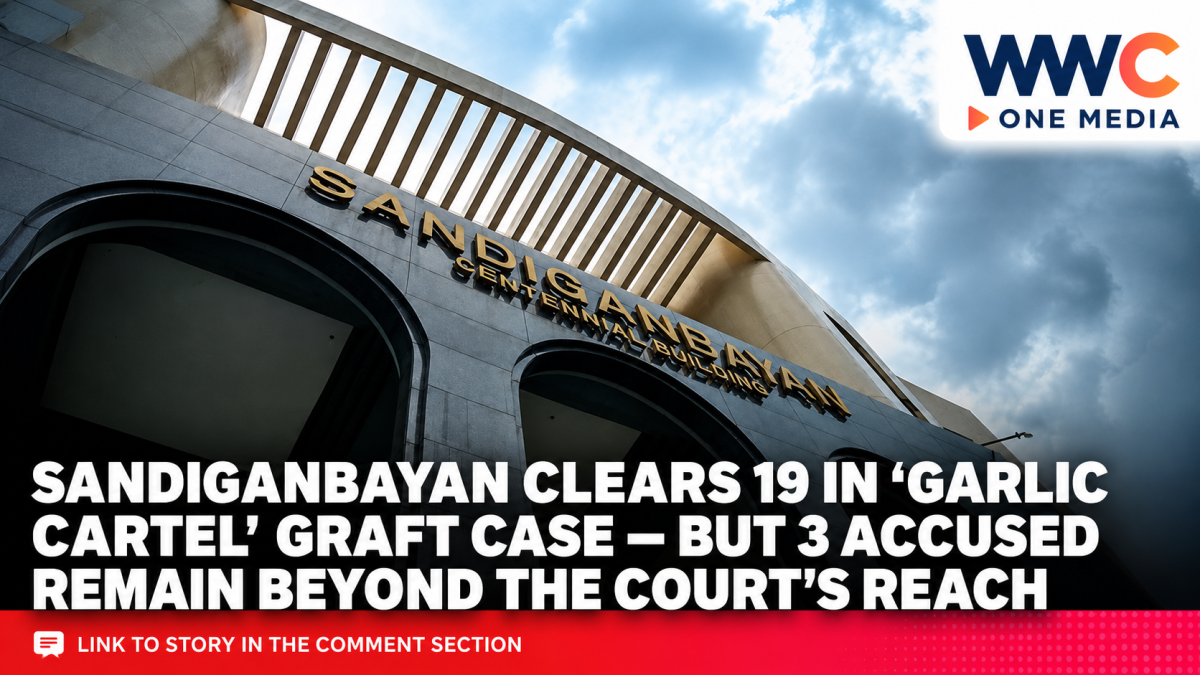
MANILA, Philippines — More than a decade after soaring garlic prices triggered investigations into an alleged scheme to control imports and manipulate the market, the Sandiganbayan has acquitted former Bureau of Plant Industry officials and private traders charged with graft in the controversial “garlic cartel” case.
The Sandiganbayan Fifth Division ruled on September 1, 2026 that prosecutors failed to prove the guilt of the accused beyond reasonable doubt, effectively clearing 19 defendants who had faced allegations arising from the garlic importation controversy that erupted during the previous decade.
Among those acquitted were former Bureau of Plant Industry Director Clarito Barron, former National Plant Quarantine Services Division chief Merle Palacpac, and Philippine Vegetable Importers, Exporters and Vendors Association Group of Companies director Lilia “Lea” Cruz.
Sixteen other traders and agricultural-sector personalities were also acquitted: Rolando Manangan, Prudencio Ruedas, Ma. Jackielou Ilagan, Gaudioso Diato, Denia Matabang, Raffy Torres, Mary Grace Sebastian, Orestes Salon, Jon Dino de Veyra, Jose Angulo Jr., Laila Matabang, Edmond Caguinguin, Napoleon Baldueza, Jose Ollegue, Rolan Galvez and Renato Francisco Jr.
The ruling represents a dramatic conclusion for most of the defendants in a case rooted in one of the Philippines’ most controversial agricultural price spikes.
Bonds Released, Travel Restrictions Lifted
Fifth Division Chairperson Associate Justice Zaldy Trespeses said the ₱30,000 bonds posted by each of the acquitted defendants would be released. Hold-departure orders issued against them will also be lifted.
Three defendants — Torres, Caguinguin and Ollegue — were absent when the decision was promulgated, but the court proceeded with the promulgation of the ruling.
The cases of three other co-accused, Rochelle Diaz, Shiela Mary dela Cruz and Angelita Flores, were archived because they remain at large. Their cases therefore stand on a different procedural footing from those of the defendants who were acquitted.
How the ‘Garlic Cartel’ Case Began
The controversy goes back to 2013 and 2014, when garlic prices surged dramatically and government investigators began examining whether control over import permits had allowed a preferred group of traders to dominate supply.
Cruz had been appointed chairperson of the National Garlic Action Team, or NGAT, in July 2013 by then-Agriculture Secretary Proceso Alcala.
The NGAT served as a consultative body dealing with issues including garlic supply, production and possible importation.
In November 2013, the body recommended importing 58,240 metric tons of garlic to meet projected market requirements.
Prosecutors later alleged that of 8,810 import permits granted during the period covered by the case, 5,022 went to PhilVIEVA, VIEVA or importers associated with the organizations.
That concentration of permits became central to the government’s theory of the case.
Prosecutors alleged that Barron served as the approving authority for permits, while Palacpac and then-NPQSD chief Luben Marasigan acted as recommending officials during their respective tenures.
But an allegation in an indictment is not itself proof of criminal liability — and after years of litigation, that distinction became decisive.
Garlic Prices Had Surged to as Much as ₱400 Per Kilo
The government’s case unfolded against the backdrop of extraordinary garlic prices.
According to allegations presented by prosecutors, imported garlic that had averaged roughly ₱165 to ₱170 per kilogram between 2010 and 2013 climbed to about ₱260 to ₱400 per kilogram from January to July 2014.
Native garlic reportedly reached approximately ₱250 to ₱450 per kilogram during parts of 2014.
The price shock prompted a government investigation.
In January 2015, the Department of Justice announced that the National Bureau of Investigation had filed complaints against more than 100 individuals following an investigation into suspected price manipulation.
At the time, the NBI reported finding indications of collusion between certain Bureau of Plant Industry officials and importers connected with VIEVA. The Justice Department also said an earlier government competition investigation concluded that there had been no actual garlic shortage, that a majority of import permits had gone to one preferred group, and that concentration of supply gave that group the ability to influence prices.
Those were findings and allegations from investigators, however — not criminal convictions.
That distinction is crucial in light of the Sandiganbayan’s latest ruling.
Alcala Was Already Cleared Earlier in 2026
The September acquittals did not come entirely out of nowhere.
Former Agriculture Secretary Proceso Alcala, one of the highest-profile defendants originally charged in the case, had already obtained the dismissal of his graft charge in January 2026.
The Sandiganbayan granted Alcala’s demurrer to evidence after concluding that prosecutors had failed to present sufficient evidence establishing his participation in the alleged scheme.
The court said there was no evidence showing Alcala influenced BPI officials to favor Cruz or VIEVA-linked importers or personally intervened in the processing and issuance of garlic import permits.
A demurrer to evidence challenges whether the prosecution’s evidence is strong enough to require an accused person to present a defense. Once granted on the merits in a criminal case, it results in an acquittal.
The case against former NPQSD chief Luben Marasigan, meanwhile, had been dismissed in 2021 following his death.
Interestingly, the litigation had previously reached the Supreme Court.
Palacpac sought to overturn Sandiganbayan resolutions refusing to quash the criminal information against her, but the Supreme Court dismissed her petition in 2021 and affirmed the anti-graft court’s rulings. That decision allowed the prosecution to continue at the time; it did not determine whether she was guilty of the underlying graft charge.
Five years later, the trial ultimately ended in her acquittal.
What the Acquittal Actually Means
The ruling does not necessarily mean the dramatic garlic price increases of 2014 never occurred, nor does it erase the investigations that followed.
The historical price spike and concentration of import permits were documented and became subjects of government scrutiny.
What the September 1 decision means in criminal-law terms is narrower but decisive: the prosecution failed to establish the accused defendants’ guilt for the graft charge beyond reasonable doubt.
That is the standard required for a criminal conviction.
With Alcala’s case already dismissed, Marasigan deceased and 19 other accused now acquitted, the graft prosecution that once emerged from the country’s headline-grabbing garlic controversy has largely unraveled.
Three accused, however, remain at large and their cases have been archived rather than resolved through acquittal.
More than a decade after consumers watched garlic prices climb to extraordinary levels, that leaves the bigger question hanging over the episode:
If the alleged criminal scheme could not ultimately be proven beyond reasonable doubt against most of those charged, what exactly caused one of the Philippines’ most notorious garlic price explosions — and what lessons did regulators learn from it?



Leave a Reply