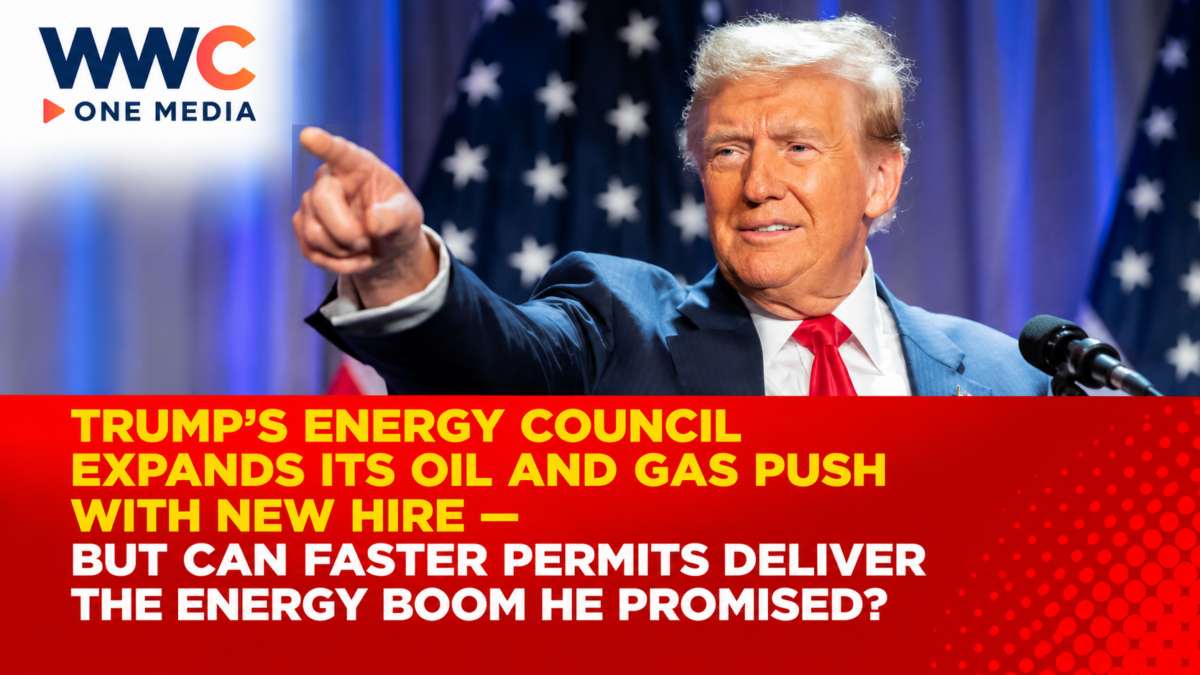
WASHINGTON, D.C. — October 31, 2026. President Donald Trump’s administration is sharpening its focus on American oil and natural-gas development, with a newly reported addition to the White House’s National Energy Dominance Council expected to concentrate on advancing fossil-fuel projects.
The development, reported by Bloomberg on October 30, comes as the administration seeks to accelerate energy infrastructure approvals, expand domestic production and strengthen the United States’ position in global oil and liquefied natural gas markets.
The White House council has become an important coordinating body for the administration’s energy agenda.
Chaired by Interior Secretary Doug Burgum, with Energy Secretary Chris Wright serving as vice chair, the council is tasked with helping federal agencies address obstacles affecting energy development.
Its work spans permitting, production, pipelines, electricity generation, energy exports and critical minerals.
But an increasingly important question is emerging.
Can a more aggressive approach to project approvals translate into greater energy supply and lower costs for American consumers—or will financing constraints, environmental disputes and volatile global oil prices undermine Trump’s energy dominance strategy?
White House strengthens its focus on oil and gas projects
Bloomberg reported on October 30 that the National Energy Dominance Council’s latest hire would focus on oil and natural-gas projects.
The staffing development fits the council’s wider mandate to help move energy investments from planning into development.
The identity, formal title and precise responsibilities of the new appointee were not independently confirmed in the available official announcements reviewed for this report.
The appointment should therefore not be described as the creation of a new Cabinet-level position or proof that specific projects have already been approved.
Its significance lies in the policy direction.
The Trump administration is continuing to prioritize domestic energy production, export facilities and infrastructure needed to move oil and gas from producing regions to customers.
The council has been established as a central point for coordinating those efforts across government agencies.
What is the National Energy Dominance Council?
Trump created the National Energy Dominance Council through an executive order issued on February 14, 2025.
The council operates within the Executive Office of the President.
Its membership includes senior federal officials responsible for major parts of US energy and economic policy.
Burgum, as Interior Secretary, chairs the organization.
Wright, as Energy Secretary, serves as vice chair.
Jarrod Agen is the council’s executive director.
According to the establishing executive order, the council is responsible for advising the president on ways to improve energy permitting, production, generation, distribution, regulation, transportation and exports.
It is also expected to encourage private-sector investment and coordinate policies across federal agencies.
The administration describes its objective as American energy dominance.
But that concept covers several different goals, including greater domestic output, stronger energy exports and lower energy costs.
Achieving one does not automatically guarantee the others.
Faster permitting is becoming a major White House priority
Oil and gas projects can take years to move from initial planning to operation.
Developers may require environmental reviews, federal and state permits, financing arrangements, construction contracts and pipeline access.
Large export facilities can face additional requirements involving maritime infrastructure and energy transportation.
The White House argues that complicated approval processes have delayed investment and increased costs.
The National Energy Dominance Council has been tasked with identifying obstacles and helping coordinate government responses.
In February 2026, Burgum encouraged energy and mining developers to bring major projects to the council for assistance.
Industry reporting described the council as a team intended to help projects navigate federal decision-making.
But streamlining permitting is not the same as eliminating legal requirements.
Projects may still face environmental rules, land-use disputes, court challenges and commercial limitations.
The administration wants more energy infrastructure
Trump’s February 2025 executive order specifically identified pipelines, power-generation facilities, critical minerals and other infrastructure as development priorities.
Among the projects mentioned were natural-gas pipelines serving regions with limited access to supplies.
Expanding infrastructure could help move gas from producing basins to electricity generators, industrial facilities and export terminals.
Supporters argue that better pipeline access can reduce regional supply constraints and improve energy reliability.
But opponents raise concerns about environmental impacts, methane emissions and the long-term consequences of expanding fossil-fuel dependence.
Those disagreements are central to the current debate over permitting reform.
A faster approval process could attract investment.
However, projects must still demonstrate commercial viability and comply with applicable legal obligations.
US natural-gas production is projected to reach new records
The energy council’s efforts coincide with expectations of continued growth in American natural-gas production.
Reuters reported on October 27 that the US Energy Information Administration expected marketed natural-gas production to increase from approximately 107.6 billion cubic feet per day in 2025 to 112.2 billion in 2026.
The agency projected further growth to around 116.1 billion cubic feet per day in 2027.
These are forecasts rather than final production totals.
The projected increase reflects output from major producing regions, including the Permian Basin and Haynesville.
Demand from LNG exports and electricity generation is also expected to remain strong.
But production forecasts depend on market prices, drilling activity, infrastructure and the decisions of private energy companies.
A White House policy announcement cannot compel producers to drill wells that are uneconomic.
LNG exports are becoming a central geopolitical tool
Liquefied natural gas is an important part of the administration’s international energy strategy.
The United States has become a leading supplier of LNG to global markets.
The industry allows American gas to reach customers in Europe and Asia through specialized export terminals and ships.
Washington views those exports as commercially valuable and strategically important.
Countries seeking alternatives to politically unstable or highly concentrated sources of supply may turn to US projects.
The Middle East conflict has reinforced those concerns.
On October 29, Reuters reported that Woodside Energy had reached a 20-year agreement to supply QatarEnergy with LNG from a planned Louisiana facility.
The project aims to begin deliveries in 2030.
That deal highlights strong demand for alternative sources of gas.
However, the agreement should not be confused with an announcement that the entire facility is already operating.
Large LNG developments require construction, financing, regulatory approvals and reliable customer contracts.
Alaska LNG represents the administration’s biggest test
One of the most ambitious projects supported by the Trump administration is the proposed Alaska LNG development.
The plan involves transporting natural gas from Alaska’s North Slope through a long pipeline toward an export facility serving overseas buyers.
Supporters argue that the project could strengthen American energy exports and provide additional supply to Asian customers.
But its financial and engineering challenges are substantial.
In September, Bloomberg reported discussions about possible South Korean investment connected to the development.
Yet a Reuters review published October 29 found that the financing commitments promoted by Trump had not been finalized in the manner suggested by some public announcements.
The distinction is important.
Political support and investment discussions do not establish that a project is fully financed or ready for construction.
For Alaska LNG, the critical tests remain binding commitments, approved plans, competitive construction costs and long-term demand.
A new permitting deal could reshape US energy investment
Congress is also considering changes intended to accelerate energy infrastructure development.
Negotiations involve Republican and Democratic lawmakers, industry groups and the White House.
The legislation under discussion would seek to make permits more predictable and restrict certain forms of federal interference after projects receive authorization.
Supporters believe reforms are necessary to expand energy supplies and electricity infrastructure.
However, disagreements remain over renewable energy, environmental safeguards and the balance of federal authority.
Democratic Representative Sean Casten has expressed concern that some provisions could disproportionately benefit natural-gas projects.
Meanwhile, some clean-energy advocates support permitting reform because renewable projects and transmission lines also face lengthy delays.
The competing positions demonstrate why an agreement remains difficult.
A bill may attract broad support for faster construction while still generating intense disagreement over which projects benefit and how environmental protections are maintained.
Wind and solar projects have become part of the political conflict
The administration’s preference for fossil-fuel expansion has created tension with renewable-energy developers.
Trump has pursued restrictions affecting parts of the wind industry, including offshore projects.
At the same time, permitting negotiations have created opportunities for selected wind projects to advance.
Bloomberg reported in late October that the administration had permitted some onshore developments to proceed while continuing legal action involving offshore wind approvals.
Critics argue that selective treatment introduces uncertainty and politicizes infrastructure decisions.
Supporters of the White House’s policies emphasize energy reliability and concerns over the cost or environmental footprint of certain technologies.
The debate is not simply about whether the United States should build more energy capacity.
It is also about how projects should be evaluated and whether approval rules are applied consistently.
Investors generally prefer predictable regulatory requirements that remain stable across political administrations.
The AI boom has increased pressure to build power plants
Energy policy is increasingly connected to artificial intelligence.
Large data centers require enormous amounts of electricity, particularly those designed to train and operate advanced AI models.
Technology companies are investing in new computing facilities while seeking reliable power supplies.
This creates opportunities for natural-gas generators, nuclear power plants, transmission equipment manufacturers and other energy businesses.
WWC ONE MEDIA examined the wider infrastructure challenge in Bank of America Predicts $2.1-Trillion AI Data Center Explosion by 2028 — But Could a Global Power Shortage Bring the Entire Boom Crashing Down?.
The report discussed a forecast of approximately $2.1 trillion in worldwide data-center spending by 2028.
That is a projection, not confirmed investment already completed.
The US energy council’s priorities overlap with this infrastructure boom.
But additional natural-gas supplies alone cannot resolve every electricity constraint.
Data centers also require grid connections, substations, transformers and adequate transmission capacity.
Google is securing nuclear power for its AI expansion
Some major technology companies are addressing electricity constraints through long-term power agreements.
Google recently announced arrangements involving Constellation Energy and approximately 3.6 gigawatts of electricity capacity.
WWC ONE MEDIA covered the development in Google Signs Massive 3.6-GW Power Deal With Constellation — But the Real AI Bottleneck Is No Longer Chips.
The agreement illustrates why reliable electricity has become an increasingly valuable part of the AI industry.
Nuclear power offers continuous generation, while natural-gas plants can provide dispatchable electricity.
Renewables, storage, transmission upgrades and demand management also contribute to the broader energy mix.
The right combination depends on local costs, infrastructure and reliability requirements.
A policy that favors one energy source without considering the full electricity system may fail to address some important constraints.
Oil prices remain beyond the control of any single government
Trump has repeatedly linked expanded American production to lower energy prices.
Greater domestic supply can affect markets, especially over the long term.
But crude oil is traded internationally.
Its price responds to global demand, production decisions, transportation risks and geopolitical events.
The conflict involving Iran and disruptions around the Strait of Hormuz have demonstrated how quickly global energy markets can change.
Reuters reported on October 24 that the war had challenged the assumption that abundant American production could fully protect consumers from international oil-price shocks.
That is a crucial limitation of the energy dominance strategy.
Even when the United States produces large quantities of oil and gas, consumers can still face higher gasoline, diesel and heating costs.
Domestic supply offers important advantages, but it does not eliminate exposure to world markets.
Middle East tensions are increasing the value of energy security
The Strait of Hormuz remains one of the world’s most strategically important oil shipping routes.
Disruption to tanker traffic can influence global fuel prices and create uncertainty for energy-importing countries.
WWC ONE MEDIA previously reported on Saudi Arabia Is Offering More Oil to Asia Through Oman — But the Crude Still Has to Survive the Strait of Hormuz First.
That report examined efforts to maintain oil deliveries despite maritime disruption.
The issue is relevant to American energy policy because supply uncertainty increases the commercial and strategic value of alternative production regions.
US LNG and oil producers may benefit from higher international demand.
But buyers also require competitive prices and reliable shipping arrangements.
The potential benefit to American energy exporters does not necessarily mean households will face lower energy bills.
Environmental protections remain a major point of contention
Expanding fossil-fuel production can increase environmental risks if projects are poorly managed.
Oil and natural-gas operations may generate methane emissions, air pollution and potential impacts on land and water.
Methane is a powerful greenhouse gas, making leak detection and management important.
The Trump administration has proposed easing certain requirements introduced under the previous administration.
Supporters argue that reducing regulatory burdens can lower production costs and encourage investment.
Environmental organizations warn that weaker requirements could increase emissions and transfer costs to communities.
These competing concerns make regulatory oversight particularly important.
Accelerating approvals may improve project delivery.
But policymakers must still consider environmental impacts, legal obligations and long-term costs.
The Philippines is also seeking stronger energy security
Trump’s energy agenda has potential implications for the Philippines.
The country relies significantly on imported energy and has experienced pressure from international fuel prices.
The United States has indicated interest in supporting LNG, nuclear power and other Philippine energy infrastructure projects.
The US Trade and Development Agency has also provided technical support for a proposed small modular reactor initiative involving Meralco’s power-generation business.
These projects are distinct from the White House energy council’s newly reported staffing decision.
There is no verified evidence that the latest council appointment directly approved a Philippine investment.
But they illustrate the wider role of American energy technology and financing in the region.
Philippine fuel reserves are another concern
The Philippine government has been exploring ways to strengthen its emergency petroleum supply.
WWC ONE MEDIA covered the effort in Philippines Moves to Secure Oil Reserves Abroad as Middle East Conflict Threatens Fuel Supply — But Will It Prevent Another Price Shock?.
The initiative includes discussions about reserving access to fuel stored in other countries.
Such arrangements could provide additional protection against temporary supply disruptions.
However, access to reserves does not guarantee stable retail fuel prices.
International oil markets, shipping conditions, currency movements and domestic taxes all affect costs.
The broader lesson is that reliable energy supply requires diversified sources, infrastructure and emergency planning.
The United States’ increasing focus on production and exports could create more options for importers, but the benefits depend on commercial agreements and actual delivery.
Can faster approvals deliver more affordable energy?
The central economic question is whether accelerated permitting will lead to projects that increase energy supply at competitive costs.
Removing unnecessary delays can improve investment conditions.
But developers still need financing, suitable sites, equipment, skilled workers and customers.
Some projects may become commercially attractive under current conditions.
Others may remain too expensive or face insufficient demand.
The Reuters review of Trump’s announced investment projects illustrates the difference between political commitments and completed investments.
Major projects can remain years from operation.
For households and businesses, the most meaningful results will be actual additional energy supplies, dependable infrastructure and manageable prices.
Announcements alone are not sufficient.
The bigger question: Will Trump’s energy dominance strategy deliver?
The National Energy Dominance Council is becoming an important instrument of the Trump administration’s energy policy.
Its mandate is broad, but the latest reported hire points toward continued attention to oil and gas development.
Supporters believe closer coordination across federal agencies could help unlock investment, expand domestic production and strengthen energy exports.
Critics question the environmental consequences and the administration’s different treatment of fossil-fuel and renewable-energy projects.
Private companies must also decide whether proposed developments make financial sense.
And global energy prices remain vulnerable to geopolitical shocks outside Washington’s control.