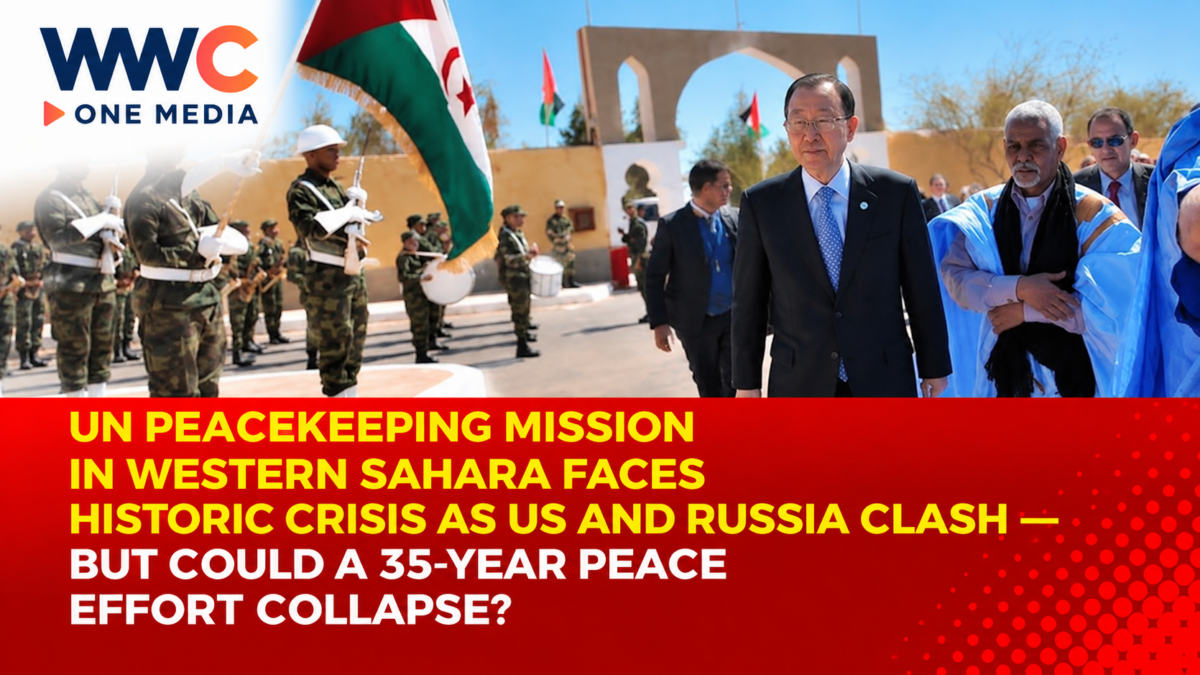
NEW YORK / WESTERN SAHARA — October 31, 2026
A diplomatic showdown between the United States and Russia has pushed one of the United Nations’ longest-running peacekeeping operations into an unprecedented crisis, raising fears that decades of international efforts to prevent another war in Western Sahara could unravel.
The UN Security Council failed to approve competing resolutions on Friday, October 30, leaving the United Nations Mission for the Referendum in Western Sahara (MINURSO) facing the expiration of its mandate on October 31.
According to Reuters and the Associated Press, Russia blocked a US-backed proposal that would have significantly reshaped the mission and endorsed Morocco’s autonomy initiative as the central framework for future negotiations.
Washington subsequently rejected Russia’s competing proposal, which sought a more straightforward extension of the existing peacekeeping mandate.
The outcome threatens the future of a mission established in 1991 to oversee a ceasefire and prepare a referendum on Western Sahara’s political future.
Now, with the mission’s legal mandate approaching expiration and no compromise secured, diplomats face a difficult question: Could the collapse of UN consensus open the door to renewed military escalation across North Africa?
US and Russia Clash Over the Future of Western Sahara
At the center of the diplomatic confrontation is a disagreement over what the United Nations should do next in the disputed territory.
The United States has supported a political settlement based on Morocco’s autonomy proposal, which would give Western Sahara a degree of self-government while maintaining Moroccan sovereignty.
Russia, meanwhile, has objected to proposals it considers too favorable to Morocco and potentially prejudicial to the outcome of negotiations.
The competing positions came to a head during the October 30 Security Council proceedings.
The revised American resolution would have extended the mission until October 31, 2027, renamed it the United Nations Mission in Western Sahara, and called for a review of its structure, staffing and resources.
An earlier American draft went further, proposing the eventual replacement of the existing peacekeeping operation with a special political mission.
According to Security Council Report, negotiations became increasingly contentious as several countries raised concerns about how the proposed changes might affect the Sahrawi people’s right to self-determination.
Russia instead presented a proposal to preserve the existing mission’s mandate for another year.
Neither approach secured adoption.
The failed votes highlight a wider problem for the United Nations: the organization’s most powerful members can prevent Security Council action even when other countries favor a negotiated compromise.
WWC ONE MEDIA previously examined this challenge in its report, World Leaders Gather at UN as Questions Grow Over How the Organisation Actually Works, explaining how the Security Council’s veto system can stall international responses to major conflicts.
Why Western Sahara Remains One of the World’s Longest Unresolved Territorial Disputes
Western Sahara is a sparsely populated territory on Africa’s Atlantic coast, bordered by Morocco, Algeria and Mauritania.
The former Spanish colony has been at the center of a territorial dispute for more than five decades.
After Spain withdrew in 1975, Morocco asserted control over the territory, while the Polisario Front pursued an independent Sahrawi state.
Morocco currently controls most of Western Sahara, while the Polisario Front, which receives support from neighboring Algeria, continues to oppose Moroccan sovereignty.
The conflict became an international issue as rival claims over sovereignty, political representation and self-determination hardened.
In 1991, a United Nations-brokered ceasefire created an opportunity for a political settlement.
MINURSO was established to monitor the ceasefire and help organize a referendum that would allow eligible voters to determine the territory’s future.
However, disagreements over voter eligibility and the territory’s final status prevented the planned referendum from taking place.
Although the mission continued operating, the political dispute remained unresolved.
That fragile arrangement suffered a major setback in November 2020, when fighting resumed between Moroccan forces and the Polisario Front.
Since then, MINURSO has continued monitoring military developments and reporting incidents while attempting to reduce the risk of further escalation.
Why the UN Peacekeeping Mission Matters
MINURSO may be smaller than some United Nations operations elsewhere, but its strategic importance extends beyond its personnel numbers.
Reuters reported that the mission had approximately 155 military personnel at the time of the latest Security Council dispute.
Its responsibilities include observing military activity, investigating reported incidents, supporting de-escalation and helping reduce threats from mines and unexploded ordnance.
The mission also provides operational support to the UN Secretary-General’s diplomatic efforts.
Its presence offers an international monitoring mechanism in a territory where the opposing parties have sharply different interpretations of sovereignty and security.
Without an agreed renewal, the mission faces uncertainty over its authorization, future operations and the possible withdrawal of personnel.
However, the failure to renew its mandate should not automatically be interpreted as proof that all UN personnel have already withdrawn or that a new full-scale war has begun.
Any operational transition would require further decisions and practical arrangements.
The immediate danger is that the loss of an established monitoring mechanism could make military incidents harder to verify and tensions more difficult to contain.
Morocco’s Autonomy Plan Versus the Polisario Front’s Independence Demand
The competing political visions explain why the dispute has remained unresolved for decades.
Morocco’s autonomy proposal, originally submitted to the United Nations in 2007, calls for local self-government within Moroccan sovereignty.
Under the proposal, Morocco would retain authority over key sovereign functions, including external representation.
The Polisario Front argues that the Sahrawi people must retain the opportunity to exercise self-determination, including the option of independence.
For Morocco, autonomy offers a pathway toward resolving the conflict while preserving territorial control.
For the Polisario Front, a settlement that excludes independence as a possible outcome risks denying the Sahrawi population a meaningful political choice.
The United States has increasingly backed Morocco’s autonomy framework, while Russia and other Security Council members have expressed concerns about imposing a predetermined political outcome.
The 2025 Security Council resolution had already identified Morocco’s proposal as a basis for renewed negotiations while calling for a mutually acceptable solution consistent with the UN Charter.
The October 2026 confrontation therefore reflects a deeper disagreement about whether international diplomacy should prioritize a specific autonomy arrangement or preserve a broader range of possible outcomes.
Could the Crisis Trigger Wider Instability in North Africa?
The consequences of the Security Council deadlock could extend beyond Western Sahara.
Morocco and Algeria are major regional powers whose strained relationship is closely connected to the territorial dispute.
Algeria supports the Polisario Front, while Morocco considers Western Sahara an integral part of its territory.
A breakdown in international monitoring could complicate efforts to manage tensions around the disputed territory.
Humanitarian organizations have also warned about the potential consequences for civilians and Sahrawi refugees.
Reuters cited concerns from Oxfam that losing MINURSO’s monitoring and de-escalation functions could threaten civilians, displaced communities and broader regional stability.
The humanitarian risks are particularly important for Sahrawi refugee communities living in camps near Tindouf, Algeria.
A prolonged diplomatic breakdown could make efforts to address displacement, political uncertainty and regional security more difficult.
Nevertheless, renewed large-scale fighting is not inevitable.
The outcome will depend on decisions by the parties themselves, continued diplomatic engagement and whether Security Council members can agree on an acceptable alternative.
A Wider Pattern of Global Diplomatic Rivalry
The Western Sahara confrontation also reflects the increasingly complicated relationship between Washington and Moscow.
The two countries remain deeply divided over Ukraine and several international security questions, even as diplomatic contacts continue.
In a separate development covered by WWC ONE MEDIA, Putin Meets Trump Envoys in Moscow as New Push to End Ukraine War Begins, American and Russian representatives pursued discussions aimed at finding a possible diplomatic path through the Ukraine conflict.
Those talks illustrate how the two governments can maintain negotiating channels while remaining far apart on major international disputes.
Security Council disagreements have also affected Middle East diplomacy.
WWC ONE MEDIA previously reported on another confrontation involving international maritime security in Mike Waltz Puts Iran on Notice Over Strait of Hormuz as U.S. Pushes New UN Action — What Happens Next?.
Although the circumstances differ, both cases demonstrate how competing strategic interests can complicate the Security Council’s ability to respond collectively to security crises.
In Western Sahara, the immediate concern is that geopolitical rivalry has now disrupted a peacekeeping framework that survived for 35 years.
What Happens Next for the UN Mission?
The Security Council’s failure to reach an agreement creates several possible paths.
Members could resume negotiations and adopt a compromise allowing the mission to continue operating under an agreed mandate.
They could pursue a shorter extension while debating long-term reforms.
A further possibility would involve restructuring or replacing the existing operation as part of a broader political settlement.
However, none of these outcomes is guaranteed.
The UN Secretary-General’s strategic review, transmitted to the Security Council in October, identified persistent political divisions, restrictions on movement, changing security conditions and financial pressures affecting the mission.
It outlined possible adjustments to improve efficiency, including changes to military monitoring and greater use of technical capabilities.
But institutional reforms alone cannot resolve the fundamental disagreement over Western Sahara’s sovereignty.
A durable settlement would require meaningful political negotiations and an outcome capable of addressing the parties’ competing positions.
The Bigger Question: Can the United Nations Still Protect Fragile Peace Agreements?
The crisis places an uncomfortable spotlight on the effectiveness of international peacekeeping.
For decades, MINURSO provided a continuing UN presence even as the promised referendum remained unrealized.
Its existence did not produce a final settlement, but it helped preserve a mechanism for monitoring military developments and maintaining communication during periods of heightened tension.
Now that mechanism faces one of the gravest challenges in its history.
For the United States and Russia, the dispute has become a test of diplomatic influence and competing approaches to conflict resolution.
For Morocco and the Polisario Front, the stakes involve sovereignty, political legitimacy and the future of Western Sahara.
For Sahrawi civilians and refugees, the consequences could be far more immediate.
The bottom line: The October 30 failure to renew MINURSO’s mandate has pushed a long-standing territorial dispute into a new phase of uncertainty. It does not mean another major war is unavoidable, but it removes confidence in a peacekeeping arrangement that has lasted since 1991.
The world is now watching whether the Security Council can repair the diplomatic breakdown — or whether Western Sahara will become another example of how great-power rivalry can undermine an already fragile peace.