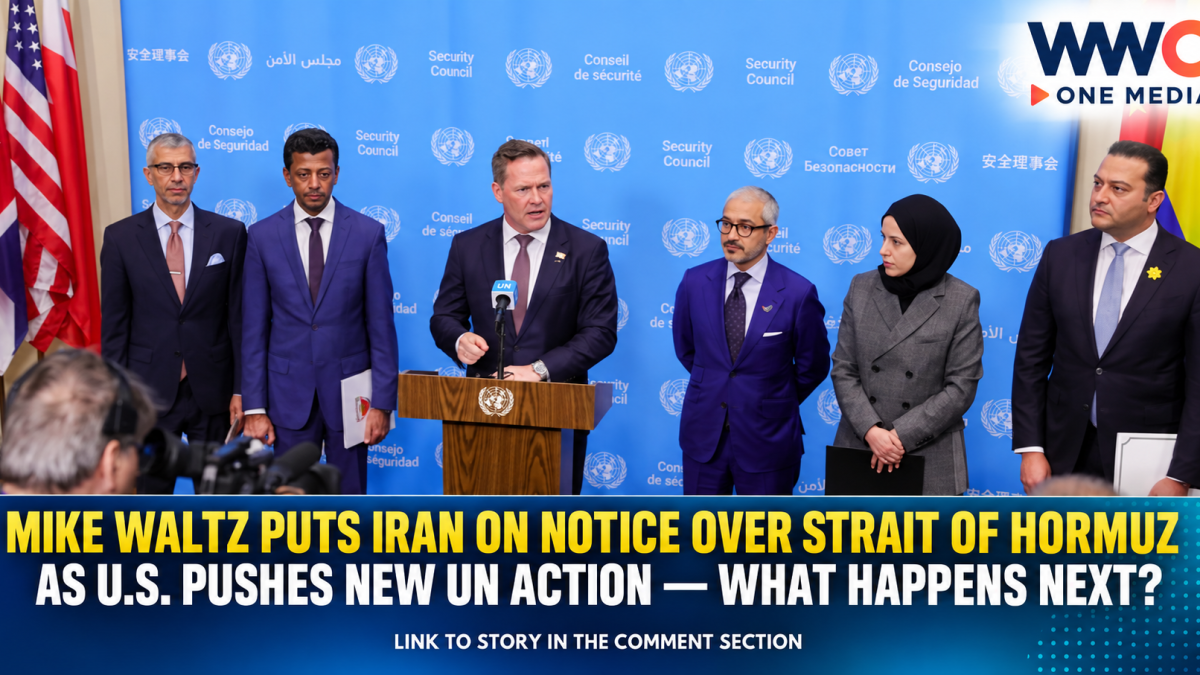
NEW YORK — The battle over the Strait of Hormuz has moved back to the center of international diplomacy, with U.S. Ambassador to the United Nations Mike Waltz calling for stronger action to protect commercial shipping and maintain freedom of navigation through one of the world’s most important maritime corridors.
For more Asia energy-risk and trade briefs, see our Asia hub and Business desk.
Speaking at the United Nations on May 7, Waltz backed a U.S.-Bahrain draft Security Council resolution that called on Iran to halt attacks against commercial vessels, disclose and remove sea mines, stop what Washington describes as unauthorized tolls on shipping, and allow a United Nations-supported humanitarian corridor through the waterway.
The remarks came after an earlier Security Council effort addressing the Strait of Hormuz failed when Russia and China used their vetoes on April 7.
What the U.S.-backed proposal sought
The May proposal was presented as a follow-up to UN Security Council Resolution 2817, adopted on March 11.
Resolution 2817 condemned attacks attributed to Iran against Bahrain, Kuwait, Oman, Qatar, Saudi Arabia, the United Arab Emirates and Jordan. It also condemned actions or threats aimed at closing, obstructing or interfering with international navigation through the Strait of Hormuz. The resolution passed with 13 votes in favor and two abstentions, from China and Russia. It was co-sponsored by 136 UN member states.
Waltz described the new initiative as an “evolution” of Resolution 2817 and said Washington wanted the international community to focus on four objectives: stopping attacks on commercial shipping, removing sea mines, ending tolls on vessels and facilitating humanitarian shipments.
The U.S. envoy argued that disruption of the waterway could have consequences far beyond the Middle East because the Strait of Hormuz is a major route for global energy and commercial traffic.
Russia and China had already blocked an earlier resolution
The diplomatic push faced a major obstacle after Russia and China vetoed a separate Bahrain-sponsored Security Council resolution on April 7.
That measure received 11 votes in favor, while Russia and China voted against it and Pakistan and Colombia abstained. Because Russia and China are permanent members of the Security Council, either veto was enough to prevent adoption.
The April draft had already been substantially softened during negotiations. It encouraged countries interested in commercial routes through the Strait to coordinate defensive efforts, including possible escorts for merchant vessels, but stopped short of explicitly authorizing the use of force.
Russia and China nevertheless argued that the proposal was unbalanced and could contribute to further escalation.
Washington tried again with a revised proposal
The May initiative represented another attempt to secure international backing.
According to Reuters, Washington subsequently revised the draft, removing an explicit reference to Chapter VII of the UN Charter, which can provide the Security Council with authority to impose measures ranging from sanctions to military action. The revised language nevertheless retained provisions allowing the Council to consider further measures, potentially including sanctions, if Iran failed to comply.
Russia and China continued to express serious objections, describing the proposal as one-sided and warning that it could undermine de-escalation efforts.
Iran also rejected the U.S.-backed approach. Iranian officials argued that the proposed text failed to address what Tehran considers the underlying cause of the crisis, including U.S. military actions and sanctions.
Why the Strait of Hormuz matters
The Strait of Hormuz connects the Persian Gulf with the Gulf of Oman and the wider Arabian Sea. Under normal conditions, it is one of the world’s most important energy shipping routes.
The United Nations has described the waterway as a crucial corridor for oil, liquefied natural gas and other commodities, while disruptions have consequences for energy markets, supply chains and humanitarian deliveries.
The International Maritime Organization has likewise highlighted the importance of protecting commercial shipping, seafarers, energy supplies and humanitarian supply chains in the region.
The stakes extend beyond the Gulf. Singapore, for example, has emphasized the importance of international navigation rights because the Strait of Malacca and Singapore is itself a major global energy and trade route. During a UN Security Council debate, Singapore stressed that the principle of transit passage has direct implications for global economic security and international stability.
The issue remains highly relevant months later
The dispute has not disappeared.
As of September 18, 2026, Reuters reported that only four commodity vessels had transited the Strait of Hormuz on the previous day, compared with a 10-day average of 16. Several LNG vessels had also reappeared outside the strait, while shipping activity remained well below normal levels.
The Associated Press separately reported that Iran said it had struck a Togo-flagged oil tanker attempting to transit the Strait, although the AP said it could not immediately independently confirm the Iranian account.
At the same time, the U.S. military has maintained that the waterway remains open to commercial shipping. A U.S. Central Command spokesperson said on September 16 that traffic continued to flow and rejected the characterization that Iran controlled the strait.
The competing claims underscore the central problem that Waltz highlighted months earlier: keeping the waterway technically open is not necessarily the same as restoring predictable, commercially viable and secure international shipping.
A diplomatic dispute with global economic consequences
The Strait of Hormuz dispute has therefore evolved into more than a disagreement over one shipping lane.
For Washington and several Gulf governments, the issue centers on freedom of navigation, maritime security and the uninterrupted movement of commercial and humanitarian supplies.
Iran has framed the issue differently, arguing that the maritime crisis cannot be separated from the wider conflict and the military and economic pressure imposed on Tehran.
Russia and China, meanwhile, have opposed U.S.-backed Security Council initiatives they consider unbalanced and potentially escalatory. Their vetoes have demonstrated the difficulty of reaching consensus inside the 15-member council while the wider U.S.-Iran conflict continues.
For global markets, however, the practical question remains straightforward: how reliably can ships move through the Strait of Hormuz?
With shipping volumes still below historical levels and new incidents involving commercial vessels being reported, the answer remains uncertain — leaving one of the world’s most strategically important waterways at the center of an unresolved international crisis.