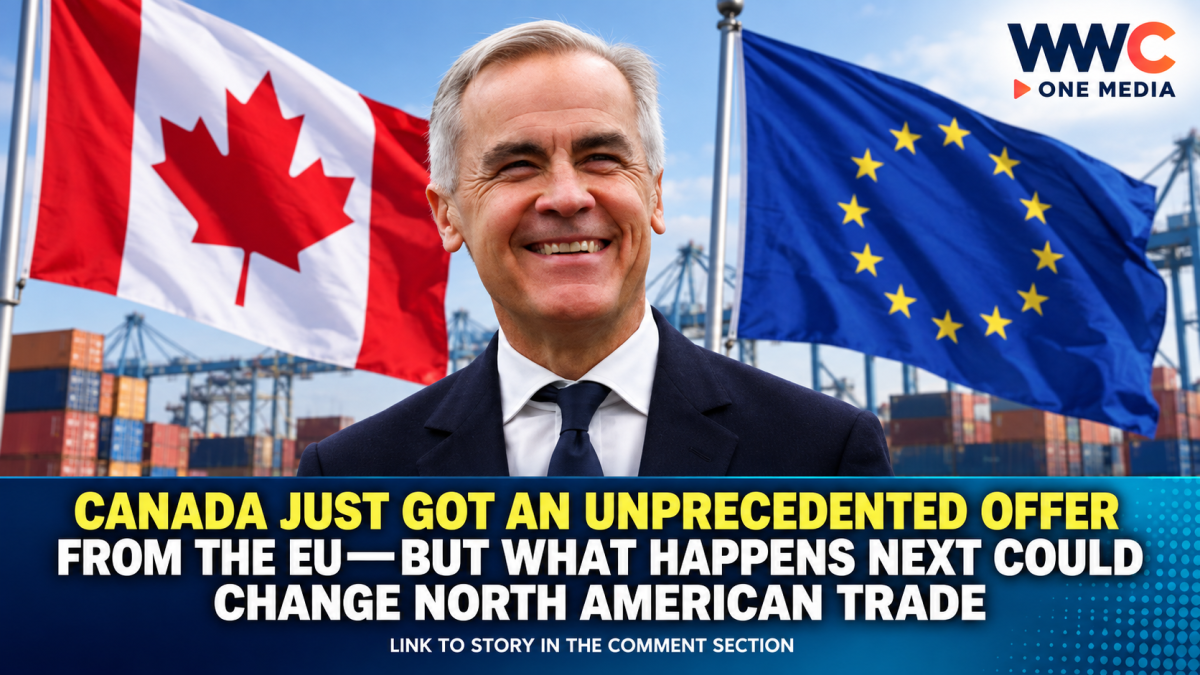
STRASBOURG/MONTREAL — Canada and the European Union are opening the door to a new kind of relationship that could reshape trade, defence, technology and economic cooperation across the Atlantic—but the proposal comes with major legal and political questions that have yet to be resolved.
European Commission President Ursula von der Leyen has proposed that Canada become the European Union’s first-ever “associate member,” an arrangement intended to take relations beyond the existing Canada-EU trade framework and toward what European officials describe as a deeper partnership.
Canadian Prime Minister Mark Carney has welcomed the proposal, while emphasizing that the precise structure and terminology still have to be negotiated. He said the emerging relationship would respect Canadian sovereignty and ultimately require approval in Canada.
What would “associate membership” actually mean?
That remains the biggest unanswered question.
There is currently no established EU legal category called “associate membership.” Canada would therefore become the first country to enter such an arrangement if the proposal eventually moves forward.
EU treaties do, however, provide a legal basis for association agreements with non-EU countries. Article 217 allows the bloc to establish relationships involving reciprocal rights and obligations, common action and special procedures. European countries such as Norway, Iceland and Liechtenstein have much deeper economic integration with the EU through the European Economic Area, although they are not EU members.
That means Canada’s eventual relationship could involve selected areas of economic and political integration without giving Canada the same institutional status as the EU’s 27 member states.
The precise model, however, has not been settled.
Trade could be at the centre of the plan
Canada already has a major trade agreement with the EU: the Comprehensive Economic and Trade Agreement, or CETA.
CETA has been provisionally applied since 2017. According to Canadian and EU officials, two-way goods trade has increased by more than 75% since provisional application began, while bilateral services trade has grown by 97%. Canada and the EU also launched negotiations in March 2026 on a separate digital trade agreement.
The proposed new relationship could therefore build on an existing economic foundation rather than starting from scratch.
Carney has called for closer cooperation in areas including digital trade, services, critical minerals, energy, artificial intelligence, financial services and payments.
He has also proposed stronger people-to-people connections, including opportunities for young Canadians and Europeans to live, work and study across the Atlantic.
Defence is another major piece
The relationship has already moved beyond trade.
Canada became the first non-European country to participate in the EU’s SAFE defence procurement framework, following an agreement signed in February 2026 and formally concluded by the EU Council in June. SAFE is designed to support large-scale defence investment and joint procurement among participating countries.
The development follows the Canada-EU Security and Defence Partnership signed in 2025.
That means discussions about a deeper Canadian-European relationship are not purely economic. They increasingly involve defence industries, strategic supply chains and security cooperation.
Canada is looking beyond its traditional economic dependence
The initiative comes as Canada faces an increasingly complicated relationship with the United States.
Reuters reported that Carney’s government has been seeking to diversify Canada’s trade and strengthen relationships with Europe amid escalating tensions with Washington. Canada has set a goal of significantly expanding non-U.S. trade over the coming decade.
Canada remains deeply integrated with the U.S. economy, however, meaning a closer relationship with Europe would not simply replace Canada’s existing North American economic ties.
Reuters reported that roughly 70% of Canadian exports still go to the United States, while the EU represents a much smaller share of Canada’s overall trade.
That makes the European initiative less a straightforward economic “switch” and more an effort to broaden Canada’s strategic and commercial options.
But there are significant obstacles
The proposal is far from finalized.
Some EU governments have questioned the terminology and the practicality of creating an entirely new category of relationship. Reuters reported that Germany, while supporting stronger Canada-EU cooperation, has indicated that the “associate member” label should be reconsidered. European diplomats also told Reuters that the concept currently has no established legal precedent.
Canada would face challenges of its own.
Trade negotiations between Canada and the EU already involve sensitive sectors, including agriculture and telecommunications. Canadian provinces also have constitutional responsibilities that could complicate any agreement covering areas under provincial jurisdiction.
And CETA itself has not yet been fully ratified by every EU member state, illustrating how complicated the bloc’s internal approval process can be.
Then came Trump’s warning
The proposal has also drawn an unusually sharp response from U.S. President Donald Trump.
Trump dismissed the proposed Canadian associate relationship with the EU as “laughable” and warned that the United States could impose substantial tariffs on Europe if the bloc proceeded.
Reuters reported that Trump framed the proposal as a potential challenge to U.S. interests, while Carney argued that Canada and Europe should be able to deepen their relationship independently.
The dispute adds another layer to an already tense North American-European trade environment.
European officials, meanwhile, have emphasized that closer cooperation with Canada is not necessarily intended to create a new geopolitical bloc against the United States. Carney has similarly described the emerging partnership in terms of resilience, strategic cooperation and shared interests rather than creating a rival great-power alliance.
What happens next?
For now, the proposal remains at the framework-building stage.
Canada and the EU are expected to work through the details of a potential new relationship ahead of a Canada-EU summit in Montreal in late October 2026, where the concept could receive greater definition.
The eventual arrangement could touch everything from trade and digital services to critical minerals, energy, defence procurement, artificial intelligence, research, education and youth mobility.
But it would not make Canada an EU member state.
Instead, the central question is whether Ottawa and Brussels can create a new form of institutional partnership that provides substantially deeper cooperation while preserving Canada’s sovereignty and avoiding the full obligations of EU membership.
For Canada, the proposal opens another channel for trade and strategic cooperation beyond its overwhelmingly important relationship with the United States.
For Europe, it offers a potential partnership with a G7 country possessing energy resources, critical minerals, advanced research capabilities and a major Arctic presence.
And for Washington, the development is another sign that Canada’s foreign and economic policy is becoming more diversified.
The real test will come next: whether the ambitious language of “associate membership” can be turned into a legally workable agreement that both Canada and all necessary EU institutions are prepared to accept.