SANTA CLARA, California — President Donald Trump’s intervention in Nvidia’s leadership crisis may have been about much more than bringing back a high-profile technology executive. It also exposed how closely the fortunes of the artificial intelligence industry, Wall Street and US economic strategy have become connected.
Nvidia reinstated co-founder Jensen Huang as president and chief executive officer on Nov. 22, 2026, reversing his resignation just 10 days earlier. The company announced the decision the following day, confirming that its board had voted unanimously to restore him to the positions.
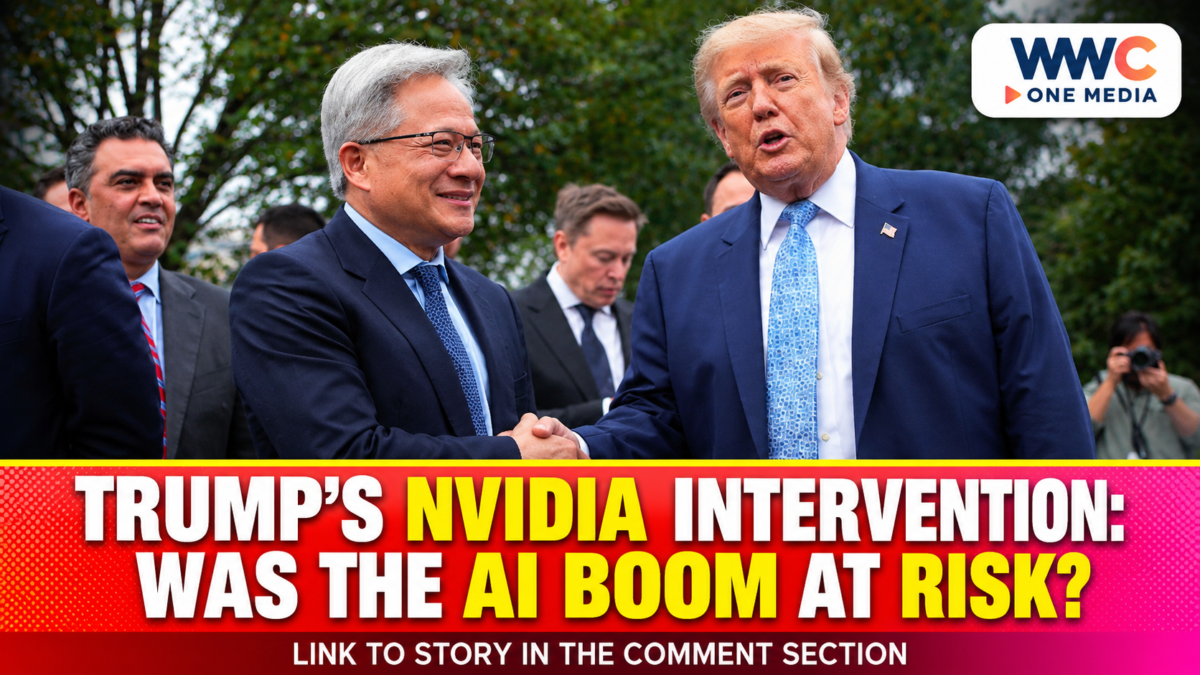
Trump subsequently claimed responsibility for helping persuade the directors. In a televised interview, he acknowledged that the recent stock-market decline probably influenced his thinking, although he said the longer-term importance of Huang and Nvidia was the bigger consideration.
The episode raises an important question for investors and technology companies worldwide: has Nvidia become so central to the AI boom that even its leadership decisions can influence confidence across financial markets?
Trump Admits the Stock Market Was Part of the Calculation
Trump did not conceal his involvement in Huang’s return.
During a Nov. 23 interview, the US president said he had spoken to Nvidia’s board and helped convince its members to reinstate the company’s co-founder.
He also acknowledged that the market downturn was a factor in his thinking.
Asked whether the recent AI-related stock selloff influenced his intervention, Trump responded: “Probably so, but the bigger impact was the long term.”
That distinction matters. His explanation linked the immediate financial consequences of Nvidia’s leadership uncertainty with a broader strategic argument about the company’s importance to the United States.
The board’s decision came after a period of uncertainty following Huang’s resignation on Nov. 12. Nvidia had appointed Chief Financial Officer Colette Kress as interim chief executive while directors considered a permanent replacement.
The reversal was swift. In its Nov. 23 announcement, Nvidia said the board had reached its decision after discussions and meetings with Huang. It also confirmed that the directors had received input from senior levels of the US government.
The board said that, based on this input, it was confident Huang’s reinstatement posed no national-security risk.
The decision therefore involved more than a routine corporate succession. It brought a publicly traded company’s leadership process into direct contact with the priorities of the US government.
Why Nvidia Matters to Wall Street
Nvidia’s importance to the stock market is rooted in its position in the AI infrastructure supply chain.
Its graphics processing units and related computing systems are used to train and operate advanced AI models. Technology companies, cloud providers and data-centre operators rely on computing capacity to develop and deliver their services.
That makes Nvidia an important supplier to an industry attracting enormous investment.
The company’s latest financial results illustrate the scale of its business. For the third quarter of fiscal 2027, which ended Oct. 25, Nvidia reported revenue of US$115.8 billion, up 103% from the same quarter a year earlier.
Its Data Center business generated US$107.6 billion, an increase of 110% year on year.
These figures demonstrate that demand for Nvidia’s computing products is substantial. They do not, however, prove that every company investing in AI infrastructure will earn an adequate return.
That is where the debate about a possible AI bubble becomes important.
A market bubble generally involves asset prices rising beyond what underlying earnings and future cash flows can justify. In AI, investors are trying to determine whether the enormous spending on computing capacity, software and data centres will eventually generate enough revenue to support current expectations.
Nvidia’s growth is real, but the future profitability of the wider AI ecosystem remains a separate question.
For a closer look at the infrastructure challenge, WWC previously examined the risks companies face when moving AI projects from pilot programmes into full-scale data-centre operations.
The AI Bubble Debate Is Not the Same as a Market Crash
The term AI bubble has become a major part of the investment conversation, but it should not be treated as a proven description of the entire industry.
There are two competing realities.
On one side, AI companies and infrastructure suppliers are reporting significant demand. Nvidia’s latest quarterly results show that its business is expanding rapidly.
On the other, investors must consider whether the spending commitments made by technology companies, cloud providers and data-centre developers can produce sustainable returns.
The distinction is important because a company can report strong revenue while parts of its surrounding market remain overvalued.
Nvidia’s own outlook shows how much the company is relying on continued demand. It forecast fourth-quarter fiscal 2027 revenue of approximately US$130 billion, plus or minus 3%.
The company also said its forecast did not assume any Data Center compute revenue from China.
That qualification highlights another risk: the AI industry is not insulated from geopolitical decisions. Export controls, trade restrictions and competition between the United States and China can affect which customers Nvidia is allowed to serve.
The issue is especially relevant to Asia-Pacific markets, where semiconductor manufacturing, electronics supply chains, cloud infrastructure and AI investment are closely connected.
A Leadership Decision With National-Security Implications
Nvidia’s board also made clear that government input formed part of its decision.
That statement is significant because advanced semiconductors are not simply commercial products. They are increasingly treated as strategic technology, with implications for economic competitiveness, national security and military capabilities.
The US government has imposed export restrictions on certain advanced computing chips destined for China. Nvidia’s financial disclosures have previously described how licensing requirements affected its ability to sell specific products into that market.
The company’s November 2026 financial results also excluded China Data Center compute revenue from its fourth-quarter outlook.
The wider relationship between semiconductor security and corporate accountability remains under scrutiny. WWC has previously examined the California investigation involving Nvidia and questions about advanced-chip security.
The board’s statement that it received government input does not mean that every investigation or regulatory question involving Nvidia has been resolved.
Nor does a national-security assessment automatically settle questions about corporate governance, workplace conduct or the independence of the company’s directors.
Those are separate matters requiring their own processes and findings.
What Happens If Nvidia Becomes Too Dependent on One Leader?
Huang’s rapid return also raises a corporate-governance question: how much of Nvidia’s confidence and market value is tied to one executive?
The company is not a small technology start-up. It is a major publicly traded corporation with a board, a large workforce, global customers and extensive financial commitments.
A leadership transition should ordinarily demonstrate that the organisation can continue operating effectively even when its most prominent executive leaves.
The speed of Nvidia’s reversal may therefore encourage investors to examine the company’s succession planning and board oversight more closely.
The board’s reinstatement announcement confirmed that Harvey C. Jones would continue as chairman and that Kress would return to her continuing responsibilities as chief financial officer.
The immediate leadership question has been answered, but the broader governance questions remain relevant. WWC has also examined the three governance tests Nvidia still faces following Huang’s return.
For companies building AI infrastructure, the lesson is not that one executive determines the future of the entire sector. It is that confidence in technology markets depends on a combination of financial performance, reliable leadership, transparent oversight and predictable regulation.
Why the Outcome Matters Beyond the United States
The Nvidia episode has implications far beyond Silicon Valley.
The company’s products and technology partnerships are connected to data-centre projects, cloud services and AI development across several regions.
A major shift in Nvidia’s leadership, supply arrangements or access to international markets can affect investment decisions throughout the technology ecosystem.
The scale of planned infrastructure expansion is also becoming a public-policy issue. Governments are considering land use, electricity supply, water demand, grid capacity and the economic costs of supporting AI data centres.
WWC has previously reported on the Trump administration’s plans involving federal land for AI data-centre development.
These developments show why the AI investment debate cannot be reduced to the share price of one company. The industry depends on physical infrastructure, energy, semiconductors, capital and public policy.
For now, Nvidia has restored the executive who helped build its position at the centre of the AI industry. Its latest financial results provide evidence of strong demand, while its forecast points to expectations of continued expansion.
But the wider market still faces a difficult test: whether the money flowing into AI infrastructure can produce lasting economic returns.
Trump’s intervention may have helped settle Nvidia’s immediate leadership crisis. It cannot, by itself, prove that the AI boom is sustainable.
What Happens Next?
Investors will be watching Nvidia’s next financial results, its ability to meet its revenue outlook and developments affecting its access to international markets.
The company’s board will also face questions about governance and succession planning after reversing its leadership decision within days.
The larger question is whether AI investment can continue expanding at its current pace without creating excessive financial exposure across the technology sector.
Nvidia’s comeback has restored a familiar leader. The next challenge is proving that the business and the wider AI economy can sustain the expectations surrounding it.
Frequently Asked Questions
Why did Donald Trump support Jensen Huang’s return to Nvidia?
Trump said he helped persuade Nvidia’s board to reinstate Huang. He acknowledged that the recent stock-market decline probably influenced his thinking, while describing the longer-term importance of Nvidia as the bigger factor.
When did Nvidia reinstate Jensen Huang?
Nvidia’s board reinstated Huang effective Nov. 22, 2026. The company announced the decision on Nov. 23.
How much revenue did Nvidia report in its third quarter of fiscal 2027?
Nvidia reported US$115.8 billion in total revenue for the quarter ended Oct. 25, 2026. Its Data Center business generated US$107.6 billion.
Is the AI industry in a bubble?
There is an ongoing debate about whether AI-related investments and valuations have moved ahead of the returns businesses can realistically generate. Strong revenue growth at companies such as Nvidia does not, by itself, settle the question.
Does Huang’s reinstatement end Nvidia’s regulatory and governance questions?
No. The leadership decision does not automatically resolve separate investigations, export-control concerns or questions about the company’s governance and succession planning.