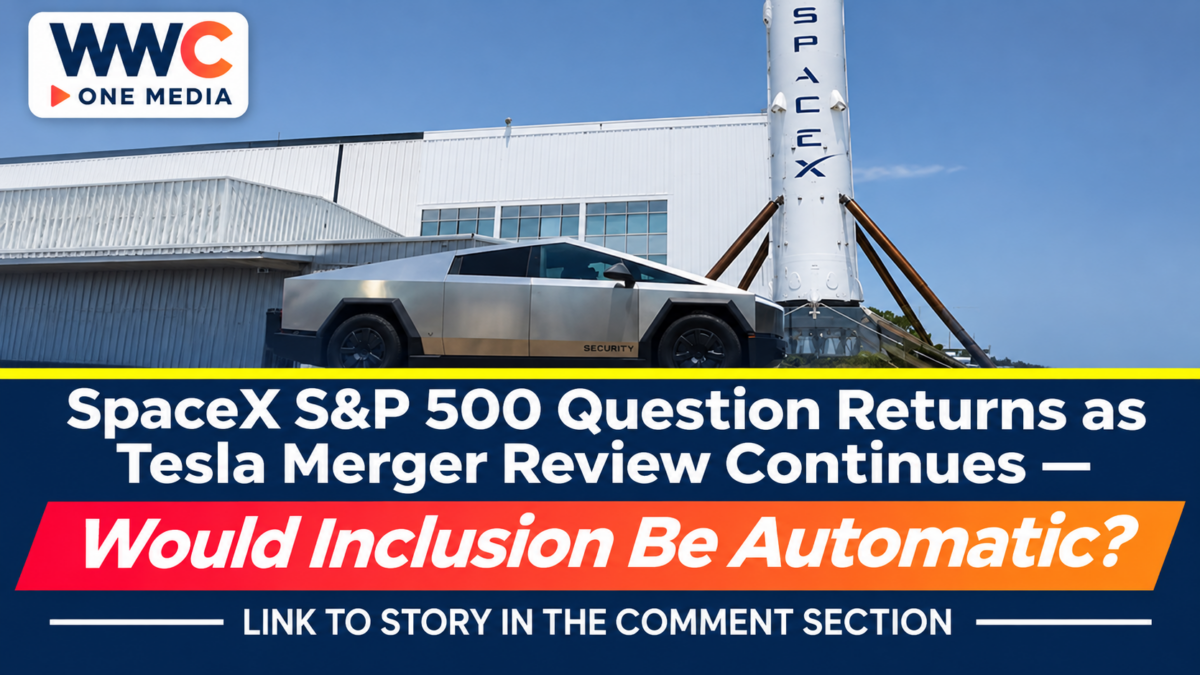
NEW YORK, United States — Nov. 15, 2026. SpaceX and Tesla are evaluating a possible business combination through separate board committees, their latest US securities filings confirm. The discussions renew a consequential question for investors: if the two publicly traded companies eventually merge, would SpaceX’s operations automatically become part of the S&P 500 through Tesla’s existing membership?
The answer is not automatic. S&P Dow Jones Indices publishes eligibility and index-maintenance rules, and its index committee retains discretion over constituent selection. The filings establish a review process, not a signed merger agreement, an approved share-exchange ratio or a decision from the index provider.
SpaceX S&P 500 Eligibility Is More Than a Size Test
The S&P 500 is designed to represent large US-listed companies. But index membership is not simply a ranking of the biggest market valuations. Its administrator assesses company type, financial viability, public float, liquidity and other requirements, while considering industry representation.
The methodology also provides for changes when constituents undergo corporate actions. A merger can affect which listed security represents a business and whether its existing index treatment continues. That makes the legal structure and surviving listed entity central to any analysis.
Tesla is already a constituent of the S&P 500. SpaceX’s public-market status, by itself, does not establish that it can enter through Tesla, nor does a proposed combination give either company the right to dictate index treatment.
An index committee’s assessment is separate from whether a corporate transaction is attractive to investors. Even a large combined business would still face the index provider’s formal rules and decisions.
What Tesla and SpaceX Actually Disclosed
Tesla’s quarterly filing for the period ended Sept. 30, 2026, says its board formed a special committee of disinterested directors to consider ways of deepening the relationship with SpaceX. The possibilities include, but are not limited to, a business combination.
Tesla says the transaction would depend on a favourable committee recommendation and any necessary shareholder approval. Its filing does not announce a purchase price, ownership split or completed transaction.
SpaceX’s own quarterly filing describes a separate special committee. It says no determination has been made and that further approval would be required from the committee, the board and the controlling shareholder. Both disclosures explicitly leave open the possibility that no deal will occur.
That procedural distinction matters. A committee studying a merger is not the same as directors approving binding terms, and a future shareholder vote cannot be treated as an accomplished fact.
WWC previously examined the prospective Tesla–SpaceX merger and its shareholder hurdles. The latest filings allow the index-membership question to be tested separately from the transaction’s possible commercial benefits.
Would a Merger Preserve Tesla’s Index Position?
Analysis: It depends on the final legal structure and the index administrator’s treatment of the corporate action. A transaction could involve the continued listing of an existing company, a replacement security or another structure requiring a constituent review.
S&P’s methodology identifies corporate actions and market changes as reasons for adjustments between normal review periods. It also states that the committee selects constituents from an eligible universe rather than applying an automatic admission rule to every large company.
The available primary documents do not describe the merger’s eventual structure. It is therefore premature to promise that SpaceX would acquire S&P 500 exposure without a separate index decision—or that an enlarged company would necessarily be excluded.
The same uncertainty applies to passive funds. Index-tracking managers typically seek exposure consistent with their benchmarks, but neither an official index change nor an associated amount of fund buying has been announced for this hypothetical combination.
Why Conflicts and Shareholder Approval Matter
The board committees are significant because the businesses have a common senior executive in Elon Musk and already maintain commercial and strategic relationships. A proposed combination could require negotiation over relative valuations, ownership rights, governance and which shareholders bear each company’s risks.
Those subjects cannot be resolved merely by pointing to headline market capitalisations. A fair exchange ratio would depend on the actual terms, share counts and other considerations put before the companies’ decision-makers.
The independence of the review is particularly important when a transaction involves related companies. SpaceX’s board disclosures also make clear that additional internal approvals would follow any favourable committee assessment.
WWC has previously reported on a SpaceX board departure during the merger review. That is relevant governance context, not evidence that the committees have approved or rejected a deal.
Why Investors Should Separate Operations From Index Mechanics
A merger could bring together different revenue streams and financial risks from electric vehicles, energy technology, satellites, launch services and computing. Whether integrating those operations would produce durable value is a business question, not an index eligibility test.
SpaceX’s quarterly report describes launches and mass delivered to orbit as operating metrics. That illustrates the difference between the aerospace company’s performance indicators and the trading characteristics used in constructing an equity index.
The potential combination also sits alongside SpaceX’s recent earnings and capital-investment debate. Growth and spending expectations can change a valuation, but they do not constitute an official index-admission notice.
For Philippine investors with US index funds, the practical issue is whether a benchmark actually changes its constituents or weights. A rumoured merger, however prominent, does not by itself change the holdings required by an index methodology.
What Happens Next
The next milestones are corporate, not speculative: a formal recommendation from the independent committees, any definitive transaction documents, the necessary board and shareholder decisions, and disclosures about the surviving listed company. A regulator or index provider may then have its own processes, depending on the structure.
Investors should watch the companies’ SEC filings and formal S&P index announcements rather than treat predictions of automatic membership or guaranteed index-fund demand as established results. As of Nov. 15, the published filings confirm an evaluation of a combination—not its completion.
Frequently Asked Questions
Is SpaceX already in the S&P 500?
No S&P announcement examined for this report confirms SpaceX as a constituent. Being publicly traded does not automatically make a stock part of the benchmark.
Have Tesla and SpaceX agreed to merge?
Their third-quarter SEC filings confirm separate special committees studying a potential combination. They do not announce an approved definitive merger agreement.
Would a Tesla–SpaceX merger automatically add SpaceX to the index?
Not necessarily. Corporate-action treatment and eligibility depend on the transaction’s final structure and the index administrator’s rules and decisions.
Who decides S&P 500 membership?
S&P Dow Jones Indices maintains the benchmark, with constituent selection overseen by its index committee under published methodology.
Does a merger guarantee index funds will buy more shares?
No. Any portfolio adjustments would depend on an actual index change and the funds’ tracking methods. No official transaction-specific buying estimate is established by the primary records reviewed.