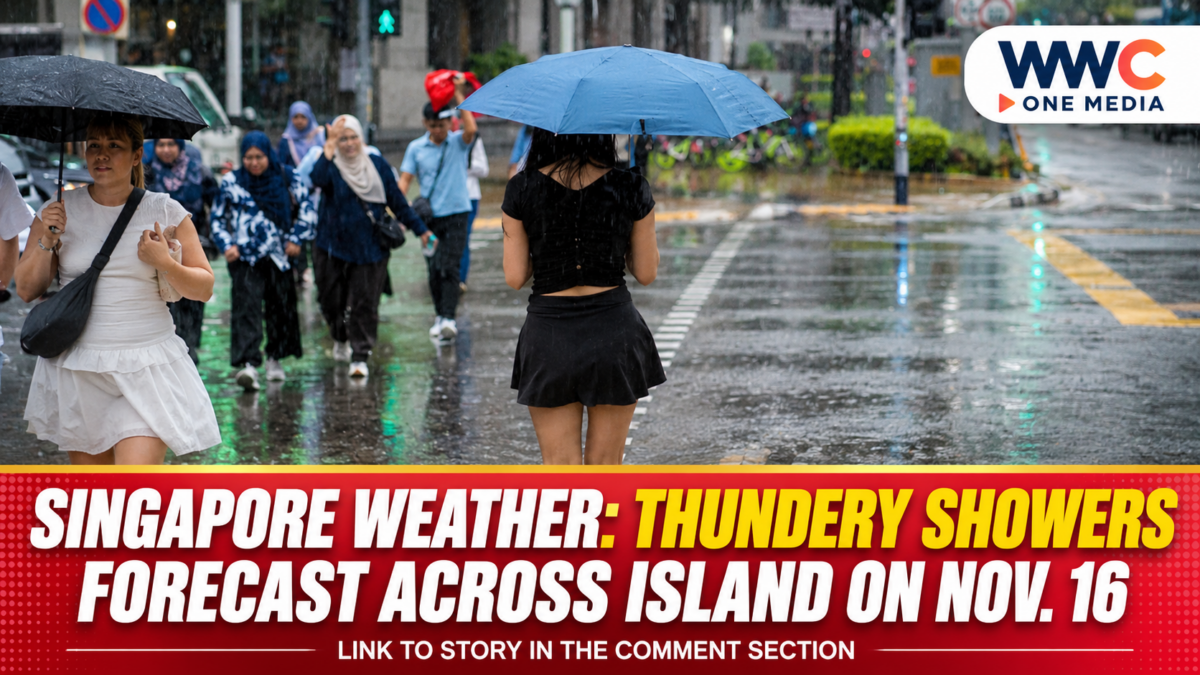
SINGAPORE — Singapore’s Meteorological Service forecast thundery showers over many parts of the island on Monday, November 16, as unsettled inter-monsoon conditions continued to influence the weather. The official 24-hour forecast listed temperatures between 24°C and 33°C, relative humidity of 60% to 95%, and north-northwesterly winds of 5 to 15 kilometres per hour.
The forecast is significant not only because of the possibility of afternoon rain, but also because thunderstorms carry a lightning risk that can extend beyond the areas directly beneath a storm cloud. Residents and commuters should distinguish between a general forecast, a short-term weather warning and an actual flash-flood report.
Singapore weather forecast: What the official outlook says
The Meteorological Service Singapore’s public weather portal displayed thundery showers over many areas during the afternoon in its November 16 forecast.
The forecast gave a minimum temperature of 24°C and a maximum of 33°C. It also listed relative humidity between 60% and 95%, with north-northwesterly winds expected at 5 to 15 kilometres per hour.
These figures describe the island-wide forecast rather than a guarantee that every neighbourhood will experience identical conditions. Rainfall can be uneven, particularly when thunderstorms develop over individual parts of Singapore.
The service’s two-hour nowcast page also displayed a forecast window from 2.30pm to 4.30pm, with the page showing an update at 2.46pm. That short-range window should be treated as a time-specific forecast, not as a continuing warning after its stated period has ended.
For residents checking conditions later in the day, the latest official updates matter more than an earlier forecast snapshot. The Meteorological Service Singapore weather portal provides the public with updated forecasts, observations and warning information.
Why thundery showers carry a lightning risk
A thunderstorm is not simply a period of heavier rain. It can also produce lightning, which creates risks for people outdoors even when rainfall at their exact location appears limited.
The National Environment Agency explains that a forecast of thundery showers indicates an imminent risk of lightning. Its weather guidance says lightning typically strikes within a six-kilometre radius of a location, although strikes have been known to occur more than 10 kilometres from a thunderstorm cloud.
That distance matters because people may underestimate the danger when the darkest clouds appear to be some distance away. Outdoor activities, open spaces and exposed locations can remain vulnerable even when a storm is not directly overhead.
The practical response is to take thunderstorm forecasts seriously. People outdoors should seek suitable shelter when thunderstorms approach and avoid remaining in exposed areas during lightning activity.
The warning is particularly relevant to commuters, outdoor workers and people travelling between transport stops and buildings during periods of unsettled weather.
Inter-monsoon conditions help explain the unsettled pattern
Singapore’s weather outlook for the first half of November described the gradual setting in of inter-monsoon conditions as the Southwest Monsoon weakened.
The Meteorological Service said this period is associated with light and variable winds, increased showers and higher lightning activity. Its outlook for November 1 to 15 anticipated moderate to heavy thundery showers over parts of the island during the afternoon on most days, with some showers potentially extending into the evening.
The service also forecast slightly above-average total rainfall over most parts of Singapore during that first fortnight.
This broader pattern provides useful context for the November 16 forecast. It does not mean that every day will have the same rainfall intensity or that every neighbourhood will receive the same amount of rain.
Inter-monsoon weather can produce localised changes. A district may experience a heavy downpour while another area has only cloud cover or lighter showers.
For readers, the important distinction is between the seasonal background and the short-term forecast. The former explains why unsettled weather is more likely; the latter provides the information needed for decisions on a particular day.
November temperatures remain warm despite the rain
Rainfall does not remove Singapore’s tropical heat. The November 16 forecast placed the day’s temperature range at 24°C to 33°C.
The Meteorological Service’s published November climate statistics give an average daily maximum temperature of 31.2°C and an average daily minimum of 24.6°C, based on the 1991–2020 climatological reference period.
The forecast maximum of 33°C is therefore warmer than the long-term November average daily maximum. However, a single day’s forecast does not establish a longer-term temperature trend or a climate record.
The same climate statistics list average November rainfall at 252.3 millimetres and an average of 19 rain days. These figures describe historical monthly conditions, not the amount of rain expected on November 16.
For residents, the combination of heat and high humidity can make outdoor travel uncomfortable even when showers temporarily lower temperatures. Wet conditions can also change quickly between neighbourhoods, making it useful to check the latest local forecast before travelling.
Heavy rain forecasts and flash-flood alerts are not the same
A forecast of thundery showers should not automatically be interpreted as confirmation of a flash flood. Weather warnings describe expected atmospheric conditions, while flood-risk alerts concern specific locations where water accumulation may become dangerous.
PUB’s published list of flood hotspots, dated February 2, 2026, includes Lorong Gambir, from Lorong Penchalak to Gambir Walk. The listing identifies an area that has been recognised as a flood hotspot; it does not prove that flooding or a live flood-risk alert occurred there on November 16.
WWC has previously reported on separate heavy-rain and flood-risk events in Singapore, including flash-flood alerts in Jurong West and flooding in Woodlands and Lim Chu Kang.
Those earlier incidents illustrate why weather forecasts and flood alerts should be checked separately. A forecast of rain does not establish that a road is flooded, while a flood-risk alert does not necessarily mean that flooding has already occurred.
Residents can also refer to WWC’s earlier coverage of Singapore’s stormy weather and changing rain conditions for context on how localised showers can affect different parts of the island.
What happens next
The next useful information will come from updated short-range forecasts, rainfall observations and any location-specific advisories issued by the authorities.
The Meteorological Service provides forecasts, current observations and heavy-rain warning information through its official weather portal. PUB separately publishes flood-related information and alerts.
For now, the verified November 16 outlook points to afternoon thundery showers, temperatures of 24°C to 33°C and a lightning risk associated with thunderstorms. Residents should check the latest official updates before making decisions based on an earlier forecast.
Frequently asked questions
Will it rain across all of Singapore on November 16?
The official forecast called for thundery showers over many areas. It did not guarantee that every neighbourhood would receive rain at the same time or intensity.
What temperatures were forecast for Singapore on November 16?
The Meteorological Service listed a minimum of 24°C and a maximum of 33°C.
Why are thundery showers a safety concern?
Thundery showers indicate an imminent risk of lightning. Lightning can strike several kilometres from a thunderstorm cloud, including areas where rain may not be falling heavily.
Does a thundery-shower forecast mean a flash flood has happened?
No. A weather forecast describes expected conditions. A flash flood or flood-risk alert requires separate location-specific information from the relevant authorities.
Where can residents check Singapore’s latest weather warnings?
Residents can check the Meteorological Service Singapore’s official weather portal for forecasts, observations and heavy-rain warning information. PUB provides separate flood-related updates.