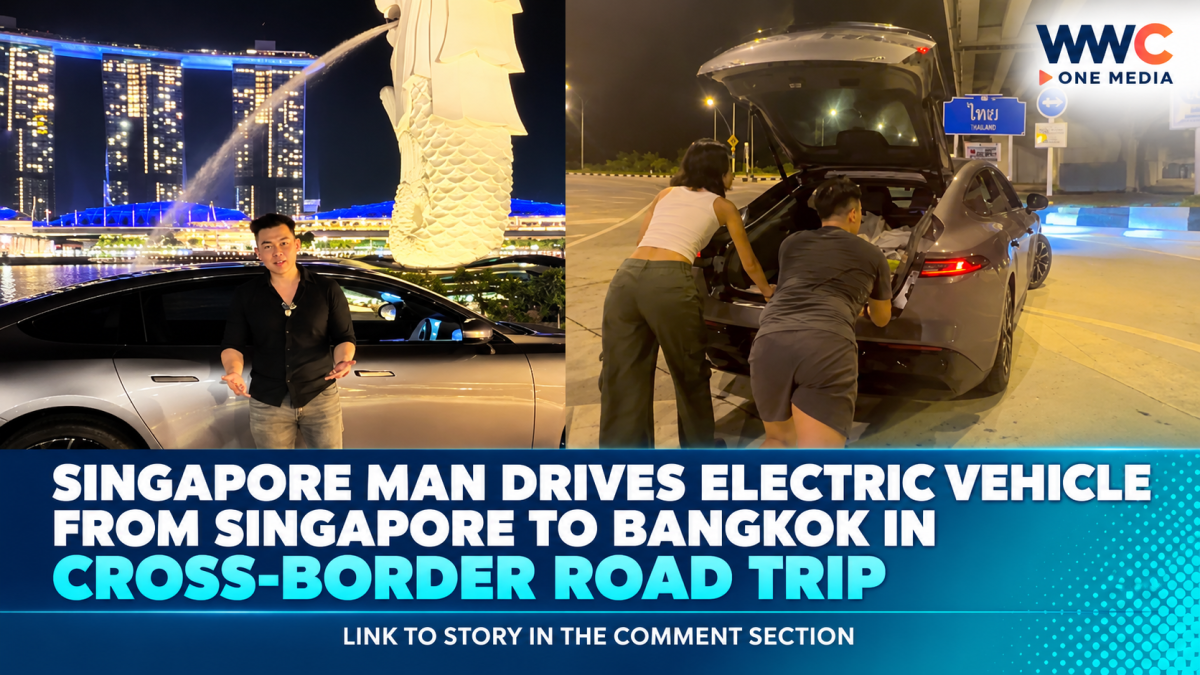
A Singapore man has taken his electric vehicle on a long-distance road trip from Singapore to Bangkok, putting the practicality of cross-border EV travel in Southeast Asia to the test.
The journey covered more than 1,800km by road, taking him through Malaysia and into Thailand before reaching Bangkok. The trip offered a real-world look at the planning involved in taking an EV across multiple countries, particularly when it comes to charging stops and route planning.
Long-distance EV travel across the region is becoming increasingly feasible as charging networks expand. Singapore has continued to build out its charging infrastructure, while Thailand has also been expanding its network as electric vehicles gain a larger share of the country’s car market. In 2025, battery-electric vehicles accounted for 19.6 per cent of new vehicle registrations in Thailand, according to figures from the Thailand Board of Investment.
Singapore’s EV market has also grown rapidly. Industry data cited in August showed electric vehicles accounting for more than half of new car sales in Singapore during parts of 2026, supported by charging infrastructure and government incentives.
The Singapore-to-Bangkok drive demonstrates how EV ownership is increasingly extending beyond short urban journeys. However, cross-border trips still require considerably more preparation than simply setting off with a full battery. Drivers need to identify compatible charging stations, account for charging times and make contingency plans in case a charger is unavailable.
Thailand’s growing EV ecosystem has helped make such journeys more practical. The country has attracted billions of dollars in EV-related investment and is positioning itself as a major electric-vehicle manufacturing and supply-chain hub in Southeast Asia.
For Singapore motorists, Thailand is also becoming an increasingly familiar destination for EV travel. Singapore and Thailand have recently reaffirmed cooperation on connectivity, energy resilience and green economic development, areas that could further support cross-border electric mobility.
The road trip provides a glimpse of how regional travel could change as charging infrastructure becomes more widespread. What once required careful calculation of fuel stops can increasingly be planned around charging networks, opening the possibility of longer EV journeys across Southeast Asia.