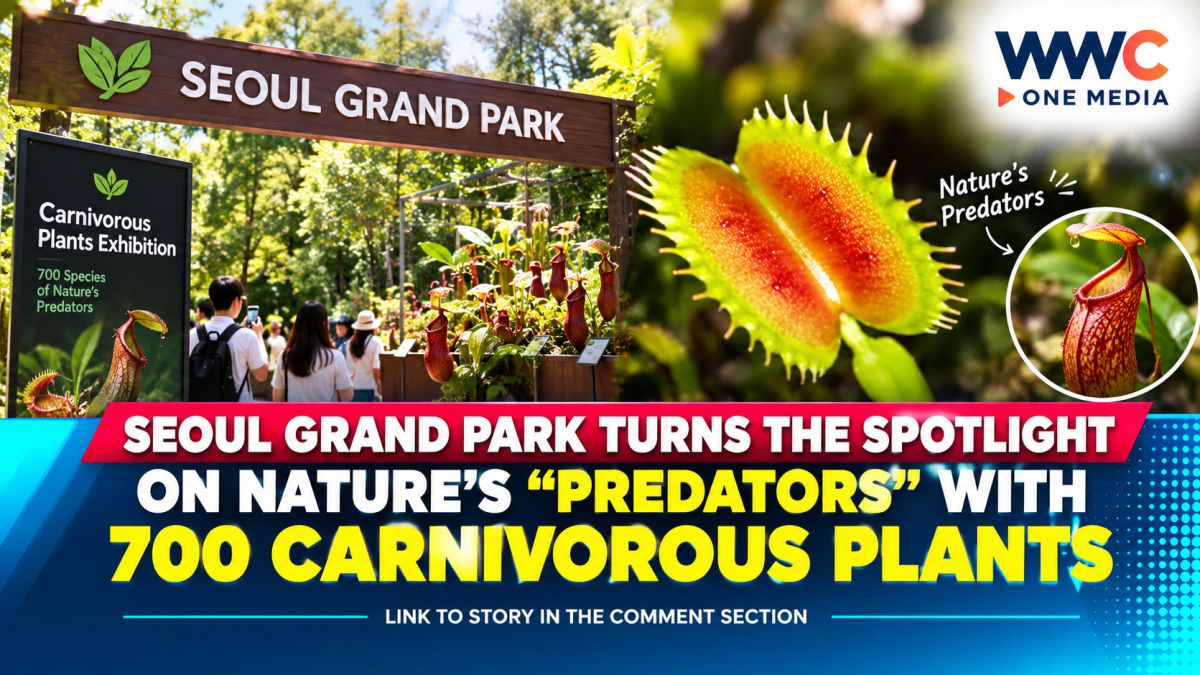
Seoul Grand Park is putting some of nature’s most unusual plants in the spotlight as its Botanical Garden prepares to open its 20th annual carnivorous plant exhibition on Oct. 2.
The 10-day exhibition, titled “Exploring North American Carnivorous Plants with JBS,” will showcase more than 700 specimens representing 16 North American species, including Venus flytraps, sundews, cobra lilies and butterworts.
Held at the Welcoming Garden near the park’s main entrance, the exhibition is designed to introduce visitors to plants that have evolved remarkable ways to survive in environments where nutrients are scarce.
Venus Flytraps and Other Unusual Plants Take Center Stage
Carnivorous plants typically grow in nutrient-poor environments such as wetlands and peat bogs. Instead of relying solely on soil for nutrients, they have developed specialized mechanisms to attract and capture insects.
The exhibition recreates several North American habitats, ranging from humid coastal bogs in the southeastern United States to colder Canadian wetlands and mountainous areas of Mexico.
One of the featured plants is the iconic Venus flytrap, alongside sundews whose surfaces are covered with sticky, dew-like structures. Cobra lilies and butterworts will also be featured.
Rather than presenting the plants simply as curiosities, Seoul Grand Park is using the exhibition to highlight their evolutionary adaptations and broader ecological importance.
A K-Pop-Inspired Way to Explore Carnivorous Plants
The exhibition also introduces JBS, a fictional idol-style group created around carnivorous plants.
The five-character group was developed as part of Seoul Grand Park’s efforts to make botanical science more accessible, particularly for younger visitors. The characters guide visitors through an interactive exploration of how carnivorous plants survive in their natural environments.
The concept connects botanical education with Korea’s familiar pop-culture format, giving visitors a more interactive way to learn about unusual plant species.
Korea’s Largest Carnivorous Plant Collection
Seoul Grand Park says its Botanical Garden houses more than 7,100 carnivorous plant specimens across 400 species, making it the largest collection of carnivorous flora in Korea.
The annual exhibition has been held since 2003 and is part of the park’s broader role as a conservation institution for rare plants.
Visitors will also be able to participate in guided tours led by forest interpreters, therapeutic gardening activities where they can pot Venus flytraps, and craft activities featuring the JBS characters.
The exhibition runs Oct. 2 through Oct. 11, from 10 a.m. to 5 p.m. daily. Admission to the outdoor exhibition area is included with general park admission.
For Seoul residents and visitors accustomed to seeing the city through its skyscrapers, shopping districts and entertainment culture, the exhibition offers a very different attraction: a close look at plants that have evolved extraordinary survival strategies.
These plants may look delicate, but their adaptations tell a much bigger story about survival, biodiversity and the unexpected ways nature can evolve.
WWC ONE MEDIA G,A