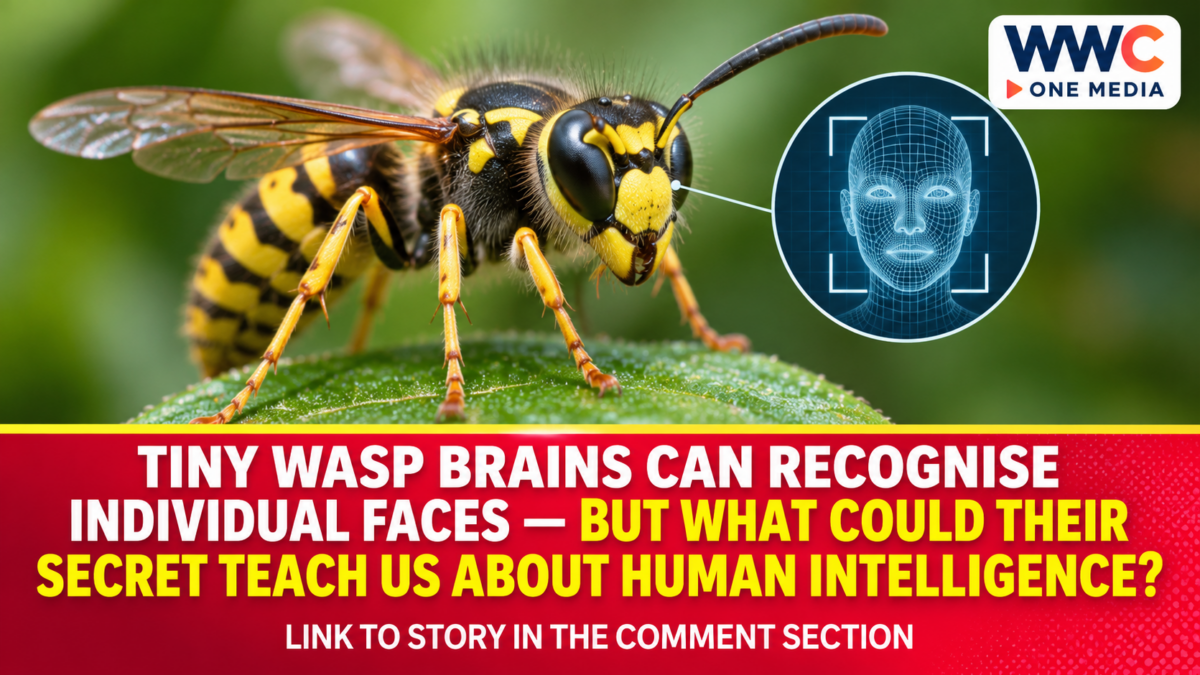
UNITED STATES — A new neuroscience discovery is challenging conventional assumptions about insect intelligence after scientists identified specialised brain cells that help northern paper wasps distinguish individual faces.
The wasp facial recognition study, published in the scientific journal Cell on Nov. 23, 2026, revealed that female northern paper wasps possess neurons that respond selectively to the facial features of other members of their species.
The discovery is particularly remarkable because these insects accomplish a sophisticated visual task using brains approximately the size of a grain of rice.
Research involving Wake Forest University and Cornell University suggests that the ability to identify individuals may have driven the independent development of comparable neural processing strategies in vastly different animals.
The findings raise an intriguing scientific question: how much of intelligent behaviour depends on brain size, and how much depends on the way information is organised?
Wasp Facial Recognition: How Tiny Brains Distinguish Individuals
The research focused on the northern paper wasp, scientifically known as Polistes fuscatus.
Unlike animals that rely exclusively on general visual characteristics to distinguish members of their species, female northern paper wasps can use individual facial markings to recognise other wasps.
For scientists, the challenge was to investigate the biological machinery supporting this behaviour.
The researchers monitored electrical activity in the insects’ brains while presenting different visual stimuli.
Their experiments identified a particular neural population that responded selectively to frontal images of wasps.
Individual neurons demonstrated different response preferences, suggesting that information about a face may be represented through the combined activity of multiple cells.
In practical terms, the insect appears to possess a specialised system for processing information that is particularly relevant to its social environment.
How Scientists Identified the Specialised Brain Cells
The researchers used electrodes to record neural activity while displaying images to female paper wasps.
The experimental design allowed them to examine whether brain cells responded generally to visual objects or demonstrated a more specific preference for wasp faces.
One important finding emerged when researchers altered the appearance and posture of the bodies accompanying the facial images.
The responses indicated that the facial features themselves were particularly significant.
Different neurons also appeared sensitive to different markings, providing a possible mechanism through which the nervous system can represent individual identity.
This does not necessarily mean that each neuron corresponds to a particular wasp. Instead, the pattern of activity across several neurons may provide information that helps distinguish one face from another.
The finding adds another dimension to research examining how animals process visual information.
WWC ONE MEDIA previously explored related questions about biological information processing in its coverage of how crows make visual decisions and what their brains reveal about intelligence.
The two studies investigate different animals and cognitive tasks, but they raise a shared question about how specialised nervous systems support complex behaviour.
Why Recognising Other Wasps Has Social Value
Facial recognition is more than an interesting visual ability for northern paper wasps.
Female members of the species establish social hierarchies that influence their interactions within a colony. Remembering individuals can help them respond appropriately during subsequent encounters.
Recognition may therefore reduce the need to repeatedly establish relationships through aggressive interactions.
This makes individual identity a biologically important category of visual information.
The study offers a different perspective on insects, whose behaviour is sometimes assumed to be entirely inflexible or automatic.
Their nervous systems can instead be investigated in relation to the particular challenges encountered in their environments.
Understanding insect behaviour also has significance beyond neuroscience, although practical applications differ substantially between species.
WWC has previously examined the importance of species-specific insect research in its coverage of Australia’s response to invasive red imported fire ants.
That separate environmental issue demonstrates another reason why studying insects requires attention to their distinct biological characteristics.
Why Wasp and Human Brains May Have Developed Similar Solutions
The comparison between wasps and primates concerns the organisation of neural information rather than the overall intelligence of the two groups.
Both possess neurons with specialised responses to socially important visual features.
Because insects and primates have very different evolutionary histories, the researchers interpret these similarities as evidence consistent with convergent evolution.
Convergent evolution describes the independent emergence of comparable biological characteristics in different evolutionary lineages.
In this case, the shared challenge is recognising other individuals through visual information.
The finding suggests that certain ways of organising neural activity may offer advantages when recognition becomes particularly important for an animal’s social life.
However, comparable processing strategies do not mean that insects and humans have identical brain structures, memories or conscious experiences.
The discovery provides a new opportunity to investigate why specialised information-processing systems emerge in nature.
Could Tiny Wasp Brains Help Explain Human Vision?
One potential scientific advantage of investigating paper wasps is the opportunity to study recognition within a relatively compact nervous system.
Researchers could use this biological model to examine how experience influences neural responses and how specialised cells work together during visual processing.
Understanding these processes could contribute to broader comparative neuroscience research.
However, the new findings remain fundamental biological research. They do not establish a treatment for human neurological conditions or demonstrate a new clinical application.
The importance of distinguishing a scientific discovery from an immediately available medical benefit was also explored in WWC’s coverage of Taiwan’s research into genetic factors associated with schizophrenia.
Although that research concerns an entirely different scientific question, both studies illustrate why discoveries require further investigation before their wider implications can be established.
What Happens Next for Wasp Facial Recognition Research?
Future investigations could compare northern paper wasps with closely related species that do not demonstrate the same specialised recognition abilities.
Such comparisons may help scientists determine how experience and evolutionary changes contribute to the development of neural specialisation.
Researchers could also investigate whether the identified cells respond to additional forms of socially relevant visual information.
These remain research questions rather than established discoveries.
For now, the central finding is that a remarkably small insect nervous system contains specialised neurons associated with processing individual facial characteristics.
The discovery does not establish that wasps think like humans.
Instead, it offers evidence that evolution can produce comparable solutions to complex information-processing problems in animals with dramatically different brains.
Frequently Asked Questions
Can wasps recognise individual faces?
Yes. Female northern paper wasps, or Polistes fuscatus, can distinguish other members of their species using distinctive facial patterns.
What are wasp cells?
Wasp cells are specialised neurons identified in northern paper wasps that respond selectively to images of other wasps’ faces.
Can paper wasps recognise human faces?
The November 2026 research did not demonstrate human-face recognition. It examined neural responses to images of other wasps.
How large is a northern paper wasp’s brain?
Its brain is approximately the size of a grain of rice, yet it supports sophisticated forms of visual and social information processing.
Why is wasp facial recognition important to neuroscience?
The discovery provides a comparative model for investigating how neural specialisation develops and how different animals independently evolve similar information-processing strategies.