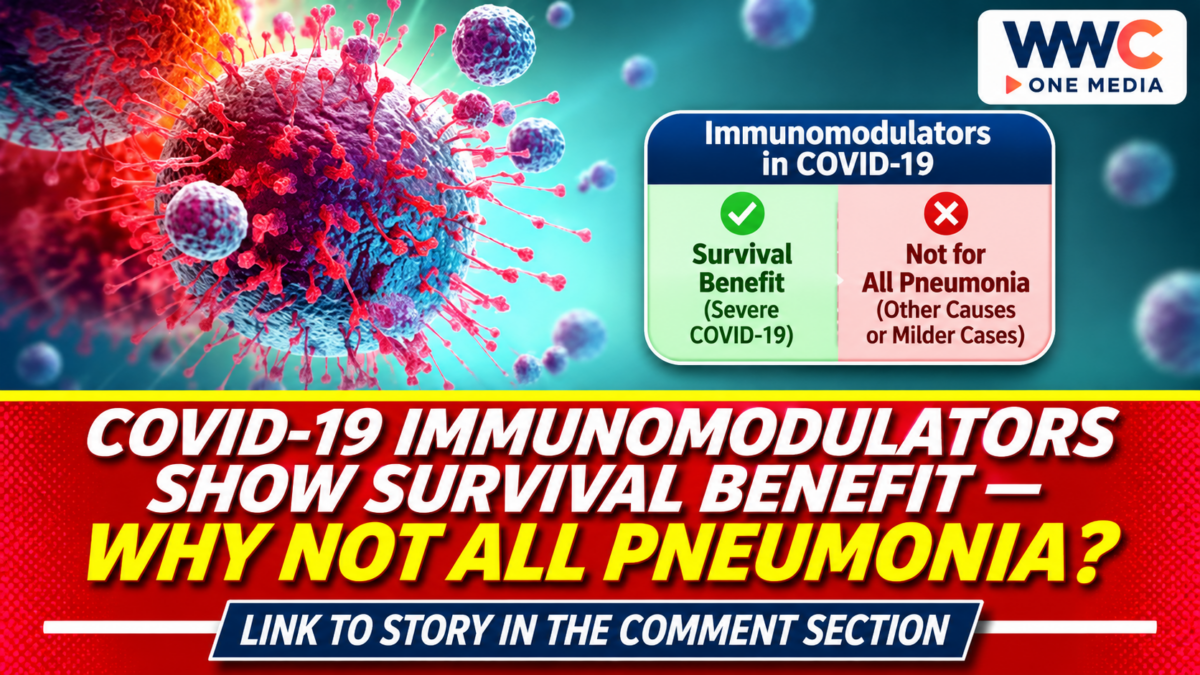
UNITED STATES — Nov. 22, 2026. A systematic review published online on Nov. 6 found that three categories of immune-modifying treatment were associated with lower 30-day mortality among adults hospitalised with COVID-19 pneumonia. But the researchers did not identify a consistent mortality benefit from these treatments in patients hospitalised with community-acquired pneumonia unrelated to COVID-19.
The distinction challenges an overly simple interpretation of pneumonia treatment. Medicines that help control damaging inflammation in a particular illness do not automatically work equally well across infections with different causes, and findings from hospital-based research should not be transferred to people with mild symptoms at home.
COVID-19 Immunomodulators: What the Review Found
The review, published in Clinical Microbiology and Infection, combined findings from 196 studies involving 89,117 patients. Its authors examined adult hospital admissions for community-acquired pneumonia and analysed COVID-19 cases separately from other pneumonia cases. Searches of five research databases covered studies available up to Dec. 9, 2025.
Among treatment categories supported by at least five randomised trials reporting 30-day mortality, cytokine inhibitors—mainly those targeting interleukin-6—were associated with lower mortality in COVID-19 pneumonia. Their pooled odds ratio was 0.84, with a 95% confidence interval from 0.76 to 0.93.
The corresponding odds ratios were 0.66 for Janus kinase, or JAK, inhibitors (95% confidence interval 0.47–0.93) and 0.87 for corticosteroids (0.765–0.999). The authors described the evidence for the latter two categories more cautiously, saying they probably reduce 30-day mortality.
These numbers compare odds between treatment and comparison groups. They are not percentages of patients who died, nor do they establish the absolute number of lives saved for every 100 people treated. Differences across trials also mean that the figures should not be used as a ranking of three interchangeable treatment choices.
Why Other Pneumonia Did Not Show the Same Pattern
The review found no immunomodulatory treatment category consistently associated with lower mortality in non-COVID-19 community-acquired pneumonia. That is not proof that every such treatment is ineffective in every case; it means this review did not establish a reliable benefit across the available studies.
Pneumonia describes infection-related inflammation in the lungs, but its causes and patients’ immune responses differ. A treatment that reduces an excessive inflammatory response in selected COVID-19 patients might have a different balance of benefits and harms in someone with another infection.
Analysis: The important policy question is not whether inflammation matters in pneumonia—it clearly does—but which patients benefit from altering their immune response. Clinical trials in one disease cannot replace trials conducted in another. Generalising the COVID-19 result would overstate what researchers actually established.
The review also looked for 90-day outcomes. Cytokine inhibitors were the only category examined in at least five randomised COVID-19 trials reporting 90-day mortality, with an odds ratio of 0.68 and a 95% confidence interval of 0.45–1.03. Because that interval includes 1, the estimate does not securely establish a reduction in deaths at that later point.
What Current Treatment Guidance Actually Says
Clinical guidance distinguishes severe or critical COVID-19 from mild illness. The Infectious Diseases Society of America recommends systemic corticosteroids for patients with severe disease, while advising clinicians to consider an additional immunomodulator for selected hospitalised adults whose condition is worsening or critical.
Its guidance suggests either baricitinib, a JAK inhibitor, or tocilizumab, an interleukin-6 receptor blocker, as an addition to systemic corticosteroids in those circumstances. The recommendation is conditional, with low-certainty evidence for choosing between the two medicines. It does not mean patients should take both medicines together or use either without professional assessment.
Treatment depends on oxygen requirements, the progression of illness, relevant medical conditions and potential medication harms. Immunomodulators affect immune signalling and require clinical oversight. The study did not test self-medication, routine use for mild outpatient COVID-19 or use for prevention.
For context, WWC has separately reported on Thailand’s COVID-19 trends and respiratory illness monitoring. Surveillance of infections and hospital treatment effectiveness answer different questions and should not be treated as interchangeable indicators.
Why the Study Deserves Careful Interpretation
A systematic review can combine a broad evidence base, but it cannot make the underlying trials identical. The researchers grouped therapies into pre-specified categories and used random-effects meta-analysis, while examining disease severity and the causes of pneumonia in planned subgroup analyses.
The reported outcomes concern adults admitted to hospital. They should not be applied to children, everyone testing positive for COVID-19 or all patients with pneumonia. A lower pooled odds ratio also does not guarantee an individual patient’s outcome.
The difference between acute hospital treatment and longer-term illness is equally important. WWC’s earlier examination of long COVID symptom duration addresses recovery after an infection; this new review measures mortality after hospital admission, not persistent symptoms after recovery.
Scientific interpretation also requires distinguishing research conclusions from unsupported public claims. That principle is relevant to WWC’s previous coverage of COVID-19 vaccine misinformation and physicians’ responses. Neither a mortality association in hospitalised adults nor a treatment guideline can establish unrelated claims about vaccination.
What Happens Next
The researchers called for more work to identify effective immunomodulatory strategies for community-acquired pneumonia not caused by COVID-19. Further trials must clarify which treatments, if any, improve outcomes in those patients and under what clinical conditions.
For health services, the immediate lesson is narrower: follow disease-specific clinical guidance, weigh treatment risks and avoid turning pooled research estimates into blanket prescriptions. The review strengthens the evidence base for selected hospitalised COVID-19 patients while leaving important questions open for other pneumonia.
Frequently Asked Questions
What are immunomodulators in COVID-19 treatment?
They are medicines that modify inflammatory immune pathways. The review examined categories including corticosteroids, cytokine inhibitors and JAK inhibitors, but did not establish that they are interchangeable.
Did the review prove that JAK inhibitors are the best treatment?
No. Its pooled odds ratios compare each treatment category with its study comparators, not all categories directly with one another. Treatment guidelines do not identify a clear winner between baricitinib and tocilizumab for the specified hospitalised patients.
Do immunomodulators lower deaths from every type of pneumonia?
No consistent mortality benefit emerged in the review’s non-COVID-19 pneumonia analysis. This finding does not exclude benefits in narrower populations that require further study.
Can people with mild COVID-19 take these medicines at home?
The research addressed hospitalised adults with pneumonia, and the cited recommendations concern particular severe or critical cases. These medicines should not be started without a clinician’s assessment.