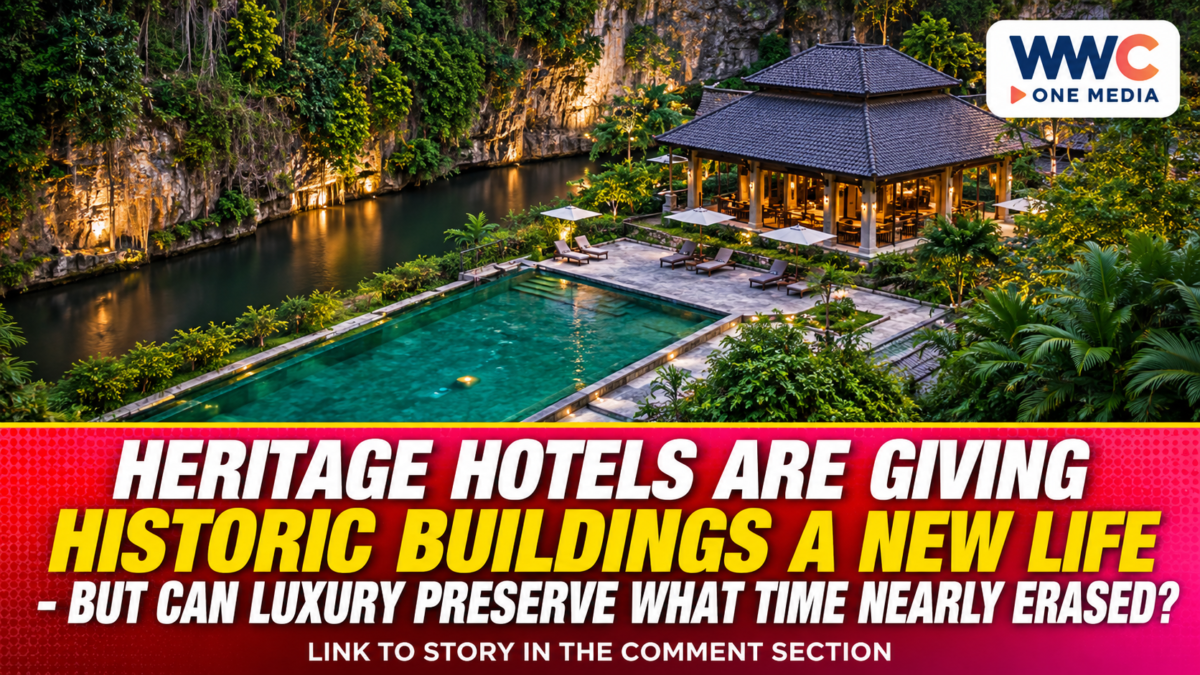
A former Nintendo headquarters in Kyoto, a 14th-century fortress in India and an 1888 customs complex beside Bangkok’s Chao Phraya River illustrate a growing approach to luxury hospitality: turning historic properties into hotels without completely removing the structures that made them distinctive.
The projects differ in age, purpose and design, but share a central challenge. Hotel operators must introduce modern accommodation and services while protecting the architectural features and cultural associations that give these places their identity.
This approach, known as adaptive reuse, offers an alternative to demolishing an old structure and starting again. It can also create a commercial reason to maintain buildings that might otherwise become difficult or expensive to preserve.
For the hospitality industry, however, the important question is not simply whether an old building can become a luxury destination. It is whether the conversion can give the property a sustainable future without turning its history into little more than decoration.
Heritage hotels turn former workplaces and landmarks into destinations
One of the most distinctive examples is MARUFUKURO in Kyoto, Japan. The hotel occupies the site of Nintendo’s former headquarters, with the original buildings dating to 1930.
The property consists of former office, residential and warehouse buildings designed in the Art Deco style popular during Japan’s early Showa period. The hotel’s official history explains that the existing structures were combined with a new building designed under the supervision of architect Tadao Ando.
The hotel takes its name from the Marufuku identity associated with Nintendo’s early business in Kyoto. Nintendo itself traces its beginnings to 1889, when Fusajiro Yamauchi opened a shop manufacturing and selling Japanese hanafuda playing cards.
The conversion gives the former headquarters a hospitality function while retaining its connection to the company’s history. It is also a reminder that industrial and corporate buildings can have cultural value beyond their original commercial purpose. <Cite refs={[“turn549619search1″,”turn549619search17”]}/>
A different kind of transformation can be found at The Ned in London. The property occupies the former Midland Bank building, completed in 1924 and designed by architect Sir Edwin Lutyens.
The hotel’s official information says the building underwent a four-year restoration before completion in 2017. Its former banking spaces now accommodate hotel rooms, restaurants and members’ facilities, while the original bank vault has been adapted into a bar and club space.
The conversion demonstrates how a building designed for financial operations can be adapted for a different commercial use while retaining recognisable features of its original purpose. <Cite refs={[“turn549619search7″,”turn549619search60”]}/>
A 14th-century fortress becomes a luxury retreat
In Rajasthan, India, Six Senses Fort Barwara shows how a much older structure can be given a new role.
The resort occupies a 14th-century fort originally owned by a Rajasthani royal family. Six Senses announced its opening on Oct. 19, 2021, following a conservation effort that took more than a decade.
The restored complex includes two original palaces and two temples within the fort’s walls. The property was converted into a 48-suite resort, retaining medieval features while introducing contemporary accommodation and wellness facilities.
The project also extends beyond the buildings themselves. Six Senses has described work involving traditional gardens, water features, native plants and the restoration of Barwara Lake, alongside engagement with the surrounding community on water management.
That wider approach matters because a historic property is not always an isolated structure. Its setting, landscape and relationship with nearby communities can be part of its heritage. <Cite refs={[“turn549619search0″,”turn549619search2”]}/>
The commercial opportunity is clear: a centuries-old fort offers a distinctive setting that a newly constructed resort cannot reproduce. But maintaining such a property also requires specialised conservation work, careful planning and ongoing investment.
Bangkok’s former Custom House prepares for a new chapter
One of the region’s most closely watched examples is The Langham, Custom House, Bangkok, which is scheduled to welcome guests from Dec. 20, 2026.
The hotel centres on Bangkok’s historic Custom House, established in 1888 during the reign of King Rama V. The building once served as an important gateway for international trade along the Chao Phraya River.
Langham Hospitality Group’s announcement says the 75-key property will combine restored heritage buildings with a contemporary accommodation wing. Its 60 guestrooms and 15 suites will be located in the new building beside the historic Custom House rather than being inserted into the original structure.
That arrangement is significant. It allows the historic buildings to serve as public and hospitality spaces while the new wing accommodates guestrooms and modern hotel infrastructure.
The project is being developed by Rabbit Holdings Public Company Limited, an affiliate of BTS Group, and operated by Langham Hospitality Group. Its planned facilities include restaurants, a riverside bar and Chuan Spa. <Cite refs={[“turn435924search1″,”turn435924search7″,”turn435924search8”]}/>
The decision to place guestrooms in a separate structure illustrates one possible answer to a difficult conservation problem: preserve the historic building’s central features while placing the technical demands of a modern hotel in a purpose-built space.
It also demonstrates that adaptive reuse does not always mean converting every room of an old property into guest accommodation.
Why heritage hotels require more than attractive interiors
The business appeal of these projects lies partly in differentiation. A hotel in a historic fortress, former bank or old headquarters offers an experience linked to a particular place and its past.
That identity can help a property stand out in a competitive hospitality market. It can also encourage visitors to explore surrounding cultural sites, restaurants and neighbourhood businesses.
But adaptive reuse is not automatically sustainable simply because a building is old.
Historic structures may require extensive repairs, specialist materials, structural reinforcement and careful integration of electrical, plumbing, fire-safety and accessibility systems. The costs and technical requirements can differ considerably from those of a conventional new hotel.
There is also a risk that commercial conversion could weaken the very qualities that make a property valuable. If original features are removed, altered beyond recognition or treated merely as decorative themes, the building may retain its address but lose much of its historical character.
This is why the approach taken at Bangkok’s Custom House is worth watching. Separating the new accommodation wing from the heritage buildings shows how a hotel can attempt to accommodate modern requirements without placing every function inside the historic structure.
For Singapore, similar questions are relevant to proposals involving former institutional buildings. WWC previously examined the former Singapore Chinese Girls’ School site and its proposed future as a lifestyle and hospitality destination. The site demonstrates how heritage retention can become part of a wider development brief, although its proposed hotel concept is not yet an operating property.
What this trend could mean for Asian tourism
Asia’s historic buildings offer a wide range of possible hospitality settings, from former industrial facilities and merchant residences to religious complexes, government buildings and royal properties.
Their conversion can support tourism by giving visitors a reason to stay within a historic district rather than treating it only as a place for daytime sightseeing.
However, the benefits depend on execution. Conservation standards, local planning rules, community involvement and the long-term maintenance of the property all influence whether a project delivers more than an attractive hotel.
The Philippines has its own opportunity to connect hospitality with local culture and place. WWC has previously explored how SM Hotels is using Filipino food and regional culinary traditions as part of the travel experience. Heritage properties could offer another way to connect accommodation with local identity, provided restoration is guided by credible historical research and conservation practices.
The country’s wider accommodation market is also evolving, as shown by Singapore’s proposed Chinatown hotel development, where planning decisions raise questions about how new hospitality uses fit into established commercial and cultural districts.
These examples are not identical to the completed conversions in Kyoto, London or Rajasthan. They do, however, point to a shared planning challenge: how to introduce new visitor activity while respecting the character of the places that attract people in the first place.
What happens next
The next milestone for Bangkok’s Custom House is its scheduled opening on Dec. 20, 2026. Its operation will provide a new example of how a historic government building and a contemporary hotel wing can function together.
Elsewhere, properties such as MARUFUKURO, The Ned and Six Senses Fort Barwara demonstrate different ways of adapting buildings to new uses while retaining elements of their original identity.
For hotel developers, the opportunity is to create distinctive destinations from existing structures. For conservation advocates and local communities, the test is whether those buildings remain recognisable and meaningful after the commercial transformation.
The most successful heritage hotels may ultimately be those where luxury does not replace history, but gives it a reason to remain part of the living city.
Frequently asked questions
What is adaptive reuse in hotel development?
Adaptive reuse is the process of giving an existing building a new function while retaining important elements of its original structure or character. In hospitality, this can involve converting former offices, factories, forts, banks or residences into hotels.
Which hotel in Kyoto occupies Nintendo’s former headquarters?
MARUFUKURO occupies the site of Nintendo’s former headquarters in Kyoto. The original buildings were completed in 1930 and have been combined with a new building designed under the supervision of architect Tadao Ando.
Was Six Senses Fort Barwara originally a palace?
It occupies a 14th-century fort originally owned by a Rajasthani royal family. The restored complex incorporates two original palaces and two temples within its walls.
When will The Langham, Custom House, Bangkok open?
Langham Hospitality Group has scheduled the hotel’s opening for Dec. 20, 2026. The 75-key property combines restored heritage buildings with a contemporary accommodation wing.
Why do developers convert historic buildings into hotels?
A historic building can provide architectural character and a strong connection to its location. Conversion can also give an existing structure a new commercial purpose, although restoration costs, conservation requirements and local planning rules must be considered.