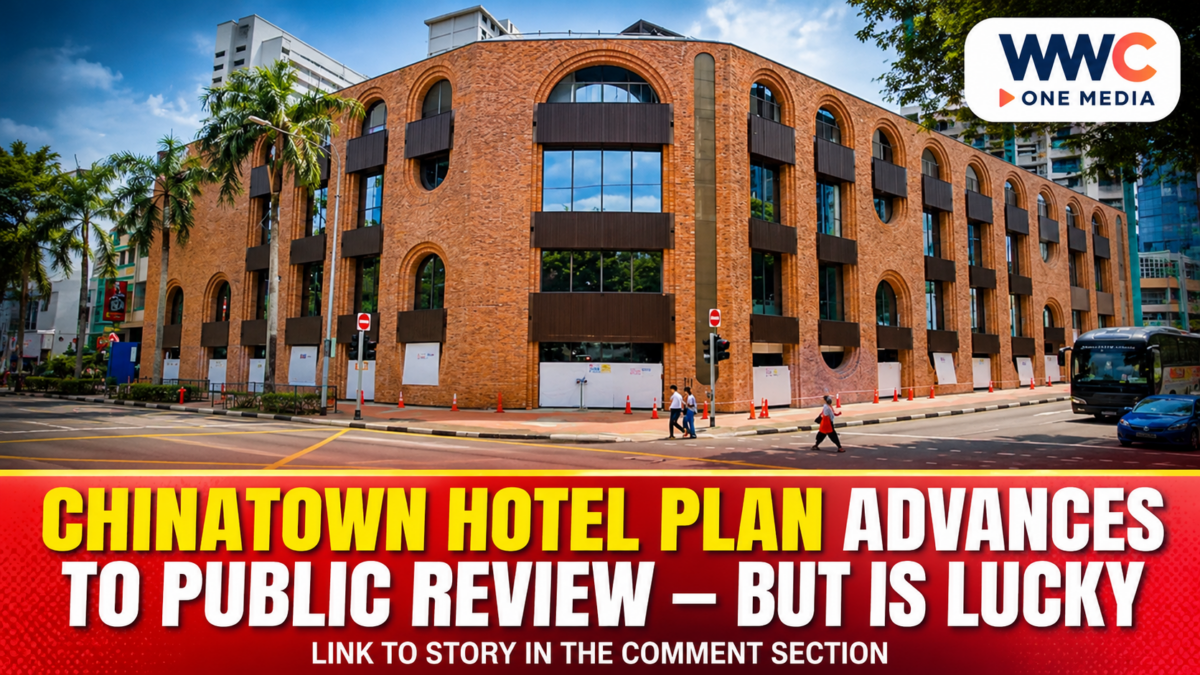
Singapore’s proposed Chinatown hotel development has entered a formal planning stage, with a government notice identifying land at 211 New Bridge Road for a change from commercial to hotel zoning.
The site is the address of Lucky Chinatown, a retail and food destination operated under Far East Organization’s mall portfolio. The proposal is now open for public inspection and representations, but the published planning documents do not establish that the shopping centre has received final redevelopment approval. Urban Redevelopment Authority (URA)+1
The distinction matters for tenants, shoppers and businesses in the historic district. A proposed zoning change can create room for a different type of development, but it is not the same as a confirmed construction schedule, demolition notice or hotel opening announcement.
Chinatown hotel proposal identifies 211 New Bridge Road
The URA’s notice dated Oct. 30, 2026, lists several proposed amendments to Singapore’s Master Plan 2025. One concerns land parcels at New Bridge Road, including a proposal to change the commercial zoning to a hotel zone and an adjacent utility zone to commercial use.
The authority’s later public listing identifies the relevant land parcel at 211 New Bridge Road and describes the proposed change from commercial to hotel use as intended to facilitate a development proposal received by URA. Urban Redevelopment Authority (URA)+1
Far East Organization’s mall directory identifies Lucky Chinatown at the same address: 211 New Bridge Road, Singapore 059432. Its listing confirms the connection between the planning location and the shopping centre. Our Malls
The planning map attached to the notice shows the proposed hotel-zone land and a separate commercial-zone portion. It is a land-use document, not an architectural plan. It does not specify the final design, room count, construction method or opening date.
The proposal is not a final redevelopment approval
Singapore’s planning rules provide for proposed Master Plan amendments to be made available for public inspection and comments. The URA explains that proposals are submitted to the Minister for National Development for approval before the amendments are incorporated into the Master Plan. Urban Redevelopment Authority (URA)
That process is important because zoning is only one part of a development’s regulatory pathway. A hotel use may be contemplated by the proposed land-use designation, but the published notice does not provide a complete development approval or confirm that construction can begin.
The notice states that representations may be sent in writing to the Permanent Secretary, Ministry of National Development, by Nov. 28, 2026. It also says the grounds for any objection or representation must be stated, as required under the Planning (Master Plan) Rules. Urban Redevelopment Authority (URA)
For now, the public record supports describing the project as a proposed rezoning linked to a development proposal. It does not support saying that Lucky Chinatown is definitely closing, that demolition is scheduled, or that a hotel will open on a particular date.
What the mall operator’s records establish
Far East Organization’s official mall directory continues to list Lucky Chinatown at 211 New Bridge Road. The company’s mall factsheet describes the development as a seven-level retail, food and beverage, and entertainment destination, with a stated total net lettable area of 32,031 square feet. Our Malls+1
Those details provide a useful baseline for understanding what the site currently represents commercially. The property is not simply an empty redevelopment parcel: the operator’s published material presents it as an established retail destination in the Chinatown area.
The factsheet also identifies the mall’s direct pedestrian link to People’s Park Complex and its location above Chinatown MRT station. That positioning makes the land-use proposal relevant not only to the property owner but also to the surrounding retail and visitor economy. fareastmalls.com.sg
The company’s directory is not a redevelopment announcement, however. It does not confirm that the mall will close or that tenants have been given a move-out date.
Why a hotel use matters in Singapore’s visitor economy
Singapore’s tourism authority describes hotels as a major part of the country’s tourism sector. Its industry overview says hotels contribute approximately 20 per cent of total tourism receipts and that the sector comprises more than 450 properties with over 73,000 rooms. The same page says the industry supports around 30,000 individuals. Singapore Tourism Board
That context helps explain why hotel zoning can be significant in a central heritage district. Accommodation brings a different pattern of activity from conventional retail: guests may use nearby restaurants, transport, cultural attractions and local services at different times of day.
But those potential effects should not be mistaken for a confirmed outcome at this particular site. The URA notice does not state how many hotel rooms are proposed, what category of hotel may be developed, or how the project would affect nearby businesses.
A future development could also raise practical questions about how street-level commercial activity is maintained, how pedestrian access is handled and how the project fits into the character of the surrounding district. These are matters for the planning and design process, not conclusions established by the zoning notice.
Chinatown’s commercial identity is bigger than one property
Lucky Chinatown sits within a district where retail, food, tourism and cultural activity overlap. The area’s commercial identity is reflected in the range of businesses and visitor destinations around New Bridge Road.
WWC has previously covered changes affecting Singapore’s Chinatown business scene, including the relocation of Victor’s Kitchen from its Chinatown Point outlet to Toa Payoh. That story concerned a separate business and property, but it illustrates how changes in a central retail location can affect where businesses serve their customers.
The district’s cultural dimension is also relevant. Singapore’s policy changes involving dialect-language films have implications for the wider cinema and entertainment environment, as discussed in WWC’s report on Singapore’s easing of restrictions on dialect films.
And the wider area remains a working commercial neighbourhood, not only a visitor destination. WWC’s report on a fire at a Chinatown shop on Upper Cross Street covered a separate incident, but it also reflected the mix of businesses and premises that operate across the district.
The planning question is therefore not simply whether a hotel could occupy a central site. It is how any eventual development would fit into a neighbourhood whose commercial and cultural uses extend beyond a single building.
What happens next
The immediate next step is the close of the public representation period on Nov. 28, 2026. The URA’s published process says proposed amendments are submitted to the Minister for National Development for approval before they are incorporated into the Master Plan. Urban Redevelopment Authority (URA)+1
Until the authority publishes a further decision or the developer makes a verifiable announcement, the final development outcome remains uncertain.
Readers should watch for an official planning decision, further details about the development proposal and any formal communication from the mall operator concerning tenants or operations.
For now, the accurate position is straightforward: Singapore has proposed hotel zoning for the land at 211 New Bridge Road, the address listed for Lucky Chinatown. The public planning process is still underway, and the proposal should not be presented as a completed redevelopment.
FAQ
Is Lucky Chinatown being turned into a hotel?
The URA has proposed rezoning the land at 211 New Bridge Road from commercial to hotel use. The proposal is not, by itself, final redevelopment approval. Urban Redevelopment Authority (URA)
When will Lucky Chinatown close?
No closure date is stated in the URA notice or the mall operator’s directory reviewed for this report.
Has the hotel project been approved?
The published document identifies a proposed Master Plan amendment. URA says proposed amendments are submitted for ministerial approval before they are incorporated into the Master Plan. Urban Redevelopment Authority (URA)
When is the deadline for public representations?
The URA notice states that written objections or representations may be submitted by Nov. 28, 2026. Urban Redevelopment Authority (URA)
How many hotel rooms are planned?
The planning notice reviewed does not state a proposed room count, hotel brand or opening date.