
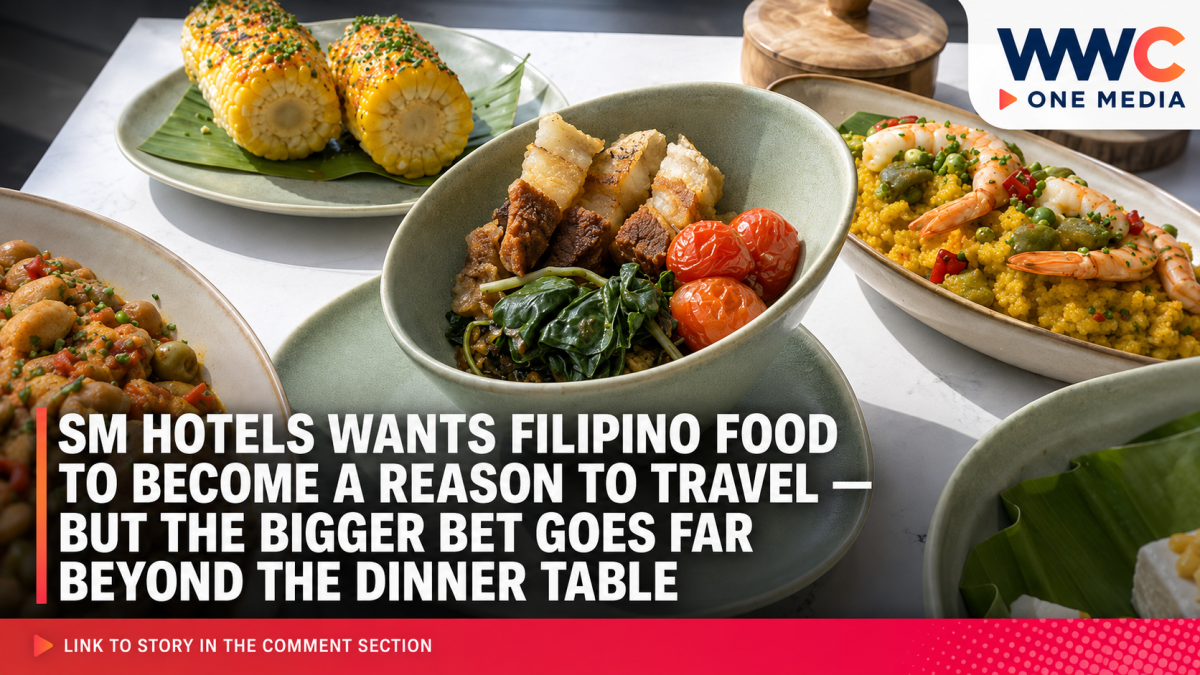
MANILA, Philippines — For decades, Philippine tourism has sold travelers on beaches, islands, heritage towns and postcard-worthy landscapes. SM Hotels and Conventions Corp. now wants another attraction to help convince people where to travel next: what Filipinos put on the table.
The hospitality arm of SM Prime Holdings is expanding its “Gateway to Gastronomy” campaign, using regional dishes, local ingredients and Filipino culinary traditions to turn hotel dining into part of the destination itself—not merely something guests do between sightseeing trips.
Its latest showcase is “Filipinas,” a culinary program at Conrad Manila led by seven Filipina chefs and built around ingredients and cooking traditions from different parts of the archipelago. The initiative is designed to bring regional Filipino food stories into a luxury-hotel setting while connecting those dishes back to the communities and places that produced them.
And behind the elaborate plates is a considerably larger business proposition: Can food become strong enough to make travelers choose a Philippine destination, stay longer and spend more locally?
Seven chefs, seven courses, one culinary map of the Philippines
At the center of the Conrad Manila program is a seven-course chef’s table at Brasserie on 3 on September 12, 2026, created by seven members of the hotel’s female culinary team: Kristine Davis, Monica Francesca Manaig, Patricia Joson, Rachelyn Bautista, Jazzel Jane Borcelis, Via Angelica Dalida and Doreene Ien Valencia.
Rather than simply reproducing familiar Filipino dishes, the menu uses contemporary techniques while drawing ingredients and inspiration from different regions.
The opening interpretation of tokwa’t baboy, for example, incorporates etag associated with the Cordilleras, coconut vinegar and soy gel. Tuna kinilaw is paired with batwan from Western Visayas, while a mushroom-and-cheese ravioli uses local kesong puti.
Later courses reach farther across the country. One features black heirloom rice from Negros Island, while another builds on Bicolano flavors with beef tenderloin, burnt coconut, labuyo and creamed taro leaves. Dessert draws inspiration from Davao through guyabano, cacao and pili.
The one-night seven-course experience is listed at ₱4,488 nett per person, with advance reservation and prepayment required, according to Brasserie on 3’s booking page.
But the concept will not disappear after the chef’s table.
Beginning September 12, Brasserie on 3 is also scheduled to offer a four-course Filipinas set menu, with choices including tokwa’t baboy, tuna kinilaw, maya-maya with alugbati, beef with laing and kordero at piyanggang, along with vegan selections. Its dessert reimagines halo-halo using ingredients such as ube, leche flan, macapuno, langka, buko-pandan and pinipig.
Why SM Hotels is treating food as a tourism product
SMHCC’s approach is broader than Conrad Manila.
The company says its Gateway to Gastronomy strategy is being reflected across its portfolio—from heritage-focused culinary experiences at Taal Vista Hotel to programs involving local ingredients and fishing communities at Pico Sands Hotel, alongside regional initiatives in Central Luzon, Western Visayas, Negros Occidental and Mindanao.
That strategy puts SM Hotels alongside a wider national effort to sell the Philippines not only as a place to see, but also as a place to taste.
The Department of Tourism formally launched its Food and Gastronomy Tourism Strategic Framework and Roadmap 2024–2029 in May 2025, with the goal of positioning the Philippines as a leading food and gastronomy destination in Southeast Asia.
Among the government’s plans are the development of culinary zones in destinations including Metro Manila, Pampanga, Cebu and Iloilo, food circuits, farm and factory visits, and even tours centered around traditional public markets.
The roadmap is also meant to strengthen the quality and authenticity of food-tourism experiences, increase recognition of Filipino cuisine, empower tourism stakeholders and create institutions capable of supporting the sector over the long term.
That matters because the opportunity is not limited to restaurants and hotels.
Done well, gastronomy tourism can create demand for farmers, fisherfolk, food processors, artisans, transport operators, market vendors and small businesses—allowing more tourism spending to remain inside the communities travelers visit.
The economic stakes are bigger than one hotel menu
There is also a powerful economic reason for hotels and government to search for new reasons to encourage domestic and international travel.
Philippine Statistics Authority data show tourism generated ₱2.27 trillion in direct gross value added in 2025, equivalent to 8.1% of the Philippine economy. Tourism industries employed an estimated 7.70 million people, or 15.7% of total employment.
The numbers also reveal an important split.
Domestic tourism expenditure climbed 3% to ₱3.26 trillion in 2025, while inbound tourism spending fell 6.4% to ₱698.46 billion.
That makes efforts to give both Filipino and international travelers additional reasons to explore destinations increasingly relevant. A successful culinary strategy could encourage visitors to think beyond the country’s most famous beaches and distribute demand toward places identified with distinct regional food cultures.
Iloilo offers one example of that potential.
The city has been a UNESCO Creative City of Gastronomy since 2023, with UNESCO highlighting its long culinary tradition, hundreds of restaurants and programs connecting gastronomy with local development, MSMEs and cultural preservation.
SM Hotels has already been working in that space through Park Inn by Radisson Iloilo, where programs have focused on gastronomic storytelling and Iloilo’s culinary identity.
The challenge: turning a good meal into an actual trip
There is, however, an important distinction between promoting gastronomy and proving that gastronomy actually generates more trips, longer stays or substantially higher local tourism spending.
SMHCC’s campaign establishes the platform, but publicly available reports cited here do not yet provide campaign-specific figures showing how many additional hotel bookings, visitor nights or tourism pesos Gateway to Gastronomy has generated.
That will be the metric worth watching.
Because if regional Filipino food can graduate from being something travelers discover after arriving to something that makes them decide where to go in the first place, the economic opportunity extends far beyond Conrad Manila’s dining room.
For SM Hotels, the bet is that the next great gateway to the Philippines may not begin at an airport, a beach or a resort.
It may begin with the first bite.
WWC ONE MEDIA MJE



Leave a Reply